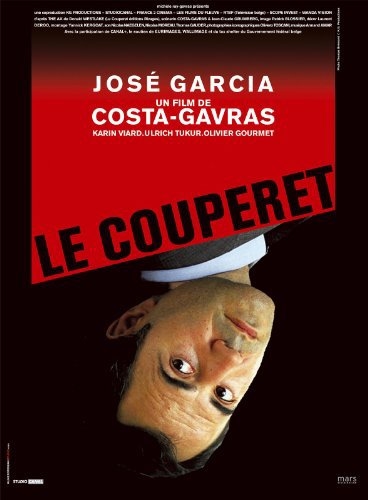
What is a man in capitalism if not his job? Costa-Gavras asked the question in The Axe (Le couperet) in 2005 in much the same way that Park Chan-wook did in 2025’s No Other Choice. Both are working from the same source material – Donald Westlake’s novel The Ax. Both come to pretty much the same conclusion – shorn of his job and his title, a male in this situation loses his status and becomes dangerously unmoored. This, both conclude, is not a good thing.
The stories are similar right down to the little details. A man who works as an executive for a paper company gets made redundant and cannot find other work in a similar role. So he starts killing the people who stand between himself and a job, to improve his chances of getting re-hired. That’s about the bones of it, though in both films there is an external and an internal complication. Fate takes a noirish hand in the lives of both men, pride rears its head too, more so in Costa-Gavras’s telling of the story.
Bruno (José Garcia), his hero, will not contemplate a lowlier job, though people he meets on his way to (lack of) enlightenment clearly have. These include his own wife (Karin Viard), who takes two jobs to fill the hole left by Bruno’s lack of salary. And Etienne, a fellow paper executive Bruno accidentally gets talking to one day. Etienne is clearing tables in a cafe and Bruno has arrived to get a bead on him before killing him. Does Bruno take a lesson from Etienne in humility and determination? Not really. He ends the film pretty much as he’s begun. In much the same way as in No Other Choice, the situation of our “hero” has changed but it’s got very little to do with him.
So, a touch morality play, a touch comedy of manners, though the lessons have been learned early on and the laughs are a touch hoarse.
Because so many of Costa-Gavras’s early films were political thrillers – 1969’s Z, most notably – he’s often seen as a political film-maker. And for sure he’s focused here fairly intently on turbo-capitalism’s tendency to chew people up and spit them out – the word “re-structuring” is uttered on several occasions, a euphemism so well worn it’s a wonder it’s still in use.

There’s a massive irony at the centre of this film, and Bruno is entirely unaware of it. He is his own one-man “re-structuring” outfit, a start-up business you might say, trying to re-order things in his favour. One man throws himself off a roof after Bruno contrives to frame him for the murders he’s been committing. And Bruno’s son, Maxime (Geordy Couturiau), gets caught shoplifting, possibly having unconsciously picked up a vibe from his old dad. The ripples of badness keep expanding but at no point does Bruno come to the conclusion that maybe he’s the dead wood the axe needs to be taken to.
The fun – there is some to be had – resides mostly with the side characters. Bruno is a bit of blank – because, we assume, he is nothing without his job – and beyond the murderous animal impulse there is not much to him. Around him spin a host of really quite interesting sorts, who act as object lessons in how to live, though Bruno is incapable of learning from them. At one frankly bizarre moment John Landis arrives on screen in a cameo, as the father of Maxime’s partner in crime.
Costa-Gavras is a touch more political a touch less personal than Park Chan-wook, though both men come to the same conclusion about this pitiful wretch who is too invested in the system and cannot function without external validation.
Ultimately, Park’s film is sleeker and has more pace. Costa-Gavras makes his points trenchantly but repeatedly. His film is too long. It could maybe do with a bit of re-structuring of its own.
The Axe – Watch it/buy it at Amazon
I am an Amazon affiliate
© Steve Morrissey 2026