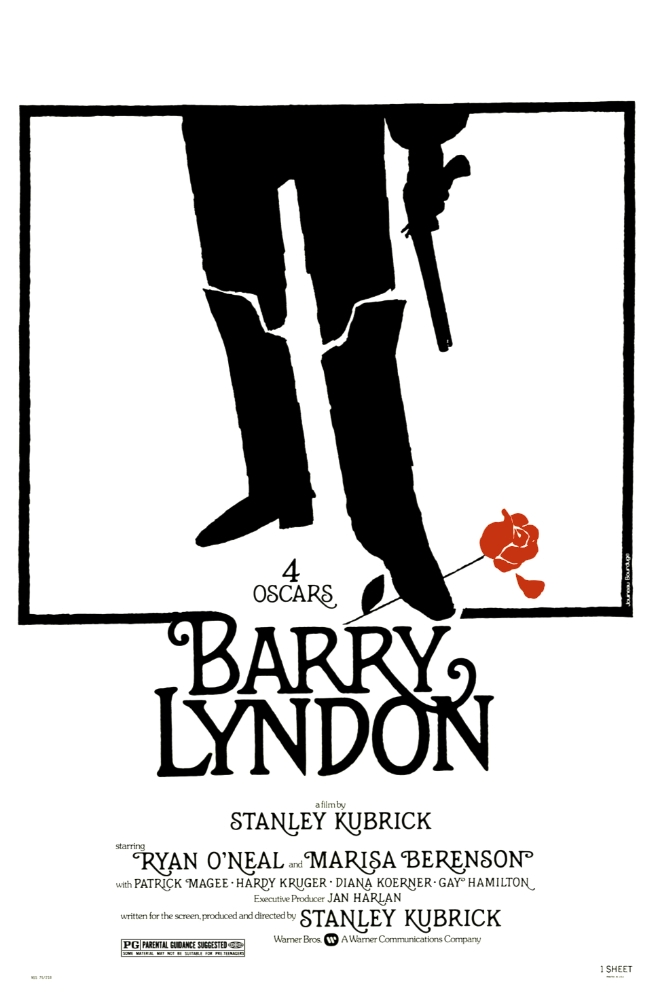
Barry Lyndon tends to get summed up in one of two ways. It’s either Stanley Kubrick’s visually sensational magnum opus and a triumph of film-making at every level, or it’s a bit of a bore, a “one thing after another” drama with not much actual drama in it.
Both are true. Adapting William Makepeace Thackeray’s story about a young Irish chancer’s escapades, it follows young Barry, original name Raymond Barry, from his first shy encounter with his sexy, cock-teasting cousin Nora (Gay Hamilton), through a series of adventures criss-crossing wartorn 18th-century Europe. To survive in the world Barry signs up for whichever army will have him – no scruples – and plugs away as a mercenary fighting other people’s battles. He’s a well put together young man and the ladies like him, which is a plus. And women and war would seem to mark out Barry’s path in life. But as well as being handsome, Barry also an eye for the main chance, the stereotypical Irish gift of the gab and a heat-treated brass neck.
So by the time the intermission rolls around – it’s a long movie – he has zigzagged his way into the charms of the Countess Lyndon (Marisa Berenson) and is about to marry her.
Hence the new name. Part one he’s lowly Raymond Barry; part two Barry Lyndon, husband of a countess. The film also structurally falls into two neat halves. The rise and the fall. It’s bookended by duels with pistols. The first one undertaken because Barry is impetuously in love with cousin Nora, who is about to marry a rich army captain (played by Leonard Rossiter). The second, exquisitely drawn out by Kubrick, is a scrappier and less successful one with his stepson (Leon Vitali), who has come to hate Barry – it’s class envy at bottom, though Barry’s treatment of the young man’s mother also leaves something to be desired.
If there is an overarching theme it is that a man cannot outrun his birth. Barry may be a man with all the gifts but he lacks “breeding” and that is something he cannot buy or talk his way into.
Ryan O’Neal was semi-forced on Kubrick as a lead. The studio told Kubrick he needed a star with proven box office or the film would never fly. O’Neal had recently starred in Love Story – a big hit – and that’s why he’s here. From half a century later he wouldn’t seem to be a cast-iron choice, but in fact he’s very good, ticks all the boxes for handsomeness and so on, and even gets way with the Irish accent, at a stretch.

This is carriage clock film-making at its most bejewelled and obsessive. That starts with the casting, which is superb when it comes to key roles, filled by the likes of Berenson, Vitali and Murray Melvin (as the countess’s conspiratorial personal priest). Extends into the cornerstone character cameos by likes of Patrick Magee, Hardy Krüger, Frank Middlemass and André Morell. Right down to relatively small roles. Early on in his wanderings Barry happens upon a young German mother, her husband away at war, and temporarily takes up with her – in a role that lasts only minutes Diana Körner plays her as a fantasy out of a tired, hungry and sex-starved soldier’s mind.
The stories about the film are not about the cast, though. Good as they are there’s not much acting going on. It’s a puppet show. Instead the legends are all about Kubrick’s mad quest to shoot his film using available light only. These are almost all untrue. Watching the film it’s quite obvious lights have been used in almost every scene. In the scenes famous for being shot only with candles there is truth to the stories. Using lots of them, with triple wicks so they’d burn fast and bright, and using the widest apertures ever used on lenses designed for Nasa, Kubrick got his shots. Wide lenses equals barely any depth of field, so to stay in focus no one moves.
In the digital era this sort of thing is no longer a technical marvel but there is an artistic aim behind the technical flummery – to recapture the looks of paintings by the likes of Gainsborough. Kubrick achieves it, sometimes at the cost of bringing the film to a standstill. As well as dramatic inertia that is the main charge against the film – pretty as a picture and about as dynamic.
And yet Barry Lyndon is not boring. Its attention to detail is fascinating, its looks exquisite, its cast impeccable, the soundtrack – The Chieftains sitting alongside the likes of Vivaldi, Mozart and Schubert – a sedan chair transporting the film grandly from start to finish. Using changes of pace rather than a narrative to drag us through, it is immersive film-making at its best. Luxuriate in it.
Barry Lyndon – Watch it/buy it at Amazon
I am an Amazon affiliate
© Steve Morrissey 2025