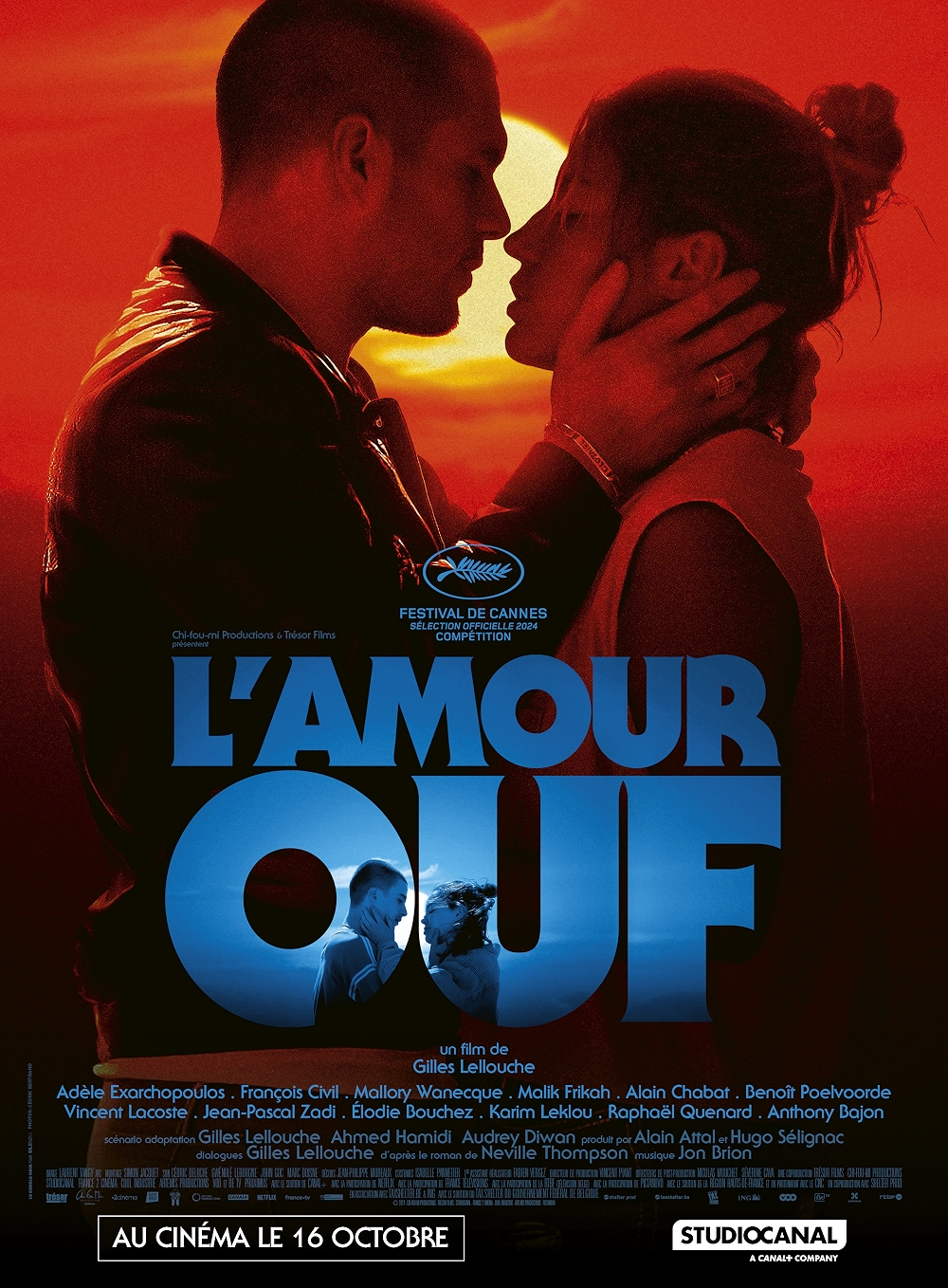
Beating Hearts is a French gangster-origin story, a noirish Goodfellas with more preamble. Let’s just cut through the flim-flam and say that it’s got some serious problems, yet the actors are so good. The concept isn’t bad either – Scorsese with some West Side Story ambitions, plus a bit of Tarantino stirred in, or that’s what director Gilles Lellouche says.
It splits pretty neatly down the middle into two halves, with the first half meant to set us up for the second, which it doesn’t. In part one, 1980s bad boy Clotaire meets swotty, smart and attractive Jackie, and is instantly smitten. Doubly smitten when he tries to flirt with her with a lippy put-down and she responds by verbally crushing him in front of his deadbeat friends.
Clotaire stands no chance with Jackie. They have different approaches to life. He’s a fly boy who’s been expelled from school and she’s bookish and wants to get ahead through education. And yet, in a worthwhile life lesson to us all (one of several), Clotaire sticks with it and somehow worms his way into Jackie’s affections. A fierce connection is established between the teenagers, only for it all to come to a crashing end when she realises he is falling in with a band of local gangsters. She dumps him. Good riddance, etc.
Years go by. Clotaire and Jackie are now grown up. He’s done time in jail after taking the rap for a murder he didn’t commit. But now he’s out and looking for financial compensation from the Mr Big (Benoît Poelvoorde) responsible for his years inside. He’s also looking for Jackie, whose early promise has come to naught – a string of nothing jobs followed by marriage to an OK guy with money.
Up to here neither of them has squeezed from life what they wanted from it. It will only get worse once their strange connection re-exerts its grip. L’amour ouf is the original French title, a play on “l’amour fou” – crazy in love in all the good and bad senses of crazy.

As Beating Hearts followed Clotaire and Jackie’s doomed trajectory, I wondered at first if this was an interesting story told in an uninteresting way before eventually concluding that it was an uninteresting story told in an uninteresting way. What juice the film has comes in the first part, when Malik Frikah and Mallory Wanecque are playing Clotaire and Jackie, and Gilles Lellouche is dallying with the notion that this is at least partly a musical – Billy Idol, Prince’s version of Nothing Compares 2 U, Soft Cell and Daft Punk all turn up on the soundtrack and there is a full-on musical number with The Cure’s A Forest behind it.
More of that would have been good. More of Frikah and Wanecque too, who are both fabulous and put François Civil and Adèle Exarchopoulos to shame when they take over as Clotaire and Frankie as adults.
Nothing wrong with either Civil and Exarchopoulos, who have propelled many a worse movie out of a rut. But acting and starry charisma can only take a movie so far. Clotaire and Frankie as teenagers are sparky and enigmatic and fascinatingly all over the place. As adults they are just dull. Sullen.
The shame is that it’s such a good-looking film, noirish and dynamic with lighting by Laurent Tangy who tries to re-insert the sparkle Lellouche has removed by simply overdoing it. This movie is an entire hour too long, and maybe could be saved by taking a knife to it and then reworking its timeline to include far less of the grown-up Clotaire and Jackie.
This feels like a kvetch and it probably is. And yet. I knew going in that the film got a poor reception at Cannes. Cannes is often wrong, especially about big-budget movies, as this one is. So I was determined to like it, or at least give it a decent shake. I came out full of warm thoughts for the actors and crew but with the sense of time almost entirely wasted. Who doesn’t like a bit of The Cure?
Beating Hearts (L’amour ouf) – Watch it/buy it at Amazon
I am an Amazon affiliate
© Steve Morrissey 2025