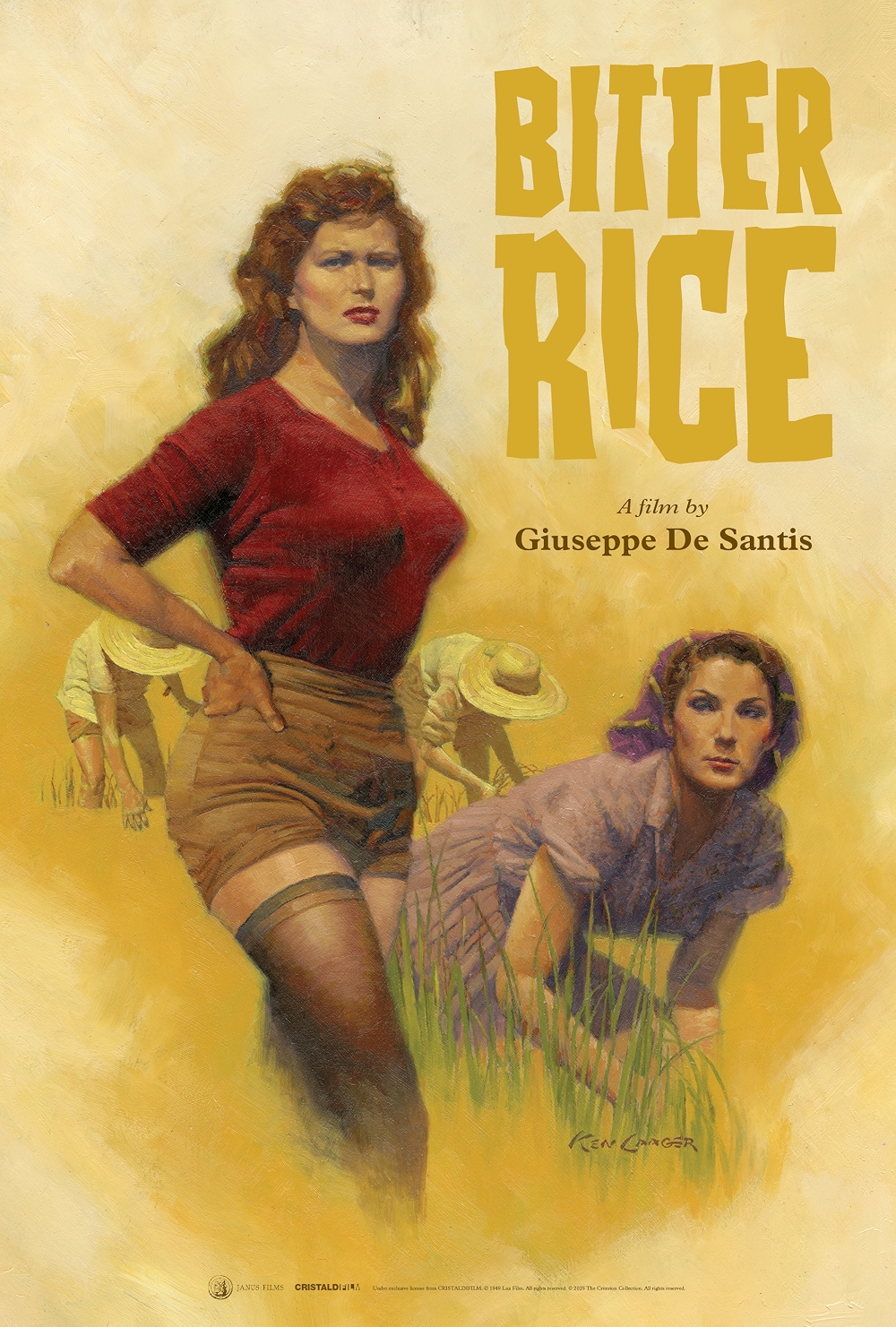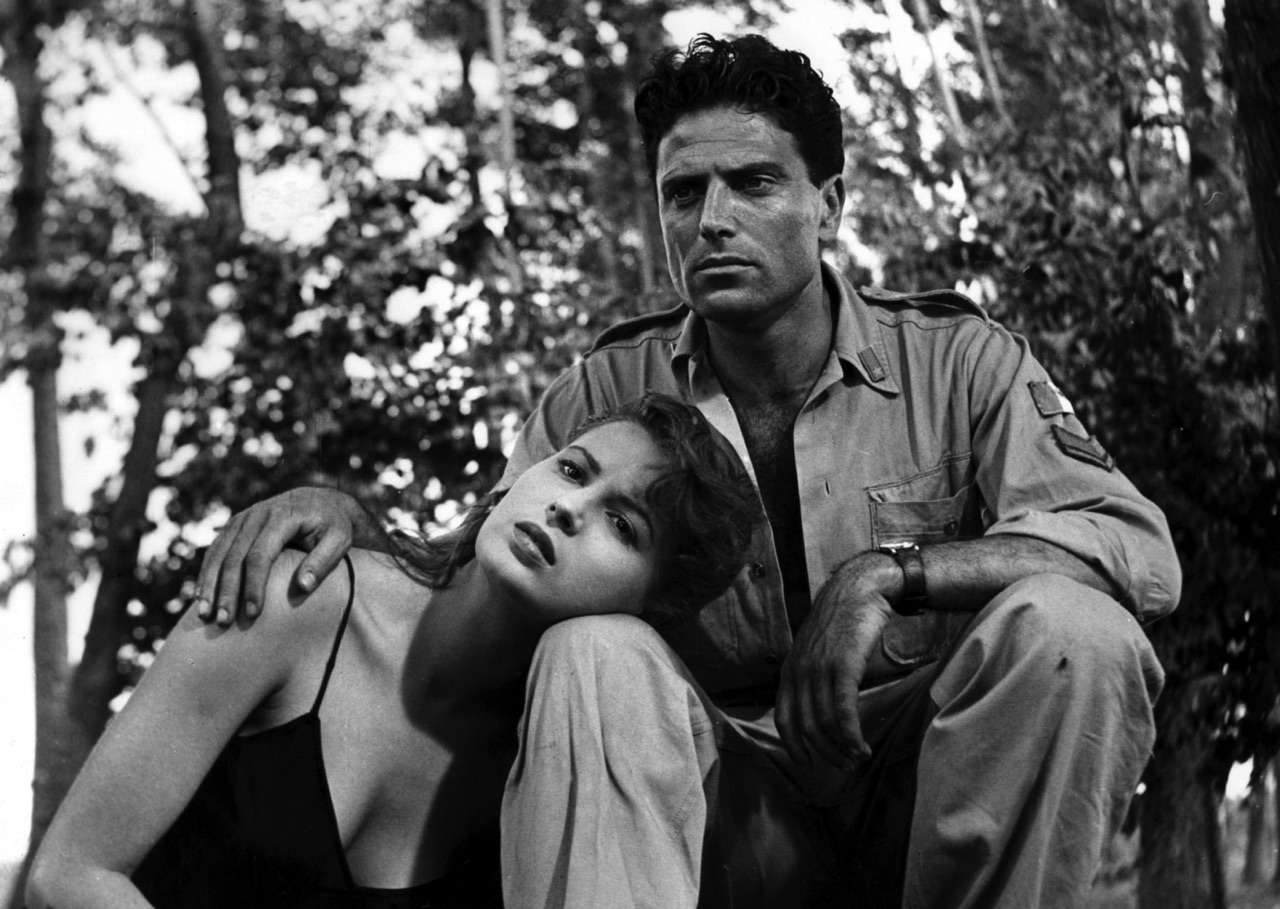
Italian neorealism meets the crime drama in 1949’s Bitter Rice (Ris Amaro), Giuseppe De Santis’s gritty fable about a pair of petty thieves joining a horde of itinerant workers to plant and harvest rice.
If drama is life minus the boring bits, De Santis is aware that neorealism at its worst can be a bit like life plus extra boring bits. So he brightens things up with crime thrills and a cast full of good-looking young things. In case we’re still not feeling it, more often than is absolutely necessary he’ll poke his camera into the cleavage of a few of his female stars as well.
The thieves are played by Vittorio Gassman and Doris Dowling, who we meet in the film’s opening moments on the run from the cops. To hide out until the search for some stolen jewels has died down, they pile on board a train taking hordes of women to work on the flooded rice paddies of Vercelli – 40 days of backbreaking work. It’s women who are doing the work, a useful voiceover tells us, on account of their smaller hands.
Francesca (Dowling) falls in with a saucy young worker called Silvana, played by Silvana Mangano at full vamp – tits out like a shelf, everything jiggling as she dances to boogie woogie – while Walter (Gassman) gets left behind, only to reappear much later with a plan to hijack the entire rice harvest and sell it on the black market.
By this time Francesca has been transformed by her experiences. She has grown to love the camaraderie and sense of purpose of honest toil, even though the work is poorly paid and, even unionised, conditions are tough. Silvana, on the other hand, wants a bit of what Francesca has, or what she imagines she has. And when Walter reappears it’s essentially as the Devil, trying to win Francesca back to the old ways but prepared to co-opt Silvana in case it doesn’t quite work out with his old lover.

De Santis is worried about moral tone, particularly as regards women. Silvana listens to American music and chews gum the entire time. She is in danger of being led astray by shiny foreign baubles and the promise of material goods. It’s a common theme in Italian film-makers of the era and it would be tiresomely laboured if Dowling and Mangano (particularly Mangano) weren’t such spiky, punchy and sexy performers.
Class solidarity rubs along in a cosy collaboration with national solidarity, to an extent. De Santis and his photographer Otello Martelli – who did La Strada and La Dolce Vita for Fellini – give it to us as if handed down from a mountain on tablets. This, that stark (but always attractive) quasi-documentary image says, is how it is. Here’s how women cool off in the sudden rain storms that threaten the harvest. Here’s how unionised and non unionised workers square off against each other. Here’s how the bosses exploit small differences for their own ends.
Sexual politics is another of De Santis’s concerns and how the eternal dance between men and women is at risk of being disrupted by new globalising (as no one ever said back then) forces.
In the end, though, it is a film about women rather than men. Even Walter the big bad criminal is a touch one ply – the “prize” for whichever woman prevails is about as much agency as Walter gets. He’s a catalyst, nothing more, and not much of a criminal when it comes down to it. Offering a touch of good to Walter’s bad is Marco (Raf Vallone), a soldier waiting to be demobbed, who hands out gobbets of philosophical observation about class solidarity. Again, a touch tissue-like.
Francesca and Silvana is where the action is and Dowling and Mangano is where the (slightly heightened) acting is. Not all the famous post-War Italian films stand up as well as Bitter Rice. Possibly because De Santis isn’t as committed to neorealism as some of his fellow travellers.
Bitter Rice – Watch it/buy it at Amazon
I am an Amazon affiliate
© Steve Morrissey 2025