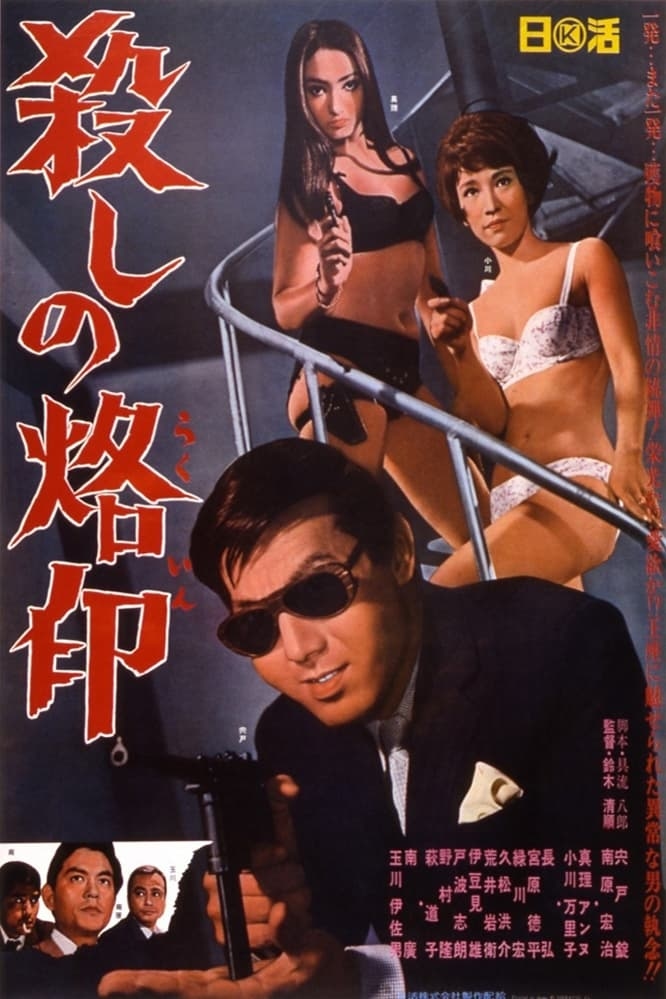
Branded to Kill is a crime thriller with so much style it’s absurd. Clearly aiming for the ridiculous it is deliberately style over content. Hashed out on the hoof by eight different writers who were clearly egging each other on, it’s a mad tumble of French New Wave crash edits and film noir poses, all held together – if it is held together at all – by a jazzy, jerky, atonal score.
Nikkatsu, the Japanese studio that made it, thought it was a mess and wouldn’t release it. Its director, Seijun Suzuki, thought they just didn’t understand what they’d been given and sued them. And won. The film got its release but Suzuki’s career suffered as a consequence. As a result of “you’ll never eat lunch in this town again” strings being pulled, Suzuki didn’t work for ten years.
Jean-Pierre Melville in a distorting mirror may be the closest approximation of what’s going on. Big American cars. Silent heroes driven by a strict code of honour. We meet Hanada, played by Jô Shishido, as he is agreeing to do a favour for old colleague Kasuga. Hanada is, Kasuga tells us, the number three hitman in Japan. All Hanada has to do is escort a client from Sagami Beach to Nagano. But the job goes wrong, which throws Hanada into fight-and-flight mode and propels him into a series of do-or-die encounters leading, ultimately, to a showdown with hitman number one.
The ranking of various hitmen is taken very seriously but any detailed summation of the plot is a waste of time. This film is a series of scenes barely linked together. In some of them Hanada is having sex with his always naked wife. In others he’s getting to know a pretty young woman first encountered driving her open-top car in a torrential downpour. She has a dead bird hanging from her rear-view mirror and tells him she hates men and dreams of dying. As an introduction it catches the attention. He, of course, falls for this femme fatale of a ludicrously existential sort. In yet other scenes Hanada hovers over the steaming rice whose smell bewitches him. And then there’s the hits, which are exquisitely ridiculous. Like the one where he kills an optometrist by shooting up the waste pipe of the sink his target is bending over – particularly good.

It does not work as a story because it’s not designed to. But it does work as a series of sketches mocking the situations that writers of crime thrillers like to engineer their proponents into. And it also works as a reference book on style. In this film if someone dies they die in an attitude of the utmost elegance, like the dead guy on the swivel chair that’s still swinging on its pivot long after it should have stopped moving.
There’s a strange coda, in which Hanada and hitman number one become, in effect, a domestic couple, each one trying to work out how to kill the other. More japery, more scoffing at the tropes of the genre. The guys who are so close they might be in love.
The story goes that this movie was edited in a day. This simply cannot be true. The film is a mass of edits and it’s put together with care and filmic intelligence. Maybe something has been lost in translation – “final editing” was completed in one day, according to various sources, but what does “final editing” mean?
Shishido and Suzuki made quite a few films together but this is probably the most celebrated of the lot. Its frenzy suits Shishido’s pouchy deadpan down to the ground. Meta in all the best ways, it’s one for people who have watched far too many crime thrillers – Tarantino is a fan, of course – and are ready to have their expectations laughed at. It’s great.
Branded to Kill – Watch it/buy it at Amazon
I am an Amazon affiliate
© Steve Morrissey 2026