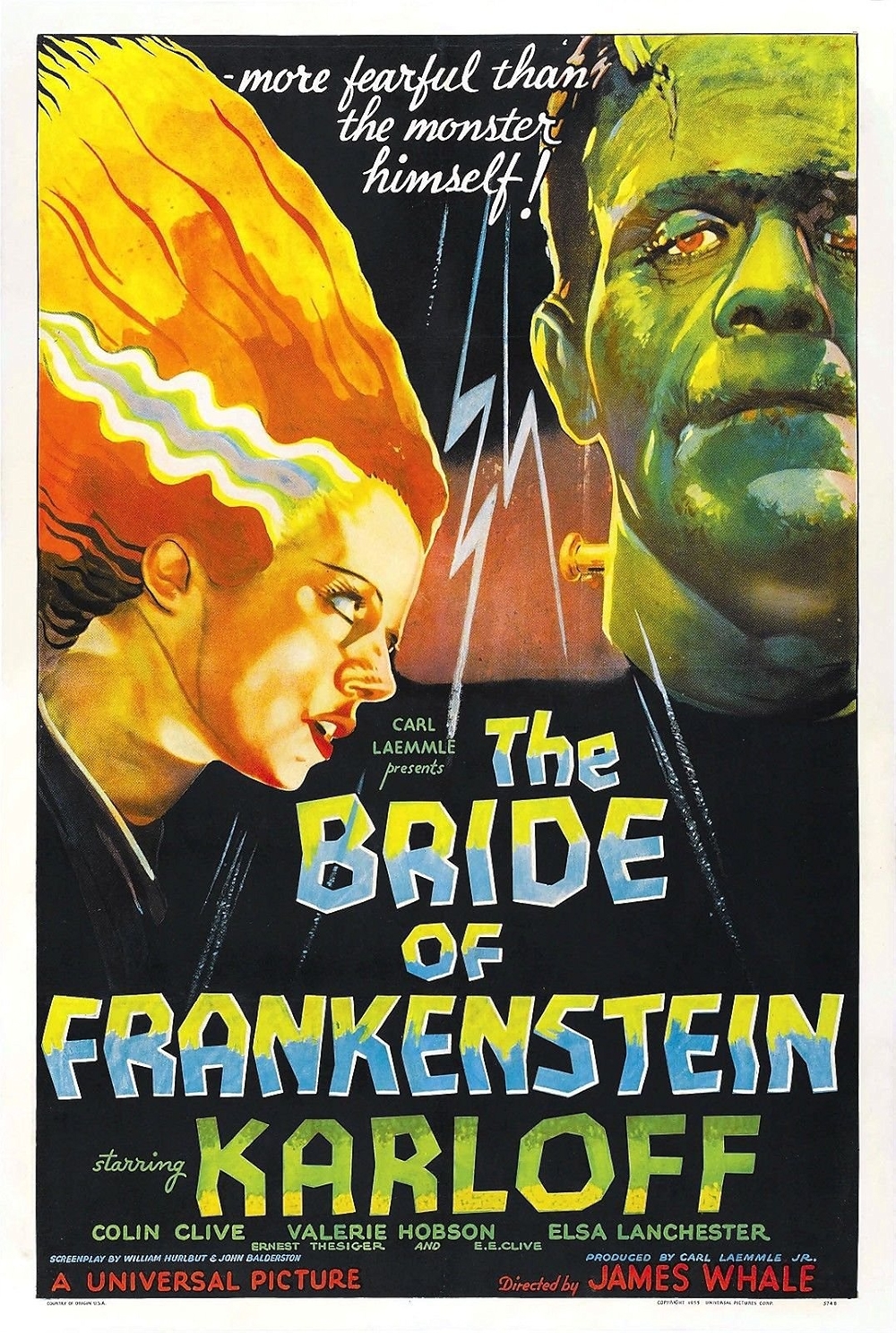
Modern film-makers could learn a lot from Bride of Frankenstein and its illustrious predecessor, 1931’s original Frankenstein, not least how to tell a story at speed. And the amazing thing is that director James Whale took the finished cut of his sequel, a tight 90 minutes, and took a further 15 minutes out of it after a few test screenings. The result is a brilliant and furiously paced 75 minutes of entertainment.
Whale hadn’t wanted to make this sequel at all, but Universal persuaded him with a promise of total artistic control. And so he set to work, opening his film with an introductory sequence set in Switzerland, where a ridiculously la-di-dah Lord Byron, Percy Shelley and his wife Mary Shelley are discussing her book, Frankenstein, a handy way of recapping the original movie, which Whale cuts to while the three of them talk.
Then, pulling back with his camera, he dissolves elegantly into his story, and we’re back at the burning windmill with the angry townsfolk and their flaming torches and pitchforks. Surely both the Baron and his monster are dead (see Frankenstein)? But no! Both survived the fire.
From here two parallel stories. In one the Baron’s monster stumbles around the countryside, much as he did in the original story, often pursued by an angry mob, and eventually takes refuge with a blind hermit, who feeds him, tends his wounds and teaches him a few basic words.
In the other the recovered Baron is badgered by an old university associate, Dr Pretorius (Ernest Thesiger), who has been conducting his own experiments into the creation of life, and is eventually blackmailed into collaborating on making a bride for his wandering creation.
The tone shifts throughout. At first it’s highly camp, as if Whale has decided to make the sequel almost as a parody of his first film. Maybe his inner artist got the better of him – things quickly become much more urgent. Then switch into the sentimental once the monster and the hermit get acquainted. Before shifting again into the madly melodramatic as the electric storm arrives and the Cosmic Diffuser and Nebularium are wheeled out and hooked up to the female creature Pretorius and Baron Frankenstein are hoping to jolt into life. But we all know that only bad can happen when humans play at being gods.

Two things. One: it’s really more the Pretorius show than Baron Frankenstein’s. Colin Clive, who plays the baron, is not in it that much, leaving the floor to Thesiger, who knows limelight when he sees it and dives right in. Tellingly, that mad hairstyle of the Bride’s – surely the most famous in movie history – is an exaggerated version of Pretorius’s own.
Two: the Bride, played by Elsa Lanchester, is in it for mere minutes, but they are effective minutes and Lanchester also plays Mary Shelley in the preamble, so if you’re feeling cheated, you can also hold on to those.
Many films of this period have to be watched with the retro goggles on but not this one – it is remarkably fresh, thanks in part to Whale’s obsessive attention to getting things right. The flaming windmill, the medieval castle, the subterranean burial chamber and the kooky laboratory all look like the real thing, not something knocked up by studio carpenters. For sure there are moments that look like they’re staged in a studio (where the whole film was shot) – the monster stumbling across open countryside, for instance – but they are rare. And Whale’s camera is loose and fluid, while John J Mescall’s gothic lighting and Franz Waxman’s duh-duh-duuuuuh score now seem classic rather than of their time.
The often discussed gay subtext is there if you go in with it pre-loaded. Whale and Thesiger were openly gay, Lanchester possibly was and Colin Clive is often rumoured to have been, but you really need to get the magnifying glass out and make the most of every ambiguity if that’s the way you want to read this film.
Which brings us to Boris Karloff, again billed as “Karloff” (his real name was Bill Pratt, and “Pratt” doesn’t have quite the same ring). He graciously humanises the monster – smiling, smoking cigars, monotonously droning the beast’s scant vocabulary – though he thought most of this was nonsense and that the monster should remain what he was first time around, a wounded beast at bay.
Really it’s Thesiger’s film, followed by Karloff’s, with Lanchester – striking though she is – a distant third, and Clive nowhere at all. And I can confirm that on at least two occasions the monster itself is referred to as Frankenstein, so that’s that old boil lanced. A brilliant film in its own right, but also always a contender in any discussion about sequels better than the original movie. What a creation.
Bride of Frankenstein – Watch it/buy it at Amazon
I am an Amazon affiliate
© Steve Morrissey 2024