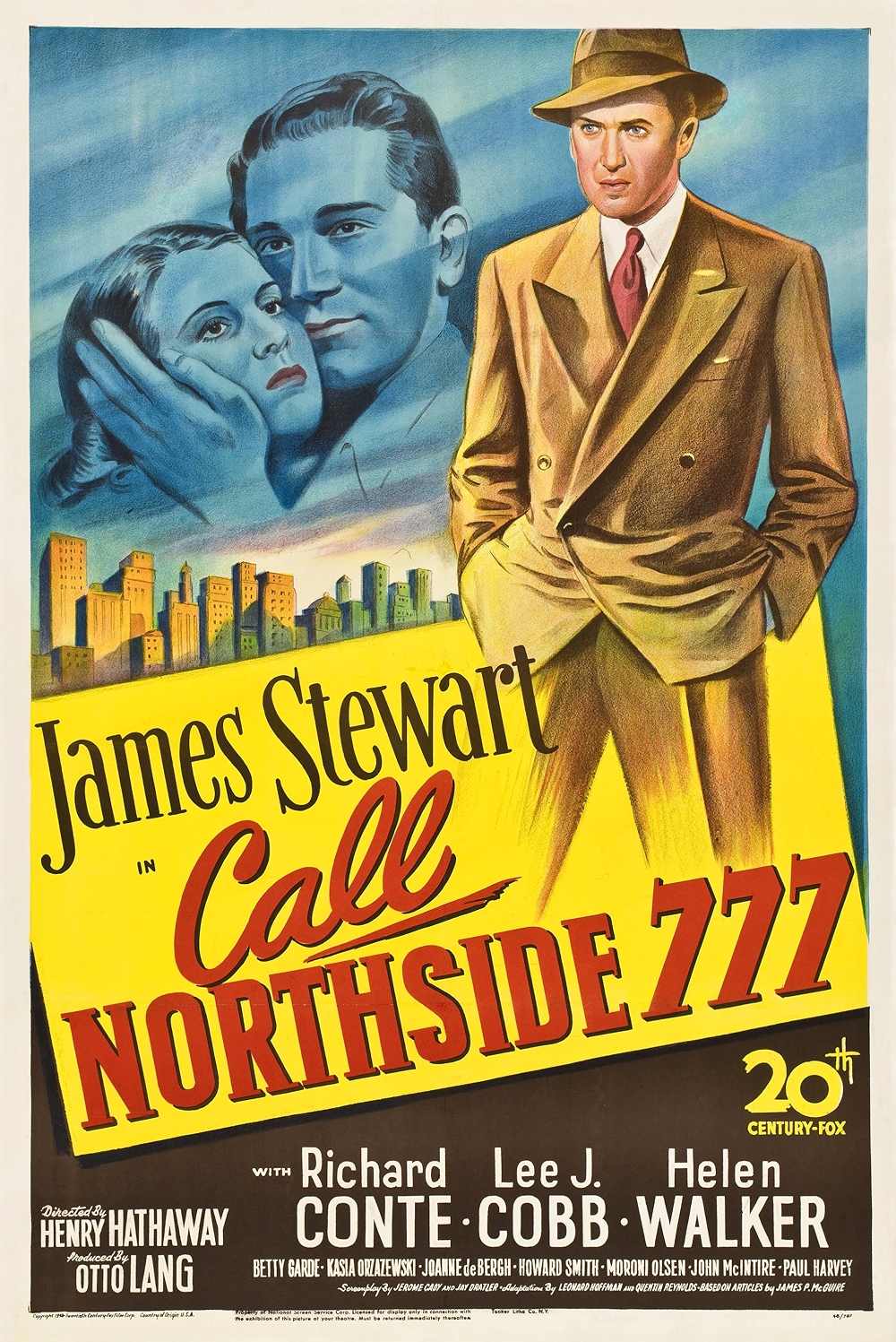
Call Northside 777 tells the true story of a miscarriage of justice – Joseph Majczek framed for killing a cop in 1932 and sentenced to 99 years – and the crusading journalist from the Chicago Times who got the case overturned. The same story was the source material for Railroaded!, released the year before in 1947. It’s probably the better movie all told – better pace, fewer digressions – but Call Northside 777 has the advantage of a big spend and very well cast actors in its lead roles. James Stewart as cynical journalist PJ McNeal , Lee J Cobb as ballsy editor Brian Kelly and Richard Conte as the wrongly imprisoned man.
Joe Majczek has become Frank Wiecek in this re-telling, but the hare that sets the hounds running is a true detail – the imprisoned man’s mother putting a classified advert into the newspaper, offering $5,000 reward to anyone who can help get her son’s conviction overturned. Wiecek’s mother has swabbed floors for 11 years to get the money together (as had Majczek’s), and though it’s the advert that catches the eye of editor Kelly, it’s those 11 years of mopping that gets the initially reluctant McNeal to take an interest. He’s convinced that the man is guilty as hell, but an old dear washing floors certain her son is innocent is a gift of a human interest story and he is sure he can milk it for all it’s worth.
Conte is particularly good casting. A career playing both good guys and bad guys suits him to this role – do we believe his decent old mum or the doubting hack?
Director Henry Hathaway indulges us with realism, or the 1940s version of it. Much is made of the fact that the film was shot on location in Chicago, and there’s no score to add false dramatics – this is all real, real do you hear (or not)? Non-professionals Kasia Orzazewski and Joanne De Bergh play Frank’s decent mother and his clear-eyed wife. The newspaper office clacks with typewriters, bars hum with conversation, trains steam over bridges. Hathaway even takes inside a real panopticon prison, and introduces the tech of the day, the wirephoto (a precursor of the fax machine) and the polygraph – the guy administering it is Leonarde Keeler, the polygraph’s inventor, which is probably more realism than is strictly necessary.

Stewart’s skill as an actor is in appearing not to do very much at all and yet conveying the essence of a character. Though it’s very much good old Jimmy Stewart up there on screen, he gets across that McNeal is a hard-bitten journo with an eye for a story, a knack for a killer opening sentence and an instinct for keeping a story alive. It’s the story, not the jailed man’s plight that interests McNeal, and in that little thumbnail we get all that’s good and bad in old-school shoe-leather journalism.
In truth, the film bogs down in journalistic ethics just a touch. Cobb does barely anything, merely appearing now and again to add a word, a warning, offer a steer to his dogged but antsy reporter, but he sets up the wise old newspaperman template that would come to its crescendo in All the President’s Men in the shape of Jason Robards. Conte gets even less to do, turning up every few scenes to offer more bona fides about his essential goodness (persuading his wife to divorce him, for instance, so she can move on with her life), while Conte’s face leaves us with a touch of doubt.
A stentorian voiceover insists, as the end credits get ready to roll that all is well with the system if a man who is the subject of a miscarriage of justice can eventually be found innocent, blithely contradicting the entire thrust of the film. Without the old woman’s swabbing, the advert, the editor’s prompting and, eventually, the conversion of McNeal from doubter to believer, none of it would have happened. But hey… it’s just a movie, Ingrid, as Hitchcock probably never said.
Call Northside 777 – Watch it/buy it at Amazon
I am an Amazon affiliate
© Steve Morrissey 2026