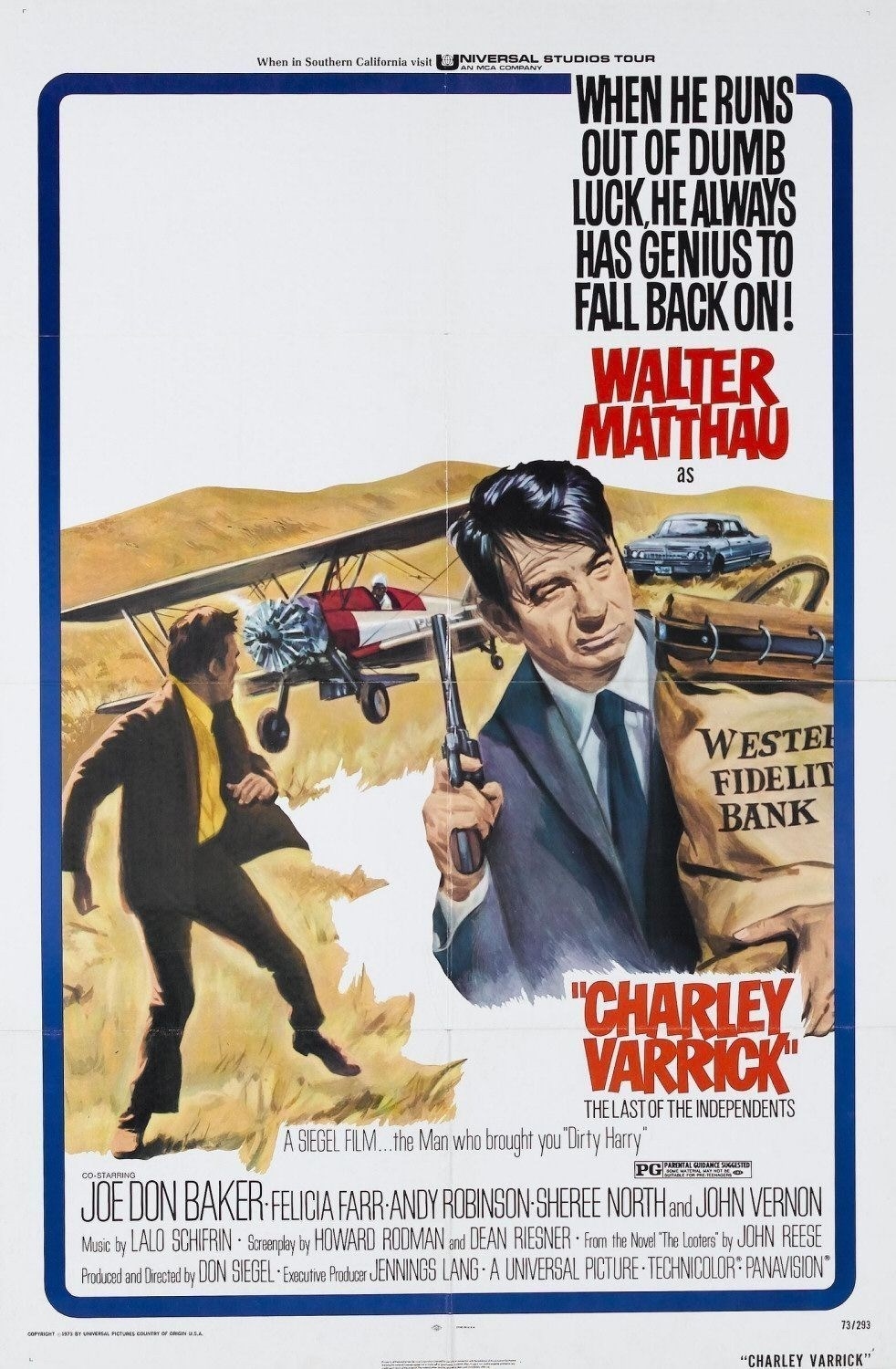
Charley Varrick, a neo-noir from 1973, is much better than its mixed reputation would suggest. Lean and fast, dark and enigmatic, it stars Walter Matthau as a crop sprayer who heists a smalltown bank in the hope of making a fair amount of easy money. Nothing too massive, just a cushion. But when he and his sidekick come to count their haul, it turns out that it’s mostly 50s and 100s, not dollar bills, fives and tens as expected. They have inadvertently heisted a lot more money than they anticipated.
This, for Charley, is a problem. It means the police will be particularly keen to get the money back. So will the bank. And so, most problematically, will the owners of the money, who have got to be the Mafia, who were most likely using this nothing bank as a “drop” – a safe space where the money could sit until it was time for it to be expatriated for laundering.
Or that’s the conclusion that Charley instantly comes to, as he explains to his usefully dim (for us) sidekick, Harman (Andrew Robinson). And it turns out Charley is absolutely right. For the rest of the film he is pursued, in ascending order of threat, by the cops, by the bank and by Molly, a Mafia fixer with an implacable, almost Terminator-like hunter’s instinct, played as charming and dangerous by the extremely underrated Joe Don Baker.
The esteemed critic Pauline Kael didn’t like this movie when it came out – “it doesn’t even look good”, she carped in her review. Much as I doff the hat to Ms Kael usually, she’s 180 degrees wrong on this one. Agreed, it does not look pretty, but good is something else entirely.
The director is Don Siegel, also massively underrated but one of the greats, and his concern is with the everyday and how far it falls from a movie-influenced ideal. Charley is not glamorous, especially not the way Walter Matthau is playing him. And the settings he moves between are really of-the-moment 1970s places. Pine panelling. Wall-to-wall carpet. A whorehouse full of nicknacks and tat. The dusty, dirty trailer park where Charley lives. Siegel and his DP Michael Butler shoot it all as if a 1950s crime drama had had the colour turned on.
As the screw tightens on Charley – and Siegel is particularly good on racking the tension – questions are left hanging in the air. How smart is Charley? How well versed in Mafia goings-on is he? Is he really just a crop-sprayer? Siegel and his writers Dean Riesner and Howard Rodman (working from John Reese’s novel, The Looters) leave all this open right to the film’s dying seconds, a gunfight showdown of sorts, but with wits as weapons rather than guns. And Matthau plays it that way too – a blank hangdog with just possibly a spark of something in his eyes.

Pauline Kael was not alone. Walter Matthau also didn’t like the movie and complained that he didn’t understand it. Siegel, for his part, complained that Matthau’s public comments damaged his movie. Fair enough, the movie did not do well. But all these years later, after so many post-Tarantino “who’s zooming who?” thrillers just like this, what Matthau could not understand then (let’s give him the benefit of the doubt: maybe he was trying to be funny) now looks as plain as the nose on your face.
The film is years ahead of its time, in other words.
Bask in it shabbiness. It was meant to be Clint Eastwood as Charley originally. He’d worked with Siegel four times already and saw him (along with Sergio Leone) as his mentor. But Eastwood eventually turned it down, leaving the way open for Donald Sutherland and eventually Matthau, which necessitated a rethink, a rewrite and the removal of quite a bit of the sex and violence. Quite a bit remains.
Another of Siegel’s talents is hiring good character actors. This film is full of them. As well as Joe Don Baker, there’s the vulpine John Vernon as Maynard Boyle, the boss of the bank. Sheree North as the sexy and devious photographer Charley turns to when he needs a passport. The excellently dithery Marjorie Bennett as the woman who lives in the next trailer to Charley’s, an old dear convinced all men are going to ravish her. And, in a strange role that doesn’t really fit the movie, Felicia Farr, bank boss Boyle’s secretary, whose part in the film and high billing can be explained by one simple fact – she was the wife of Jack Lemmon, Matthau’s friend and Odd Couple co-star.
Throw in a rinky-dink Lalo Schifrin score that’s about halfway to Mission Impossible and it’s all in all a very nice package.
Charley Varrick – Watch it/buy it at Amazon
I am an Amazon affiliate
© Steve Morrissey 2025