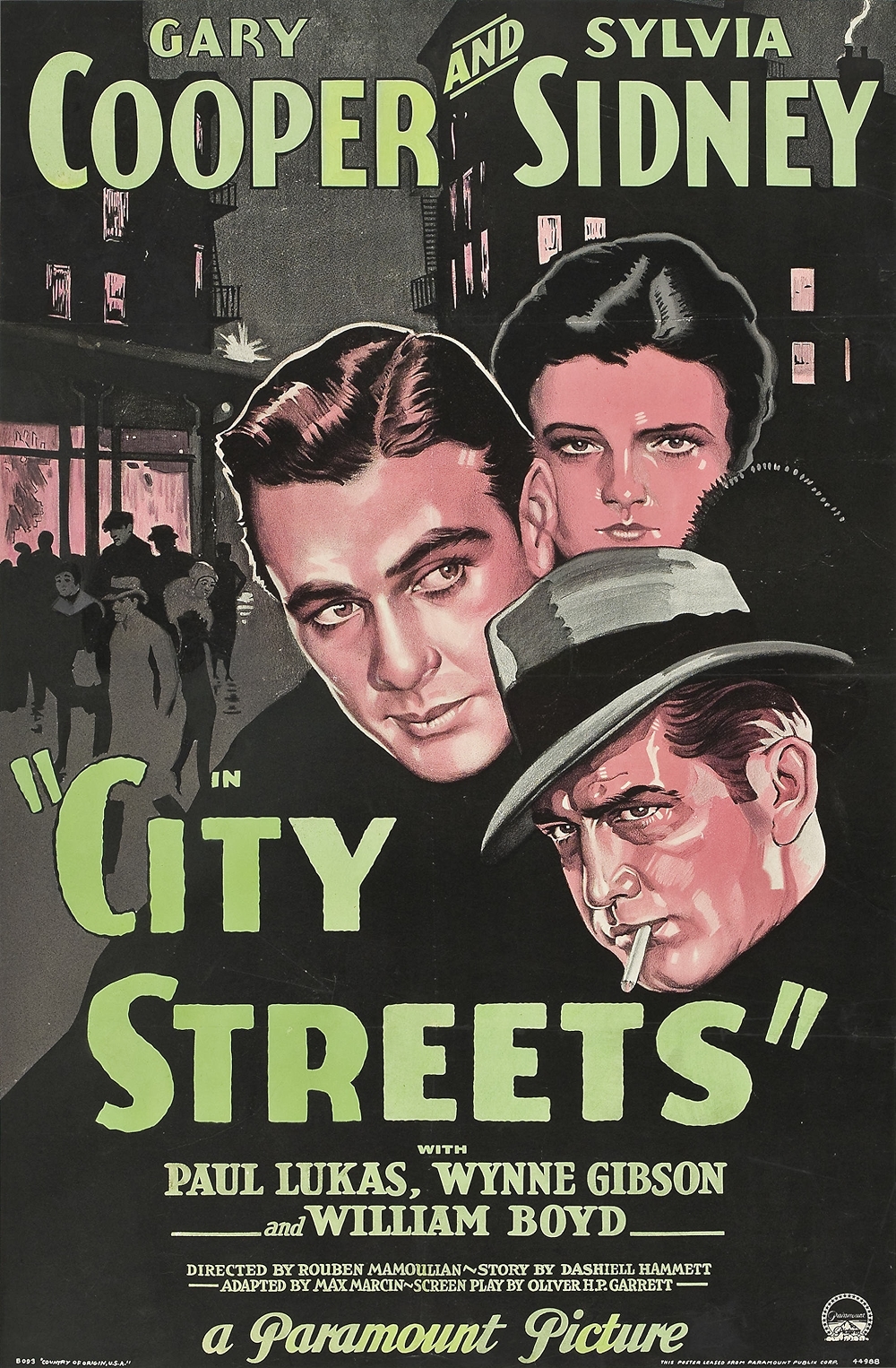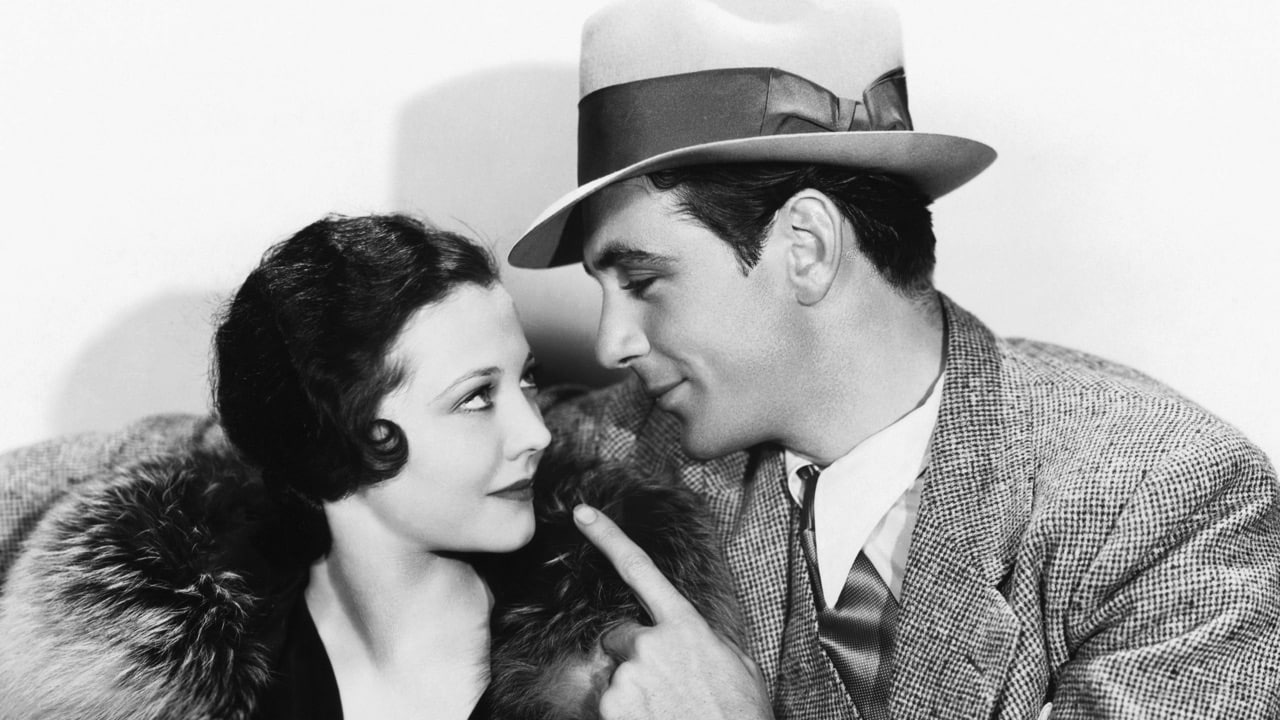
Gary Cooper was a long way from his craggy, motionless Mount Rushmore phase when he made City Streets in 1931. In fact he still looked boyish enough to play a character called Kid, a fairground worker who gets caught up with some gangsters, finds he has a taste for it and then lives to regret it.
It’s a Dashiell Hammett story and it is typically Hammett – complex – with two interwoven fields of play, the romantic and the criminal, each providing the obstacle to the smooth progress of the other, before the two eventually switch about.
So Cooper and co-star Sylvia Sidney are required to cover a lot of emotional ground. He’s the decent guy who goes to the bad and comes back again. She’s the daughter of a gangster constantly trying to win him over to a life of crime – she fancies him but he’s broke and she is used to the high life – and when she finally succeeds, she then wonders if she’s done the right thing.
Hammett’s interesting twist is that it’s the girl trying to lead the boy astray. But it ends happily ever after (enough) in one of those Hollywood finishes where a car tries to outrun a train so it can make it over a level crossing and evade the police, a visual metaphor for the competing forces of crime and love. Which will prevail?
This was Sidney’s first major role. She replaced Clara Bow and possibly made it through the final selection on the strength of her bow-shaped lips. Cooper is the 1930s handsome Hollywood leading man – leggy and lean. Both are excellent, she playing with the idea that Nan might be a decent girl beneath the corrupt womanly exterior, he all gosh-wow folksy simplicity, but a man who learns fast.
The director is Rouben Mamoulian, a master of compression. He gives us silent-movie introductions showing us all the key players almost in dumbshow before moving on into what’s often called proto-noir – urban, nighttime, crime, cynical in tone. There are enough little splashes of expressionism – converging parallel lines, fancy shadows and so on – for the film to be tagged that way too. Though calling it either noir or expressionist is a stretch. Lee Garmes (later of Duel in the Sun fame) did the lighting and is a master of his craft, so it looks great however you describe it.
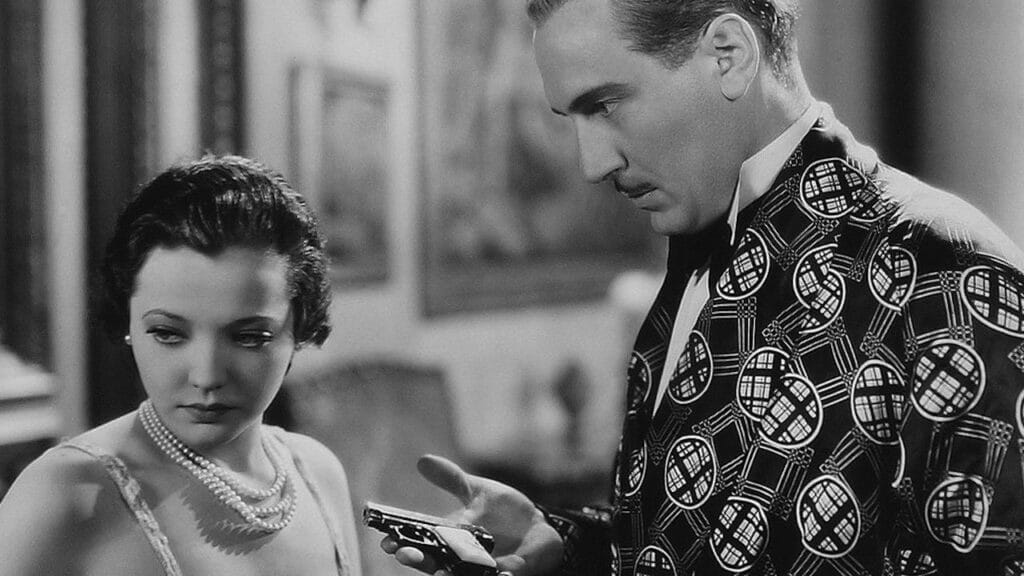
The supporting roles are more than well filled, with Paul Lukas very well cast as Big Fellow, the violent, emotionally unsteady gangster who wants Nan (Sidney) and is settling for Agnes (Wynne Gibson) until he can get a proper bead on his target. It’s the thwarted Agnes who will provide the twisty propulsion that eventually ejects the film from its central section – Kid and Nan, what’s it to be? – and into the finale, when the police arrive like the cavalry to rush things to a conclusion.
All the casting is good, though, and Mamoulian exults in it at one point, giving us a rogues gallery of Big Fellow’s henchmen, cutting from one to the next to the next. Look at this shower, he appears to say. Screengrab time.
It’s not absolutely prime Hammett. He’d go on to supply the stories that powered The Maltese Falcon, The Thin Man and Miller’s Crossing, among many others. But all the hallmarks are here – smart dialogue and a plot that interlocks beautifully, every piece having consequences for every other. Film historians point out that it also marked the first appearance of the voiceover in the movies. So it’s technically innovative too. And for a gangster movie from the 1930s, there’s a distinct lack of screen violence. Which might explain why Al Capone liked it.
City Streets – Watch it/buy it at Amazon
I am an Amazon affiliate
© Steve Morrissey 2025