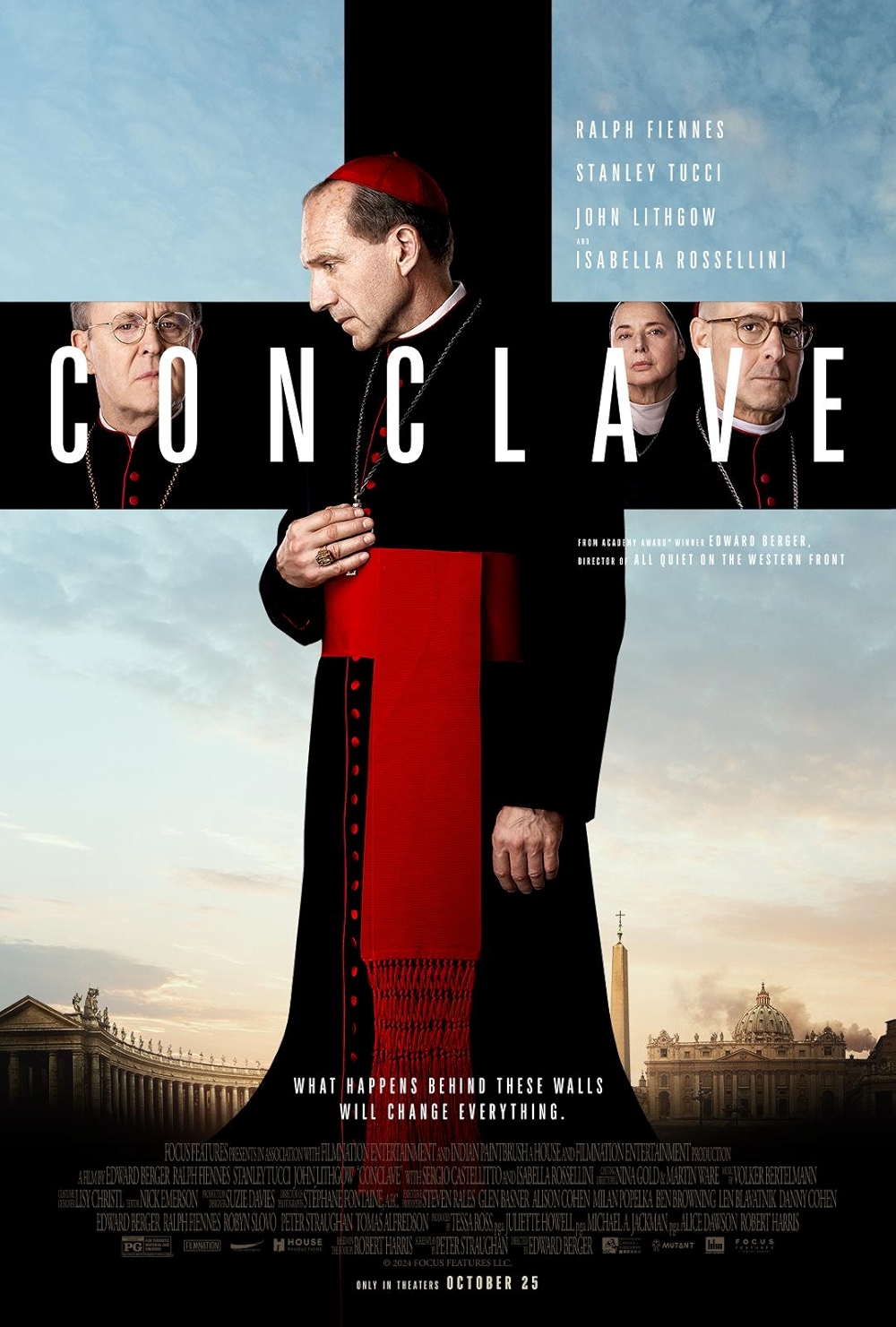
Conclave is not so much a case of who done it as who won it, a thriller set in the Vatican as the cardinals gather to elect a new pope. Being an adaptation of a Robert Harris novel, like Enigma (which became a film of the same name) and The Ghost (which became The Ghost Writer), it’s a closely researched thing, its potentially deadening attention to detail kept spiky by the addition of some suspense, intrigue, cloak and dagger and some lively thumbnail performances by a lot of mostly old white guys as the cardinals.
Following custom, when an old pope dies, the men in scarlet come together from the four corners of the Earth. There the cardinals are sequestered in the Sistine Chapel, where they vote and vote again for a new pope until a candidate creeps over the two-thirds-majority threshold. After each round of voting, the slips of paper on which they wrote the name of their preferred candidate are gathered up and burned in a special stove, the black smoke indicating to the outside crowds that the vote was unsuccessful, the white that, in the words of another movie, “Habemus Papem” – we have a pope.
It’s a human-resources exercise, in other words, though dressed up very nicely, with backdrops by Michelangelo and the finest Renaissance artists. And it could make for a flat, dull movie, without the caballing, the dark corners, the plotting and backstabbing.
Holding it all together is Ralph Fiennes as Cardinal Lawrence, the dean running the conclave and also scuttling between the various factions. Liberals like himself one minute, represented by Stanley Tucci’s Cardinal Bellini. Conservatives the next – Sergio Castellitto’s Cardinal Tedesco. Less political, more self-interested parties – like John Lithgow’s Cardinal Tremblay. And the rank outsider – Carlos Diehz’s Cardinal Benitez, who has been the Archbishop of Kabul up to this point, a position so freighted with danger that the old pope appointed him secretly (“in pectore”). No one knew this interloper even existed.

The casting here is apt, Diehz also being something of an outsider compared to Fiennes, Tucci, Lithgow and Castellitto, having only taken up acting as he hit middle age. This is his first feature. He holds his own.
“Checks practically every woke box,” was the opinion of Bishop Robert Barron, an American Catholic who didn’t like Conclave much. But Harris, adapter Peter Straughan (who sticks close to the book) and director Edward Berger are not driven so much by wokery as by the demands of the thriller – what could possibly be a good plot gotcha in the context of a gathering of old males? No spoilers, but the answer is actually the film’s only really good joke. And it’s vaguely in keeping with some of the legends about the identity of various popes down the centuries.
Of all the major religions, cinema has favoured Catholicism the most. The pageantry, the costumes, the fabulous wealth, the backdrops, its star performers – it’s Hollywood before Hollywood. Berger doesn’t overdo either the reverence or the glam, keeping things largely on an even keel and letting the plot take the glory.
Though the score makes claims to weightiness, there’s nothing faintly profound about this movie. It’s a good story told well, and nothing wrong with that. Fiennes screws as much angst and soul-searching as he possibly can out of a character who is essentially decent but doubting. You might have hoped for more to do for Isabella Rossellini, who plays a nun who turns out to have a pivotal impact, for all Rossellini’s scant screen time. As for the politics, there’s barely any, and the question the film asks whenever anything faintly contentious comes up is: what would Jesus do? Bishop Robert Barron has largely got his cassock in a twist over nothing.
Conclave – Watch it/buy it at Amazon
I am an Amazon affiliate
© Steve Morrissey 2024