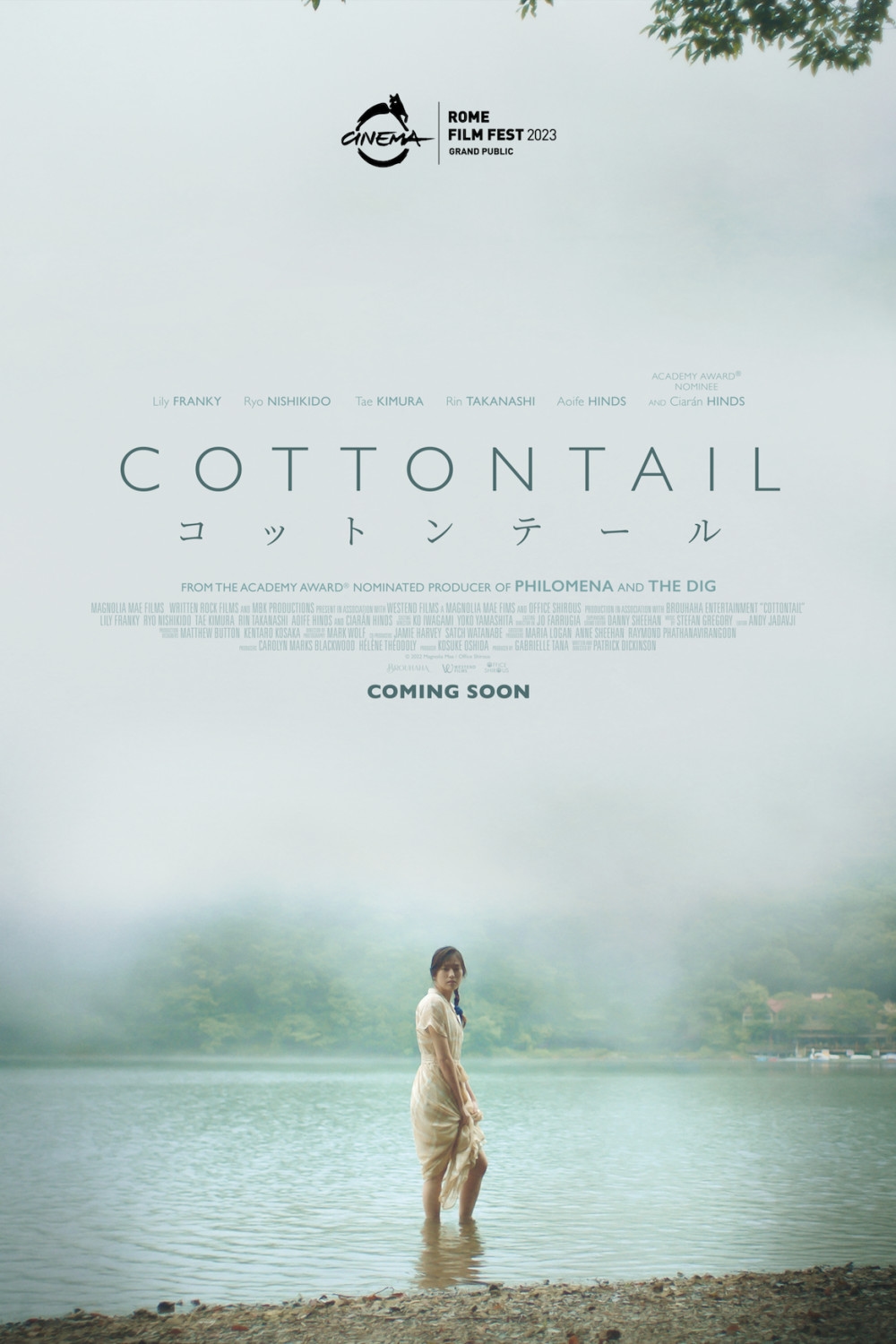
Whoosh, Patrick Dickinson’s film Cottontail rushes into the territory generally occupied by Hirokazu Kore-eda. That is, the deceptively simple, beautifully crafted, sensitively acted, tender human drama.
He’s even given it a Japanese top coat, since it’s the story of an emotionally inert Tokyo dad whose wife has just died heading to Lake Windermere in the the UK’s Lake District to scatter his wife’s ashes, as per her dying wish.
Along for the journey is the son Kenzaburo can barely communicate with, plus son Toshi’s wife and daughter. Kenzaburo didn’t want any of them to come, but those were Toshi’s mother’s dying wishes. Toshi is there for her sake not dad’s.
It’s clearly a drama about emotional release and we wait – and how Dickinson makes us wait – for dad to yield and for he and Toshi to connect, if only for a second.
Like a cab driver trying to up his fare, Dickinson takes us all around the houses – some flashback to when Kenzaburo and Akiko first met and bonded over rabbits. She was a fan of Beatrix Potter. Some more recent flashback to Akiko being diagnosed with some version of early onset dementia and losing her mind and control of her body.
Then, post funeral, a couple of scant minutes in London, where Kenzaburo, Toshi, Satsuki and little Emi have arrived en route to the Lake District, before Kenzaburo does a bunk and tries to leave his family behind.
He gets lost in what is probably Yorkshire (he’s taken the wrong train) and winds up in the house of a bluff farmer who’s also just lost his wife, and his daughter, who is kindness itself. They are the connected duo which Ken, as John instantly takes to calling Kenzaburo, and Toshi are not.
This is perhaps the greatest digression of all, this Yorkshire sequence, and if it weren’t handled so delicately you might think of crying foul.

Dickinson drops in little details about Ken which flesh out a man who at first glance is ornery, peevish, selfish and frequently drunk. The flashbacks show us a more hopeful Ken, before life gave him a battering. His career as a writer hasn’t come to much and he has had much to deal with – not least a shocking late reveal which re-orients us much more in his favour and introduces An Issue.
Dickinson and DP Mark Wolf shoot it all as a mournful elegy. Muted tones, soft lighting, defocused images, lots of rain (that’s the Lake District for you). Stefan Gregory’s score of strings and xylophones make it even more diaphanous. Meanwhile Lily Franky, who you might know from After the Storm or Shoplifters, plays Kenzaburo as an exasperating and irritating man – the grit in the oyster. But he can be charming too – the scenes where Ken explains himself to John and daughter Mary in halting English are freighted with two kinds of anticipation. Is Ken going to say in this foreign language things he cannot say in Japanese? Is he going to get to the end of the sentence?
Ryō Nishikido, as Toshi slots right into the groove as the loving but hurt son waiting for a sign from dad. Rin Takanashi is excellent in a tiny role, really, as the supportive wife gradually losing patience with the old man. Ciarán Hinds and his own daughter Aoife, meanwhile, play the Yorkshire father and daughter, their characters and casting pointing up that this, really, is the movie’s turning point – behold non-pathological family relations!
It could so easily shade into the twee, especially given the presence of Beatrix Potter in the background. And yet it doesn’t. It is never in doubt what this film is setting out to explore, from the first second to the last, and yet it’s compelling throughout. It is the total package, and even though Dickinson occasionally tugs at the heartstrings manipulatively, I stayed inside and onboard for the entire dramatic journey.
You might shed a tear.
Cottontail – Watch it/buy it at Amazon
I am an Amazon affiliate
© Steve Morrissey 2025