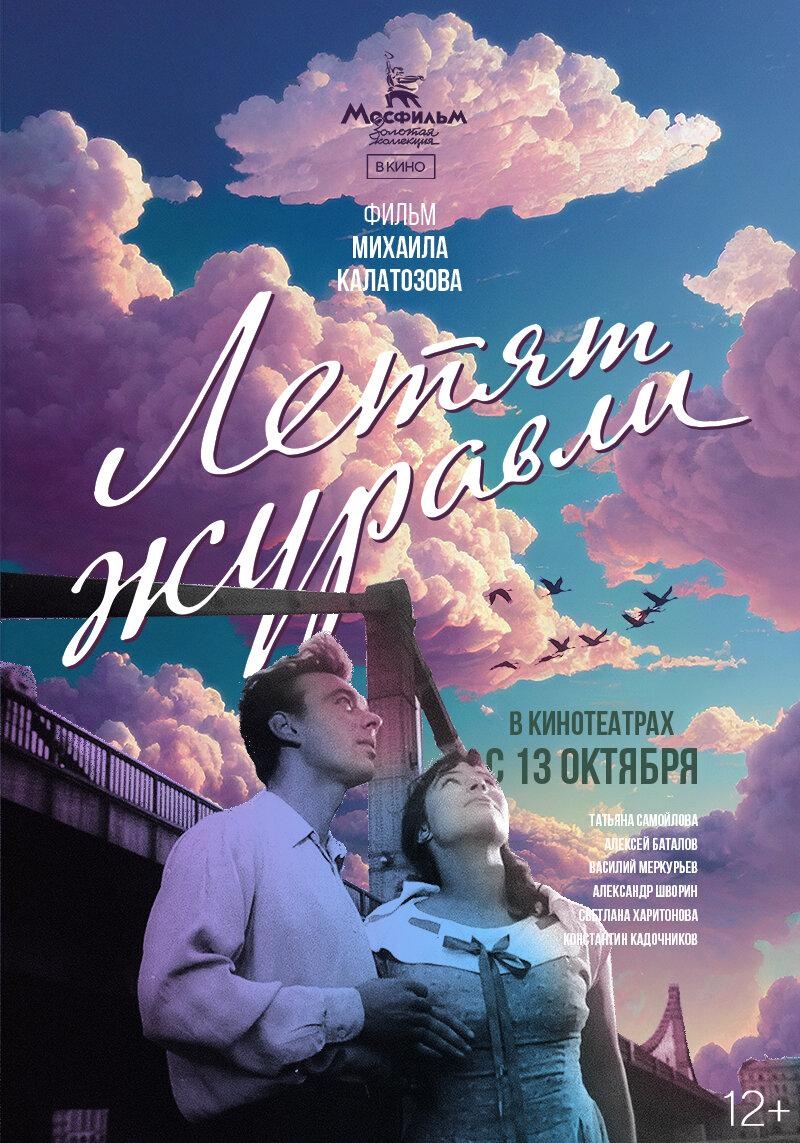
The Cranes Are Flying is remarkable in so many ways. The only film from the USSR to win the Palme d’Or at Cannes, it is also a reminder that an epic doesn’t need epic length to tell its story.
A simple story at that. Two people very much in love. Slightly diffident Boris (Aleksey Batalov) and feisty, beautiful Veronica (Tatyana Samoylova). He’s slightly punching above his weight, and knows it, and it’s this that probably tips Boris’s hand when he is weighing up whether to volunteer to go to the front, as the Nazis advance on Moscow. This in spite of the fact that composer Mark (Aleksandr Shvorin), Boris’s handsome cousin, has designs on Veronica, is not going anywhere near the front and will be back in the city with her. Exposure compounded when Veronica’s home and family are obliterated by a bomb and Mark’s parents persuade her to move in with them.
The tale of torrid romance set against a background of tumult is a familiar proposition, but director Mikhail Kalatozov does it in just over 90 minutes without anything feeling rushed or forced. That’s because everything is doing double duty – love is a metaphor for war is a metaphor for love, part of a broader picture where the inner is constantly in tension with the outer. Duty and love, the personal and the party, staying at home and serving at the front.
The Palme d’Or was probably awarded because of the remarkable cinematography, by Sergey Urusevskiy. In its simplest and least frenzied moments this is a beautiful looking film, with compositions and framings to freeze-frame and lighting and exposures that are beautifully judged. But it comes into its own in the crowd scenes, beautifully staged by Kalatozov and shot by Urusevskiy with a handheld camera that really does the business. Who, in 1957, was getting shots like this from cameras being carried through crowds? The scene where Veronica chases off after Boris when she hears he has signed up, fighting her way through the jubilant throng applauding the volunteers, is a brilliant evocation of chaos and confusion, again the externals acting as a metaphor for the inner.

Visually we’re halfway between Eisenstein and Tarkovsky – touches of constructivism, hints of expressionism, but also poetic realism, Hollywood framing of the sort you see in a 1930s Lubitsch movie and Urusevkiy’s lighting doing remarkable things with architectural shapes.
Though this is a surging and grand film it has its feet firmly on the ground. Why does Veronica ultimately accede to Mark’s wishes – has Boris not been ardent enough, is she’s being practical or has Mark raped her?
Throughout the Cranes of the title – a reference to a song Veronica sings – stand as a signifier for the poetic soul she shares with Boris, and which Mark has no access to. Mark, a member of the elite, does not come out of any of this well.
It’s Veronica’s story, which makes it unusual as war films go, and it paints a not entirely flattering portrait of her. That’s in keeping with the movie too, which is unusually frank about life in the Soviet Union, coming close at times to mocking the Party line.
Yes, it’s visually melodramatic at times, but that’s the demands of compressed storytelling for you. What’s really evident is that the film’s most touching moments are silent and almost still.
Yet again, this is another astonishing freebie you can get on the Mosfilm channel on YouTube – where so many gems of Soviet cinema are preserved (mostly subtitled). I alternated between that and the Criterion Collection version just to compare and contrast. It was hard to tell the difference.
The Cranes Are Flying – Watch it/buy it at Amazon
I am an Amazon affiliate
© Steve Morrissey 2026