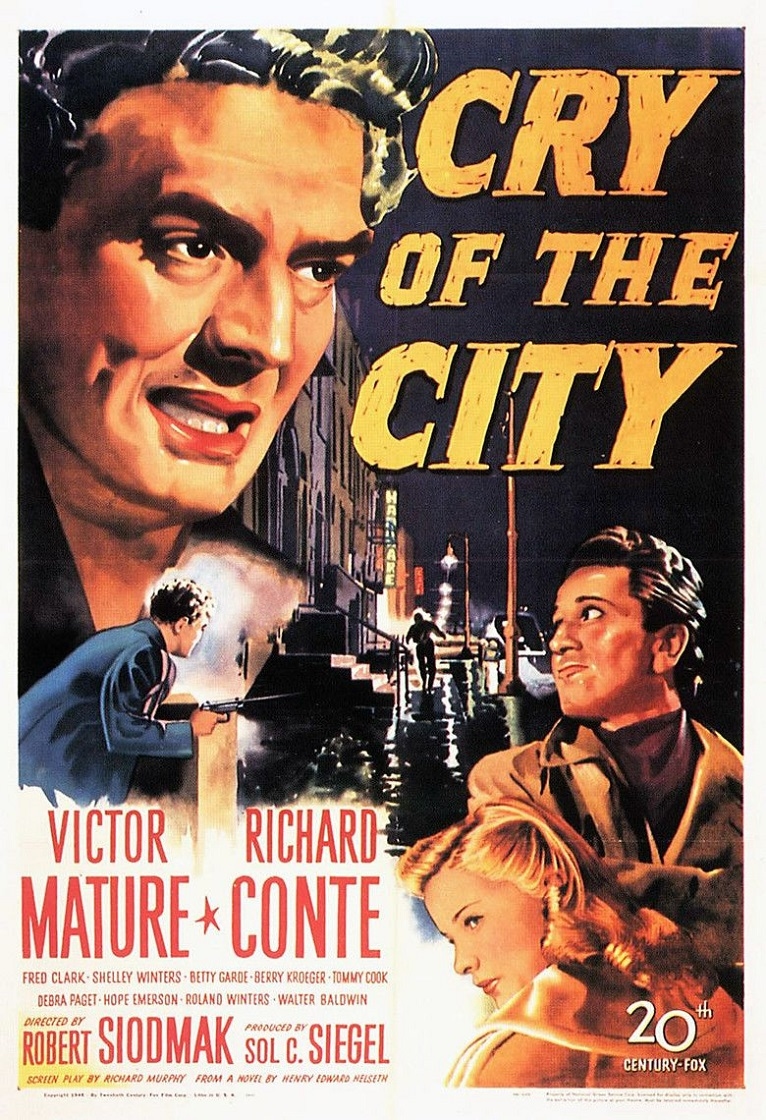
Threaded with religious sentiment like a 1970s Martin Scorsese or Abel Ferrara movie, 1948’s Cry of the City stars Richard Conte and Victor Mature as two Italian-Americans who knew each other as kids. Now grown up they’ve wound up on opposite sides of the law – Martin Rome (Conte) is a criminal languishing in a prison hospital after a heist gone wrong. Vittorio Candella (Mature) is the cop trying to chase down what happened.
A cop also died at the scene of the heist so Martin Rome is heading for Death Row, if he survives. Aiming to use this to his shadowy client’s advantage, slippery lawyer WA Niles (Berry Kroeger) is also buzzing about the scene. He’s hoping to persuade Rome to take the rap for a completely unrelated crime, the death by strangulation of a rich old woman, using Rome’s young girlfriend Teena (Debra Paget) as leverage. Take the rap or the girl will get it, kind of thing.
With its plot about kids who started out the same but wound up in wildly different situations, Cry of the City harks back to the nature-versus-nurture crime movies of the 1930s, such as Angels with Dirty Faces, Public Enemy or G-Men. There’s even a familiar scrappy-kid character, Martin’s younger brother Tony (Tommy Cook), who idolises his older brother and is heading in the same direction, but not if Candella can persuade him otherwise.
There’s something else going on, though, a foreshadowing of films by Scorsese or Ferrara, which would hinge on redemption and often stage scenes in a Catholic church, where religious ritual echoes the hierarchies of the gangster existence. They’d often also regularly feature scenes in the family home, where sweet parents from the old country steadfastly refuse to acknowledge what their adult offspring are getting up to.
Once Martin escapes from hospital, and with Lt Candella on his trail, director Robert Siodmak really ups the religious ante – is it too fanciful to suggest that Martin is a flawed Christ figure and that this is somehow his 40 days in the desert? If so, does that make the cop John the Baptist? It does not map quite that neatly, but wait for the scenes featuring Teena, played by Paget aged only 14, when Siodmak goes all in on the Virgin Mary styling.
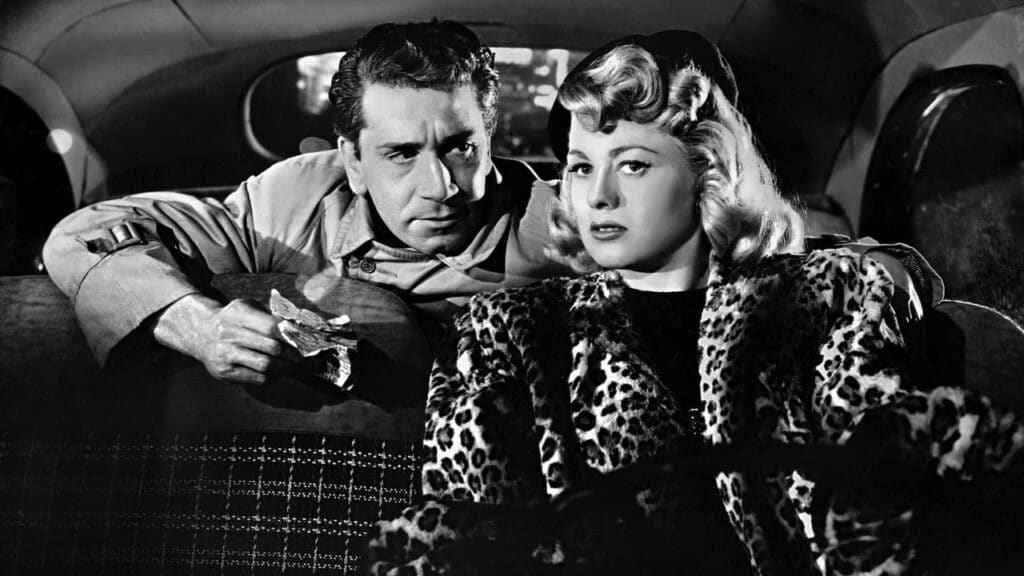
A fancy thought too far, maybe. I’m on safer ground pointing out that much of the film’s atmosphere derives from footage shot out in New York – newspaper vendors, cafes, taxis, wet streets. Siodmak hated location shooting so gets back into the studio as often as he can, allowing Lloyd Ahern to have his way with directional high-contrast lighting. Never one of the famous noir cinematographers, Ahern does a great job here. He shifted into TV in the mid-1950s and never went back to movies. Bewitched, The Fugitive, Columbo, he shot all the big shows.
Conte is good here, playing a smart villain with a smart mouth. Mature keeps his end up, more engaged than he often is. Intriguing to think that they were originally cast in each other’s roles. But it’s in the smaller characters that this movie comes alive. Fred Clark as Candella’s wingman Lieutenant Collins. Shelley Winters as Brenda, a brassy blonde in a leopard skin coat and beret. Further down the pecking order, Walter Baldwin as a prison factotum full of idiot optimism. Hope Emerson as a big woman who gives Martin a massage and then tries to kill him. And whoever it is playing that drunk in a bar who tries to pick up Brenda, cracking stuff. Small roles all but written with care and played with style, they give the movie a real boost and deliver several more good reasons to watch.
Cry of the City – Watch it/buy it at Amazon
I am an Amazon affiliate
© Steve Morrissey 2026