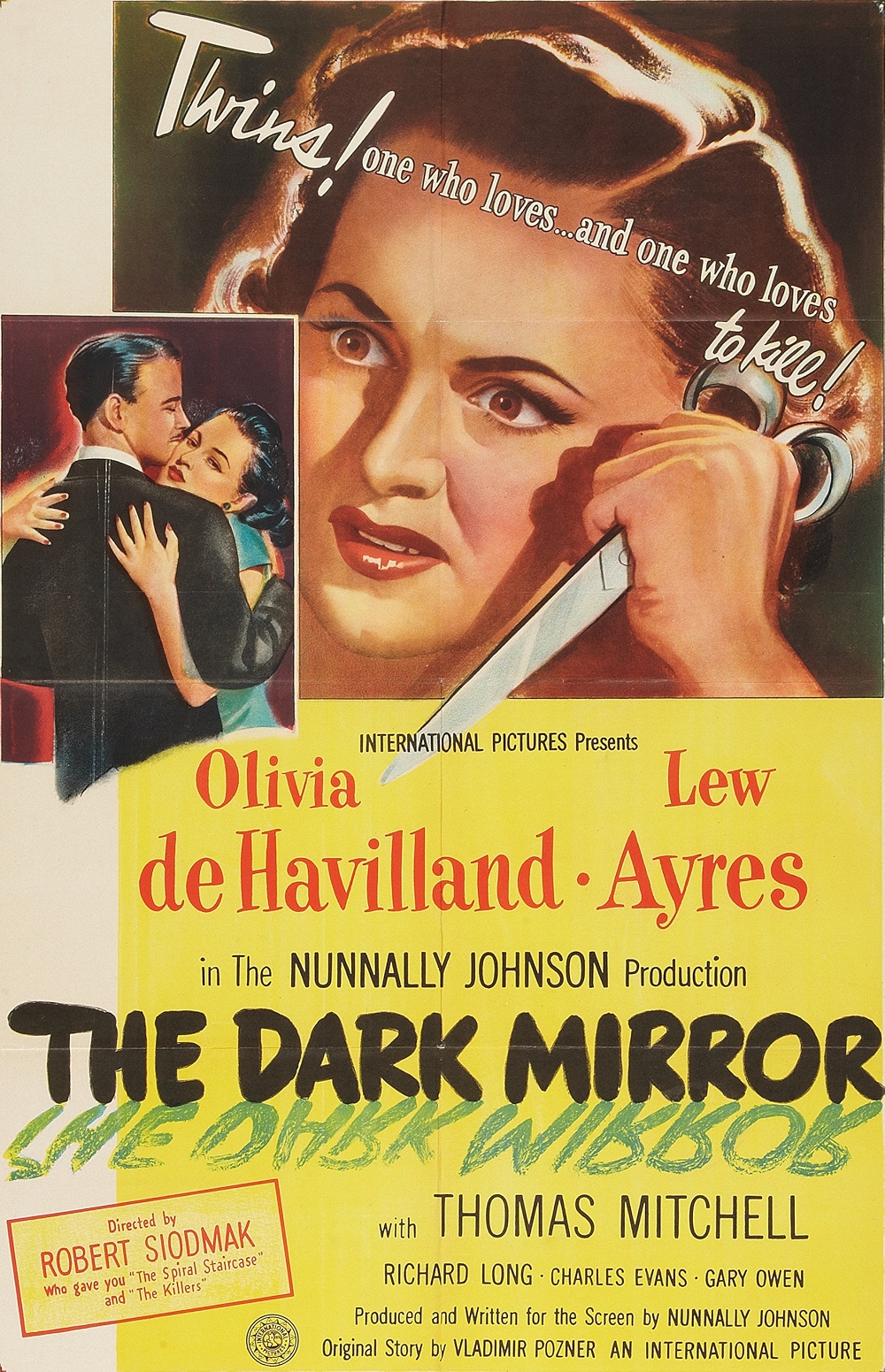
I asked Gemini, Google’s AI thingie, what the best “abnormal psychology” film noir was, pretty certain it would say The Dark Mirror. It did. Along with In a Lonely Place and Night of the Hunter, a couple of other suggestions. In the halls of appreciation of old movies those last two get plenty of love, but for some reason 1946’s The Dark Mirror seems to have fallen by the wayside a bit. Which is unfair for all sorts of reasons.
The plot is a cracker, for starters. A doctor has been murdered but the woman placed at the scene of the crime has a watertight alibi. She was elsewhere, and several witnesses can back her up. Until it’s revealed that the woman has a twin. It seems certain that one of these two did it, cop Lieutenant Stevenson has soon worked out. But since neither one will say a word, he cannot just charge them both – that’s not how the law works.
This is a tale of aberrant behaviour, a dark twin and a light twin, with Olivia de Havilland playing both roles – sweet Ruth and sour Terry. (In case you can’t tell the difference, even though de Havilland makes the two women quite distinct, one wears a necklace spelling out TERRY in massive letters, while the other’s spells RUTH.)
Twins are an abnormality in itself, the film suggests, with Terry’s left-handedness offered as a sign of her particular waywardness. Another is Terry’s behaviour – more masculine than her twittery sister, more likely to make the first move when it comes to men.
Talking of which, there’s not an awful lot for Thomas Mitchell to do once the plot gets properly underway. Which is a pity because he’s really good as Lieutenant Stevenson – relaxed, affable and avuncular, the cop easing his way into a person’s comfort zone, the better to strike. Instead the detective work goes to a shrink, as it probably should, with Lew Ayres playing the handsome, debonair Dr Scott Elliott.
For reasons that don’t quite stack up, since there’s a charge of murder hanging over their heads, both women seem happy to spend time with Dr Elliott and let him dig into their personalities. One of them falls for him. But the other one is determined to get him, possibly just to spite her sister. Carrying out the full panoply of movie-shrink assessments of the time – word association, Rorschach tests, a lie detector – Dr Elliott is also kitted out with a character quirk, a love of lemon drops, which marks him out as a bit different too. Maybe he’s the killer?

The tech enabling de Havilland to play both roles stands up well, though it’s obvious that there’s split-screen chicanery going on. De Havilland is particularly good at all this, maintaining sight lines with her “sister” – so often the giveaway – though probably most of the credit should go to director Robert Siodmak and the special effects team of Eugen Schüfftan, Deveraux Jennings and Paul K Lerpae.
There is a hint of expressionism, though not as much as some sources seem to suggest, and plenty of surging music from Dimitri Tiomkin’s score, which swells and skitters about like an emotional incontinent.
Of course, at one point one of the twins is going to pretend to be the other one, but things are confusing enough with both sisters dressing the same quite often and thankfully Siodmak and writers Vladimir Pozner (story) and Nunnally Johnson (screenplay) don’t overdo it.
Badness trumps goodness in film noir, and the bad sister has a hold over the good one that just about explains why the innocent sister doesn’t turn the other one in. 1946 was an interesting year for the genre. After the relative freedom of the war years, it was time for all those loose-living noirish females to be put back in their place. Meek homebody Ruth and assertive gadabout Terry offer us two versions of womanhood. Is there any doubt which one is the murderer?
The Dark Mirror – Watch it/buy it at Amazon
I am an Amazon affiliate
© Steve Morrissey 2026