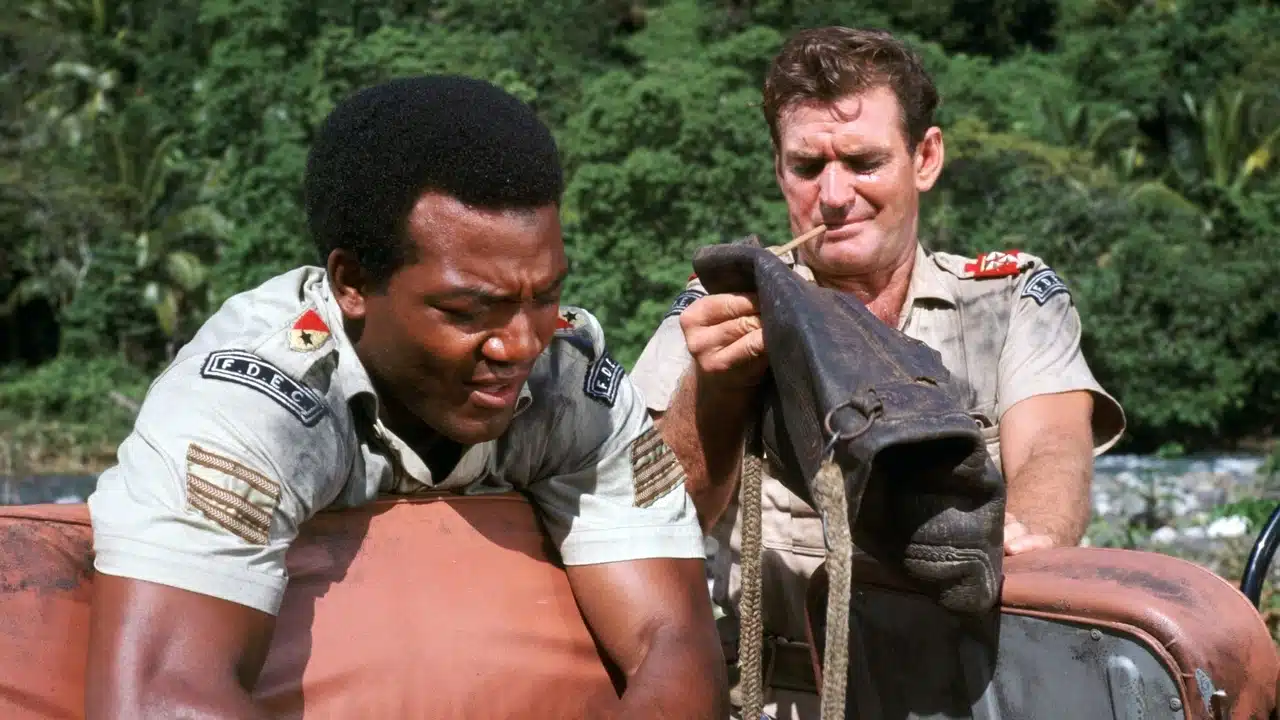
One of those “dangerous train journey” movies, Dark of the Sun stars Rod Taylor as a mercenary pitching up in war-torn Africa and heading off on a rickety old steam locomotive to rescue some diamonds. Also known as The Mercenaries, it paints a particularly pitiless picture of war and the sort of men who fight it for money. But there is a soft heart beating in there somewhere. While he’s no hero, Taylor’s Curry is also on an internal journey to find his soul and by the movie’s finale has discovered or rediscovered what it means to be a decent human being.
It sounds a touch soppy but isn’t, thanks in large part to the casting of Taylor. He fits this role possibly better than any other he ever played – the tough man’s man who knows what motivates people, is resourceful and, mercentary motivation to one side, is a straight arrow in a bent world. As Curry makes clear on more than one occasion, with him at least you know what you’re getting. Everyone else – UN peacekeepers, journalists – is a hypocrite and in forthright manner Curry takes anyone to task who tries to sneer at him for being a gun for hire.
By Curry’s side throughout are his right hand man, Ruffo (Jim Brown, also never better). Henlein (Peter Carsten), an old Nazi soldier who disparagingly heads a unit of black soldiers and wears a swastika. An alcoholic doctor called Wreid (Kenneth More) lured onto the journey by the promise of good whisky. And a distraught pretty female they pick up en route, played by Yvette Mimieux, who will cause almost as much friction between the men as the diamonds.
This was the great cinematographer Jack Cardiff’s tenth feature film as director, possibly his best, and it has everything you could want. Action, adventure, personal jeopardy and bravery, a good cast and crew. Everything in fact except real drama. It exists in moments but there’s no big motivating idea dragging this film along. Curry’s journey towards a sort of redemption? OK, if you’re feeling charitable, but it’s the least convincingly handled element in the whole thing, and is further complicated by what looks like an attempt to go bromantic on the Curry/Ruffo relationship. Which comes way too late.

Scorsese calls it a guilty pleasure and Tarantino has borrowed from it, particularly in Inglourious Basterds, and there is a lot to like. The performances are excellent, the action well staged, it looks sparkly and bright thanks to DP Edward Scaife (and unacknowledged input from Cardiff). The score, by Jacques Loussier, mixes Maurice Jarre lushness with Morricone expressive percussion and whistles. It’s a movie movie right down to the speed of those final credits – in bright, bright red – which roll across the screen at the speed of a state funeral.
What sets it apart, the technicals to one side, is its depiction of violence and cruelty. This is no larky jaunt, à la The Dirty Dozen, though there is an echo of its desperado plotting. Cardiff really wants to demonstrate that war isn’t fun or pretty. Many of the most violent moments were cut before the film even got to the censors, where further cuts were made. Even so, the scenes of children being shot, a soldier getting anally raped and women terrorised, a man being dragged down the road tied to a motorbike (originally we saw him being set alight, apparently) are brutal and borderline unwatchable. There’s an added racial aspect – white women defiled by black men – but with a Nazi as one of his characters Cardiff already has his villain and isn’t keen on going further into that territory.
Once or twice the action shades into James Bond improbability but in the main Cardiff keeps it plausible. Apart from the savagery of war, his other point, taken from the original novel by Wilbur Smith (a white guy born in sub-Saharan Africa, let’s not forget), is that easy distinction – white and black, coloniser and colonised, the politically engaged and disengaged – are distractions when it comes to personal morality. Against expectation, Curry increasingly starts to look like a hero, for the simple reason that he has a personal code of honour. He even gets a soliloquy – “I’m a paid hand,” it starts – laying it all out. As a balancing counterweight, towards the end of the film the black character of Kataki (Bloke Modisane) begins to emerge as the film’s conscience. Again, just a bit too late.
There’s a really first rate film in here. The frustrating thing is that you can see it peeping out all the way through.
Dark of the Sun – Watch it/buy it at Amazon
I am an Amazon affiliate
© Steve Morrissey 2025

