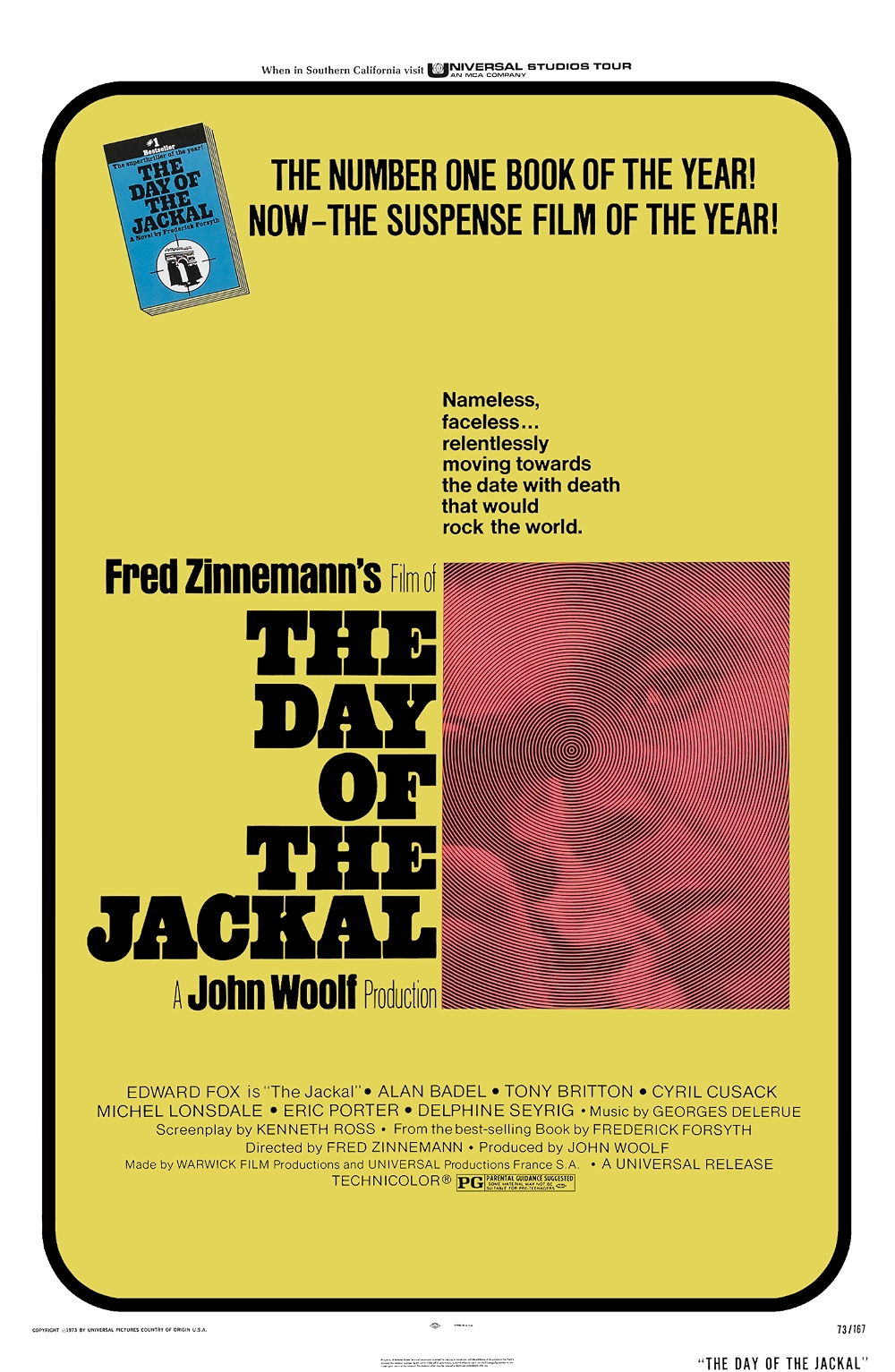
The Day of the Jackal would probably appeal to the members of a Facebook group called the Dull Men’s Club – recent topics include fuel efficiency while driving, insulating old buildings and dealing with nail fungus. The Dull Men’s Club (a Dull Men’s and Women’s Club also exists) loves detail, procedure, process, how things work and why they sometimes don’t. The Day of the Jackal is the procedural film with knobs on.
It came out in 1973 and was made by Fred Zinnemann, an Austrian-born American director based in London who managed to get studio sign-off on his adaptation of Frederick Forsyth’s novel about an assassination attempt on the life of General de Gaulle, president of France. This meant Zinnemann could cast who he wanted. No Americans was his stipulation. The result was an entirely Euro-cast of fairly familiar faces headed by one largely unfamiliar one – Edward Fox as the Jackal, the cool and methodical man hired by a renegade group of French military men outraged that the General has, as they see it, given Algeria back to the Algerians.
So, against studio wishes, Jack Nicholson was put back in his box and Fox took on the lead role. You’ve got to wonder what Nicholson would have done with the role. He’d have been showier than Fox, surely, but Fox seems just right as the impeccable Englishman going about an assassin’s job in a structured and analytical way, courteous except when being ruthless, keeping his head down, getting the job done.
This, as said, is a film about process. How the Jackal goes about getting himself a false identity, a car, a sharpshooter’s rifle that can be broken down into harmless-looking pieces, copying keys, getting another identity, another car, crossing and re-crossing borders, and starting to position himself so that at a given time on a given day he’ll be in place, his lightweight weapon assembled and ready.
It is fantastically detailed. At one point the Jackal hides the bits of the disassembled rifle in tubes underneath the white Alfa Romeo Giulietta Spider he’s stolen, and Zinnemann illustrates how he actually does that, with cutting gear and rolls of polythene and so on. Later, the Jackal realises he’s been compromised, that the police may be on to him, and so he resprays the car, just like that, in a clearing by the roadside. Zinnemann shows us the extent of his masking, so there’s no overspray on the chromework.
This fascination with particulars influences the film more generally. Interiors tend to be shot bright, in the style of the era, but Zinnemann often shoots his exteriors on long lenses – as if it were surveillance footage – and in a semi-documentary style for added authenticity. There are the black Citroën DS’s favoured by the French authorities, Parisian street musicians with accordion and clarinet, washing hanging out to dry, glasses of pink Campari as a daytime tipple.

For his big moments, like the assassination attempt itself, Zinnemann is shooting on the actual locations where state occasions were about to be held, with a lookalike General (Adrien Cayla-Legrand) as the target. There is no musical score – or none after the opening credits at any rate.
The “heroes” – French cop Lebel (Michael Lonsdale) in Paris and British counterpart Inspector Thomas (Tony Britton) in London – are unglamorous jobbing cops, shoe-leather guys who sleep in the office and go doggedly about finding their man, once they realise there is a man to find. In France the underlings sort through the official cards (name, address, passport number etc) all hotel guests are required to fill in. In England the passport archives are combed.
It is an ode to routine police work done by decent cops working to the best of their abilities. But Forsyth’s original story also throws in what looks like a touch of hubris on the part of the Jackal – he proceeds with the job even once he knows his cover has been blown. There’s also the odd intervention by fate to keep things lively. It’s not all entirely nuts and bolts.
A couple of women too, as flies in the ointment. First, in Paris, the splendidly upholstered Olga Georges-Picot as Denise, the plotters’ inside woman sleeping with one of the French security service to keep tabs on what they know. And Delphine Seyrig, as Colette, a dalliance for the Jackal en route to completing his assignment. Is she a case of sexual chemistry overpowering the Jackal’s professional code, or is he up to something?
Zinnemann keeps switching the action about – the Jackal, Lebel, Thomas, Denise, Colette, the South of France, Paris, London, Italy – and though methodical the Jackal is glamorous. Zinnemann’s camera swoops dramatically. His edits are crisp and his scenes are never too long. His film is exciting, it’s well done, and at all times you can see all the working parts and how they interlock. Dull men, rejoice!
The Day of the Jackal – Watch it/buy it at Amazon
I am an Amazon affiliate
© Steve Morrissey 2025