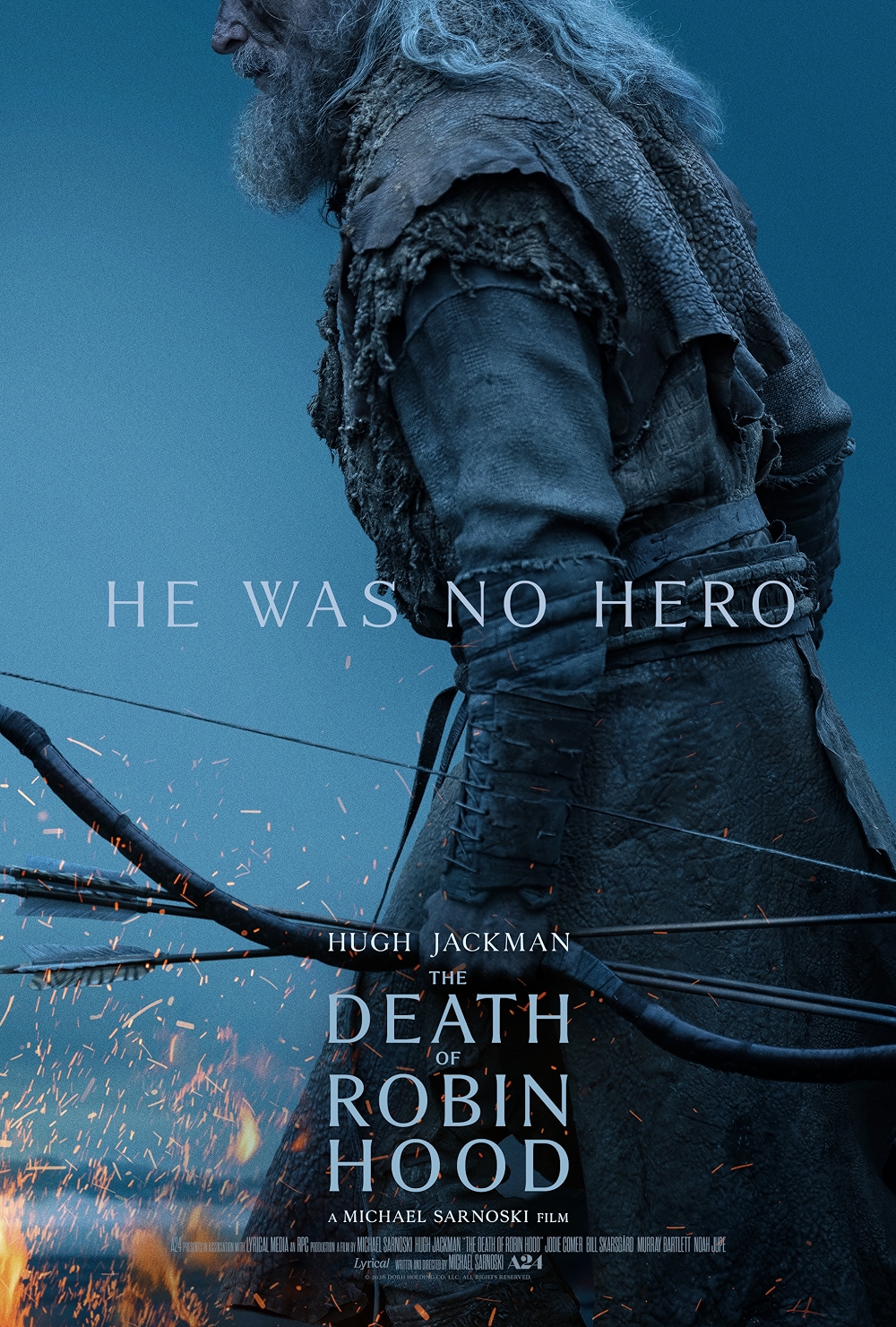
Can Robin Hood even be killed? Writer/director Michael Sarnoski thinks he can, and approaches the immortal figure of legend from two different directions in The Death of Robin Hood. Errol Flynn, Kevin Costner, Russell Crowe and Daffy Duck (yes, really), stand back.
First up, a dark, wind-blasted and grungy cavalcade of extreme bloodletting. In Sarnoski’s telling, the hero of ballad and folk tale is demythologised and presented as an old yet vicious killer. Stow all memory of Errol Flynn in wrinkled tights of Lincoln Green, Hugh Jackman’s grizzled, white-haired Robin is already despatching a young woman in the film’s first five minutes, but not before informing her that the old stories about brave Robin of Loxley were all untrue. This Robin, he tells her as she gasps her last, loves robbing and killing just for the hell of it.
Having set up an entirely different Robin in part one, part two works in the opposite direction. After Robin is wounded, he is nursed back to health in a nunnery. Recovering under the tender ministrations of prioress Sister Brigid, his mind roams over a life of misdeeds and brutality. Eventually he achieves a redemptive inner peace and is ready for the medieval equivalent of a Dignitas death, fully embraced.
Merry Men? Not so much. Little John (Bill Skarsgård) turns up in the dark first half, every bit as bloody and frightening as Robin. And in the second half Jodie Comer’s Sister Brigid is a Maid Marian of sorts, bringing succour and gentility to a world that’s dark and bad.
It’s the anti-Robin Hood, in other words, the one that’s nothing like the legends, the one that appears to be looking at Ridley Scott’s Robin Hood and saying “You didn’t go half far enough, mate”.
Falling into two distinct halves, both unequivocally done, there’s little visually or thematically to join them, apart from a hellish amount of mist. There are almost two separate movies here, which DP Pat Scola shoots in different styles. Dark and brooding for part one, possibly borrowing cues from Justin Kurzel’s windswept Macbeth. Tender and soft-edged in part two, with maybe a nod to 1976’s Robin and Marian, though let’s not overdo it. Jim Ghedi’s folky score, meanwhile, goes for drones and faint reminders of Clannad’s theme music for the TV show Robin of Sherwood (plain old Robin Hood in the US).

In part two, with Robin on the road to recovery, the film is on the road to moping itself to death. What is it trying to say? That there is more than one way of coming at Robin Hood, for one. That a life of violence leaves scars. Or, going out on a limb, that the civilised life has a lot to recommend it, and a society based on blood debt is a grim place to be.
Though there isn’t an awful lot to hang onto, Sarnoski’s film has structure and pace, good light and shade. Jackman is excellent and even has a go at a Midlands English – Nottingham or thereabouts for the most part – which is more than Kevin Costner ever did. Skarsgård is an impressive lump of meat as the (usually) blood-drenched Little John and Jodie Comer, queen of accents, this time aims for somewhere in Lancashire, I think, for her hypnotic portrayal of the benign and merciful prioress.
Sarnoski made Pig, which did good things with Nicolas Cage in pursuit of a stolen pet porker. Here, he’s done good things with Jackman, Comer, Skarsgård and, to an extent, rising stars Noah Jupe and Katie Breen – as members of the makeshift family Robin picks up on the way. The result is a Robin Hood that’s vibes rather than lore, fascinating if not entirely satisfying and in the end posing a question – once you’ve demythologised a figure who’s probably entirely mythological, what’s left?
The Death of Robin Hood – Watch it/buy it at Amazon
I am an Amazon affiliate
© Steve Morrissey 2026