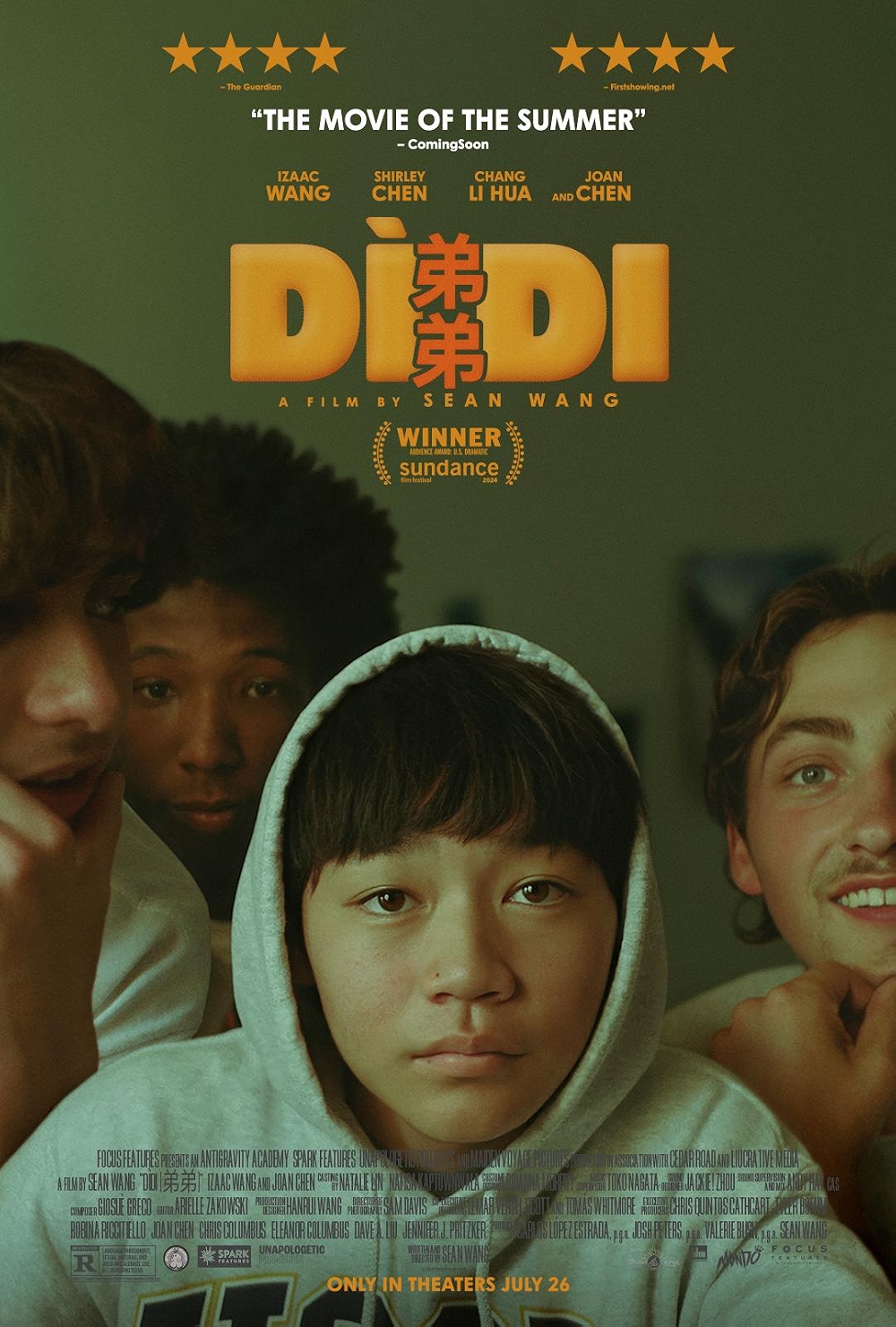
Messy, but good-messy like real life, Didi is the coming-of-ager working most of the angles in an attempt not to do the “arcs” of this sort of thing, and mostly succeeding. The other thing it’s doing is successful too, maybe even more so – depicting that dewy moment in the early 2000s when social media was still fresh and new and offered a vista of exciting possibilities, exactly like this film’s subject, a kid on the cusp of the rest of his life.
“Didi” is Mandarin for younger brother, and refers to Chris Wang, Wang Wang to his friends, an American Asian growing up in suburban Everywheresville with an absent dad, a typically anxious first-gen-immigrant mother, a grandmother who wonders what happened to discipline and respect and an older sister who barracks him constantly over every little thing.
So far, so normal, and so is what follows – hanging out with his dick-obsessed friends, fixating on the unattainable Madi, a girl too cool and pretty for nice but unremarkable Didi, making new friends with some older skateboarders, reluctantly studying to get into the good high school and so on.
Since the film is made by Sean Wang, who was that age at that time, we assume that Chris’s life is based on his own and that’s borne out by the film, which has the sloppy, unresolved feel of real life rather than structured narrative completeness. Some things go OK, some go a bit bad. There’s an argument here and there, nothing too devastating, a romantic success, then a failure. Chris is neither a comedy buffoon nor a loser to be pitied. He’s just a kid.
He’s not even that easy to connect to, Chris being at that age where he’s turned inward and is locked in an internal dialogue we have no access to – no voiceover, no useful best mate to talk his woes out of him. The nearest we get to all that is Chris’s interactions with his peer group through Facebook, AOL Messenger, MySpace (heady days) and so on, and his realisation that with instant answers to all the tricky questions at his fingertips – thank you, Google – he can steer his online personality in a way the offline one can only envy.
The old friends, the new friends, potential-girlfriend Madi, Chris’s interactions with all of them hit some kind of a buffer when the contradictions of his off and online self become obvious. His task then becomes to achieve zen by being himself rather than his peers’ or the internet’s version of cool.

This is Sean Wang’s debut fictional feature and he does it right, DP Sam Davis’s cinematography often imbuing his imagery with the raggedness of early YouTube, while the score, by Giosuè Greco, has a ringtone insistence that also ticks the boxes. 2008 was not that long ago, but it was a different world – a more optimistic one, before the tech bros became Bond villains – and this movie absolutely catches that world of positive possibility.
In a sense Didi/Chris/Wang Wang is that vibe. The future in compact Asian American shape. An entirely winning performance by Izaac Wang (no relation) here – Didi is not cute but he is likeable, a touch fragile. It’s a good cast all round, with Joan Chen the most recognisable face – films for Bernardo Bertolucci, David Lynch, Ang Lee – and Mahaela Park also excels as the unattainable Madi, a proposition more sexually precocious than 13/14-year-old Didi can handle (how true that rings). I also particularly liked Raul Dial, who plays Fahad, Didi’s dick-obsessed friend, a performance and character recalling Christopher Mintz-Plasse’s McLovin from Superbad (which would have come out at about the time this film is set).
I have no idea how Sean Wang is going to top this film – lots of awards, sitting on many a “best of 24” list. But that’s not such a bad place to be, surely?
Didi – Watch it/buy it at Amazon
I am an Amazon affiliate
© Steve Morrissey 2025