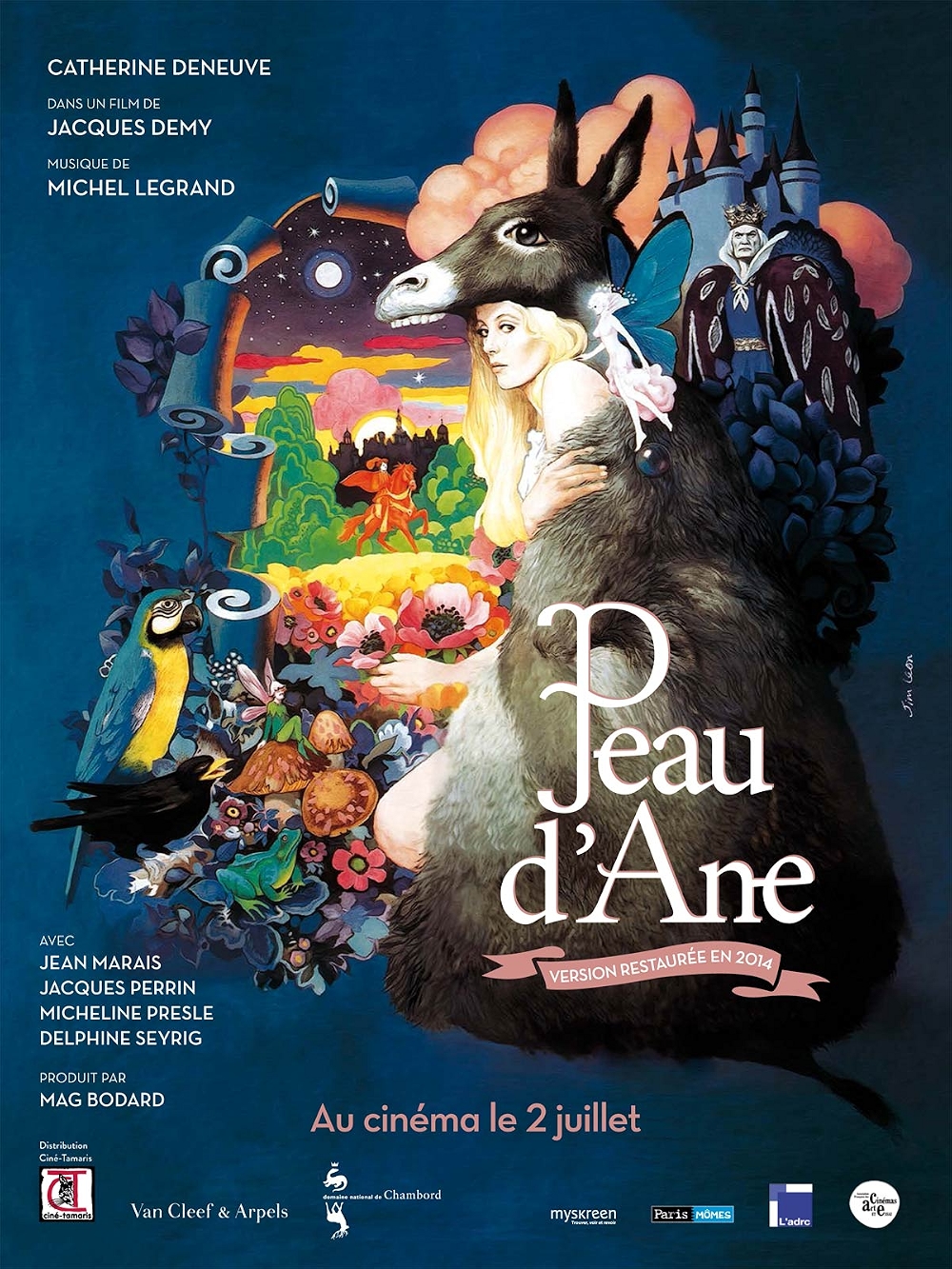
A big thing in France but barely talked about anywhere else, Jacques Demy’s Donkey Skin (Peau d’âne), sometimes known as The Magic Donkey, possibly owes its failure to ring cultural bells globally to its plot, which is about a king trying to marry his own daughter – incest, in other words. It’s Catherine Deneuve as the daughter, trying to put the king off with one ruse after another. Jean Marais as the king, Delphine Seyrig as a fairy godmother reinforcing the young woman’s belief that sleeping with daddy is wrong, and Jacques Perrin as the prince of a neighbouring kingdom who falls for the disguised young woman after she goes on the run to save her virtue.
It’s a Charles Perrault story originally and bears a lot of similarities to Cinderella, another of his. You could almost see it as Cinderella’s back story, with all incest-focused business at the royal palace front-loaded. The back end leads to a dénouement not unlike Cinderella’s: whomsoever this shoe (a ring in this case) shall fit etc etc.
It’s terrifically arch, the whole thing – from the fantastical costumes to the vivid pastel colour scheme, reminiscent of Demy’s The Umbrellas of Cherbourg, big acting, all set in a surreal biscuit-tin-medieval world and with a score and songs by Michel Legrand (who also did Cherbourg) that are majestically plaintive – all those descending minor chords.
As for the title, that’s strange in itself. The daughter, trying to stave off the king’s designs on her by setting him one challenge after another, asks him for various coats – one the colour of weather, another the colour of the moon, a third the colour of the sun. All of which he manages. Finally she asks him for a coat made from the skin of the king’s magical donkey, which shits gold. The king, clearly meaning to have his daughter no matter what the cost, obliges, and so the princess gets her donkeyskin coat, complete with head, hooves and tail.
For all its weirdness, it is on the money about one thing – the incest. The princess’s feelings towards her father are loving and so she does wonder whether she ought to comply with his wishes, as a dutiful daughter might. Affection and carnal love are confused in the young woman and it’s only after being set straight by her fairy godmother, who in a song tells her “boys do not marry their mothers… girls do no marry their daddies” that the princess finally sees things clearly. For his part the king is not so much a pervert as just vastly entitled – it’s a powerplay.

Demy echoes Jean Cocteau’s The Beauty and the Beast here and there – with slo-mo, the use of mirrors, double exposures and film running backwards. The casting of Marais – the Beast/Prince in Beauty and the Beast, reinforces the notion. His big lion head suits him to the role.
Beneath it all, in Perrault style, the idea that nobility will out. Even tending to the pigs dressed as a scullery maid there is something about the disguised princess that marks her out from the plebs around her. Demy puts no countercultural 1960s spin on this, though late on there is a moment (just a moment) when the prince is horrified at the conditions the lower orders are forced to live in.
So the prince discovers the princess, proposes marriage, order is restored and they all live happily ever after? More or less, though Demy adds in a final scene that is funny and absurd. It features a helicopter.
This was Demy’s return to film-making in France after a couple of years in Hollywood with wife Agnès Varda. They had not been successful years and Donkey Skin was designed at least partly to put them behind him with a return to the colourful musical melodramatic style that had made his name. It succeeds.
Donkey Skin – Watch it/buy it at Amazon
I am an Amazon affiliate
© Steve Morrissey 2026