Which witch? That seems to be the question behind Don’t Torture a Duckling (Non Sevizia un Paperino in the original Italian), the film that made Lucio Fulci something of a name in his home country – the sex, the gore.
It’s essentially a police procedural and sets off in a very familiar direction. A child is killed and a man has soon been arrested for the crime. But this arrest is too easy, too quick, and when another child is killed while the suspect is behind bars, it is suddenly clear that it cannot be Barra, the town simpleton and peeping tom. It must be someone else and Barra’s story about having buried the child after finding him already dead might be true after all.
So who done it? There are in effect two men on the case, the police commissioner (Virgilio Gazzolo) and Andrea (Tomas Milian), a journalist from Rome, though it’s journalist Andrea who does most of the actual detecting. There seem also to be two obvious suspects, both female. One is introduced naked on a sun lounger. A former drug addict hiding out in this small town to recuperate, Patrizia (Barbara Bouchet) is sexy, wanton, not above flirting with young boys and drives a red open-topped buggy. She’s the permissive society on (long) legs.
The other is Maciara (Florinda Bolkan), a local weirdo who sticks pins in the effigies of children, has possibly had a child with her own father. She’s a witch, basically, and is so obviously the guilty party that it seems obvious it cannot be her.
What about the local priest, the unnaturally handsome Father Alberto (Marc Porel), who enjoys the company of pretty boys? It’s 1972, remember, so he might not be the dead cert you might expect.
Fulci keeps the focus on the women, largely, muddying the water with deliberate lapses in logic and doing his best to confuse things while his nervous, constantly roaming and often highly subjective camera ties everything together, visually at least.

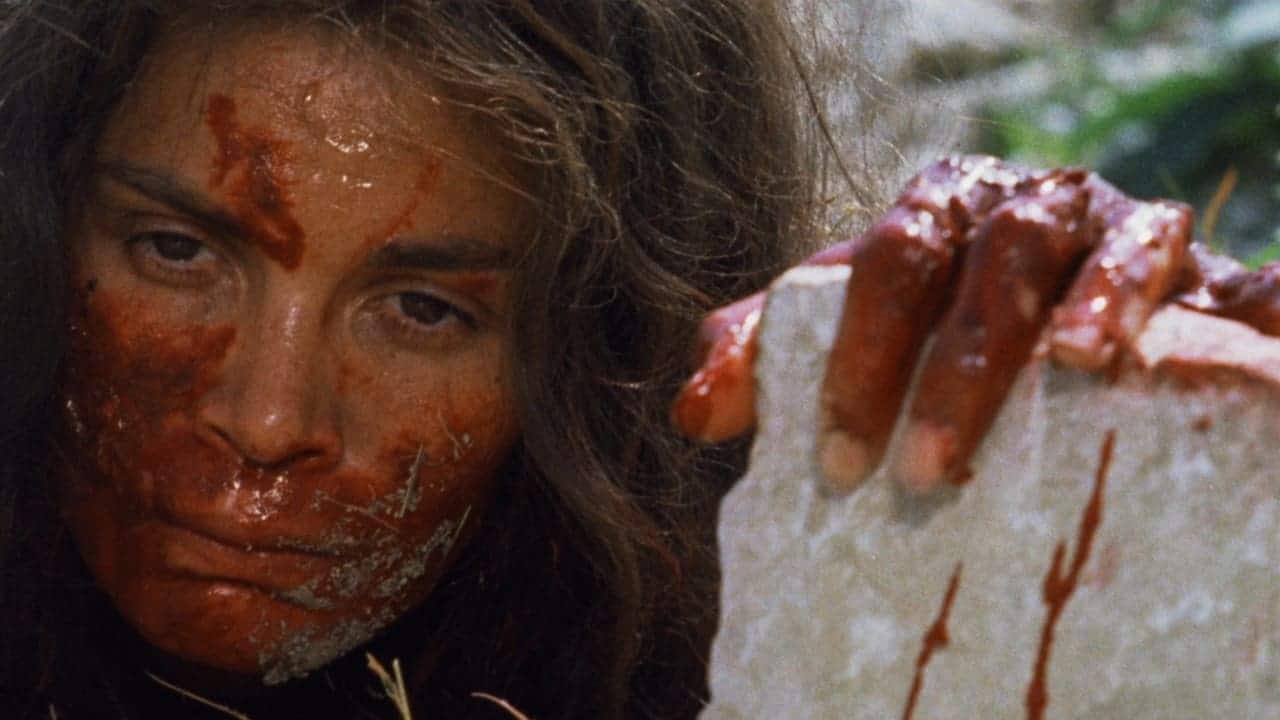
Women seems particularly in the frame, whether they adhere to the old ways (witchcraft) or the new (drugs and nudity), and Fulci keeps juxtaposing the old (it’s all set in one of those white-painted Italian villages) with the new (a vast concrete viaduct snaking through the valley). The occasional nipple adds a frisson, and Fulci tops it all with gratuitous gore. At one point the local men decide to have it out with Maciara by beating her with chains. Fulci goes to town on the injury, much as the men go to town on Maciara’s face and body.
Irene Papas is also in it, playing the priest’s mother, and since she’s something of a name, we must assume she’ll be wheeled in to assist in the final reveal, which, when it comes, isn’t much of a surprise at all.
Almost none of the cast is Italian and they all speak in their own languages, with the dreaded post-dubbing adding its own distinctive flavour.
Bolkan’s performance is the full froth-mouthed, boggle-eyed madwoman’s custard. Bouchet is slinky and wanton and gives off the vibe of a woman who likes to spend afternoons in bed with men. As for Porel, you might have seen him in Visconti’s Ludwig playing a gay toyboy. Too pretty to be innocent you say?
The film’s strong suit is its mood, both visually and sonically. But the best thing about it is the the score by Riz Ortolani – intensely discordant and stridently dramatic staccato strings run through an echoplex, switching to gothic church organ. Tarantino is a fan and you can see why. This soundtrack says early 1970s giallo even though the film itself isn’t entirely comfortable in the giallo box. Too many outdoor scenes.
The tease throughout is “which way is Fulci going to jump?” Is he going to blame the witch or her modern counterpart, the priest’s mother, the priest himself? Is he going to condemn the old world and support the progressive new world, or vice versa? He keeps us hanging on till the last second.
Don’t Torture a Duckling – Watch it/buy it at Amazon
I am an Amazon affiliate
© Steve Morrissey 2025

