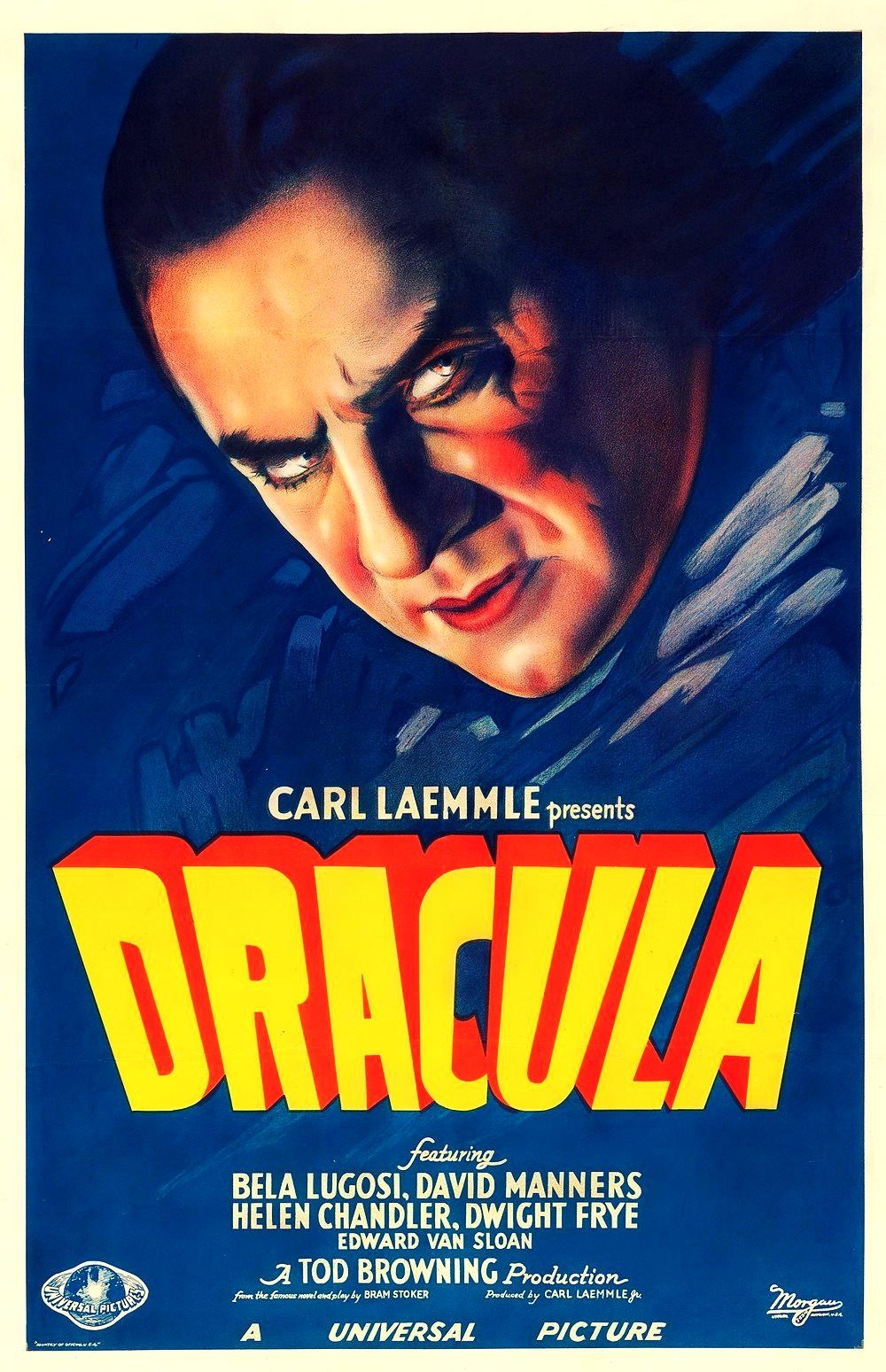
“Listen to them. The children of the night. What music they make.” Hollywood horror starts here, with 1931’s Dracula. Directed by Tod Browning, it made an international star of the man who uttered those words, Bela Lugosi. He’d already become a huge Broadway star off the back of a stage adaptation of Bram Stoker’s novel. This film would propel him onto the global stage, and into posterity.
The film sticks fairly close to the play, which sticks fairly close to the book. There have been trims in characters and settings but most of the original plot is intact as Browning’s version of it follows Dracula from his ancestral home in Transylvania, on to London and eventually to Carfax Abbey, bypassing the Whitby-set sections of Stoker’s story entirely.
As he would later in The Mummy, the slightly wan David Manners gets a vanilla role, as dullard John Harker, whose only real function is to ask a pertinent question of the men who know things – Dr Seward representing science and Van Helsing representing supernatural knowhow – and to act as an unwitting conduit between Dracula and first Lucy, whose blood Dracula drains, and Mina, his fiancée.
The plot is, essentially, can Harker, Seward and Van Helsing save virginal Mina before the Count takes her?
Lugosi does not blink once through the whole film (the IMDb trivia page says as much, but I can confirm it), and is entirely impressive in a role that created an archetype.
Unlike the vampire Nosferatu (either Murnau’s version, or Herzog’s, or the Robert Eggers update) the count is not a vile, low beastlike creature but a suave man with savoir faire to spare. Not as suave as Christopher Lee, perhaps, but we get the idea that Dracula’s attraction to young women – and theirs to him – is sexual. Throats are not so much attacked as borne down upon, gently, with the lady in question vaguely arching to meet the Count in mid slow-dive.
Apart from Lugosi, the standouts in the cast are Dwight Frye as Renfield, Dracula’s swivel-eyed, frequently gibbering and not entirely reliable gopher. And Edward Van Sloan as Van Helsing, who’s not as prominent a figure as he would become in later films but still key to the plot working out the way it must – with a stake in the vampire’s heart.
Talking of which, we don’t see any unpleasantness at all, neither death nor the ravishing of maidenly necks. At key moments the cloak either rises theatrically to provide cover or the camera cuts away.

Really, though, apart from Lugosi it’s the sets and the atmosphere that are key here. So many impressive backdrops, so much fog, so many ancient interiors and dramatic lighting set-ups, most obviously in Dracula’s Transylvanian castle and in Carfax Abbey, where the film climaxes. As well as shadowy gothic, there’s quite a lot of French poetic realism in the mix. For all the horror, this is a handsome picture, highly composed, daintily lit. Pretty, even.
This is all down to cinematographer Karl Freund, who’d been FW Murnau’s lighting guy on a string of films (though not his Nosferatu) and did so much work here that he now often gets a co-director credit – Browning was mourning the death of his old friend and collaborator Lon Chaney and was in no mood to work, so Freund filled the gaps.
Some of it is funny now. Like the bats on strings. The obviously painted backdrops (fabulous though they are). The storm-tossed ship (a model in a tank). But the key stuff all works – Lugosi and Van Helsing, Renfield and Dracula’s brides, the virtuous Mina and even the superstitious locals at the beginning of the film warning against being abroad after sunset.
If you go for a disc based on the 2012 restoration (most of them now do), it also comes with an optional Philip Glass score played by the Kronos Quartet. It is balletic, appropriate for such a highly choreographed film. Personally, I prefer the film as originally intended, with no score – silence is frequently used to build tension and that is lost with Glass and co sawing away.
In terms of visuals, the 2012 restoration is remarkably good. The picture does not flicker, there are no scratches, the contrast is good and the detail is all there. It points up, perhaps, the static nature of the film, which we must blame on Browning rather than Freund, but it does at least emphasise what was always the good stuff – the sets, the lighting and not least Lugosi himself. He’s massively impressive though not in the least frightening any more. How could he be when his Dracula has become a cultural cartoon? Immortality!
Dracula – Watch it/buy it at Amazon
I am an Amazon affiliate
© Steve Morrissey 2025