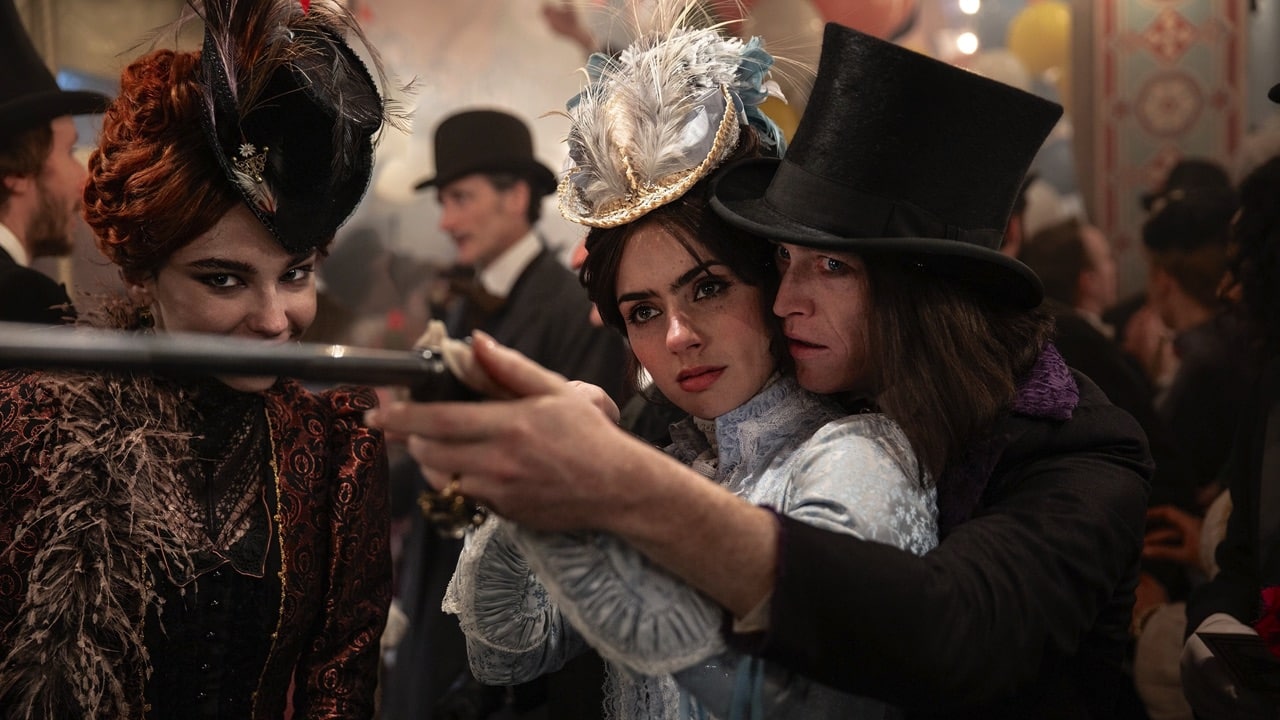
Persistently undead, always on point, it takes more than a stake and some garlic to keep the Carpathian count in his box. This Dracula is one of several outings for the thirsty aristocrat and pretenders to his crown in recent years. As well as a recent Nosferatu, other high-profile entries on a long list include The Last Voyage of the Demeter and Renfield, not forgetting El Conde, The Vourdalak, Day Shift and Humanist Vampire Seeking Consenting Suicidal Person. In 2025 alone there were two movies called Dracula. This one, by Luc Besson – also known as Dracula: A Love Tale – and Radu Jude’s starkly mononymic Dracula. No surname required.
To be honest, it was the Jude one I wanted to watch, on account of Jude being from Romania, Dracula’s home territory. But the Besson one also tickled my fancy. Partly on account of that A Love Story. Also partly because Caleb Landry Jones plays the count. Those pale features, that distracted air – as born to the role as Jonathan Rhys Meyers (who’s already played Dracula in a 2013 TV show).
So what do we have? I’d say, boiled down into two hours, the perfect instance of a film that’s entirely enjoyable but not very good. Dracula is a lot of flapaway fun. A gothic blancmange, it sticks pretty close to the original Bram Stoker story with CLJ playing the count as an amalgam of Max Schreck, Bela Lugosi, Christopher Lee and Gary Oldman (the hair!).
Besson, meanwhile, stops off en route to 2025 at various other Draculas while also repurposing a fair bit of the style of Coppola’s 1992 movie. His plot departure from Bram Stoker’s original story, for instance, isn’t a long way from Coppola’s – the count is drawn to key victim Mina Harker because she resembles his long-dead wife, Elisabeta.
Borrowing from Nosferatu, Besson’s Mina is at least on the road to complicity with the count. She’s not the shrinking violet being drained of her life force by a rapacious vampire, but a willing victim who actively gives herself to him. The old count took; the new one is offered – that’s sexier, yes?
As for the other characters, they are Stoker’s people but with their names changed. The Van Helsing character has shifted from man of science to man of religion. Priest – it’s how he’s billed and addressed – is played by Christoph Waltz as a cleric who might not entirely believe in god but uses the tools religion offers because they’re the only ones in the armoury.
The Dr Seward character is now called Dumont, and is played by Guillaume de Tonquédec. Renfield, Dracula’s lunatic accomplice, is now a woman, Maria (Matilda de Angelis), a vampire in this version but still essentially performing the same function, John the Baptist to Dracula’s Jesus Christ.
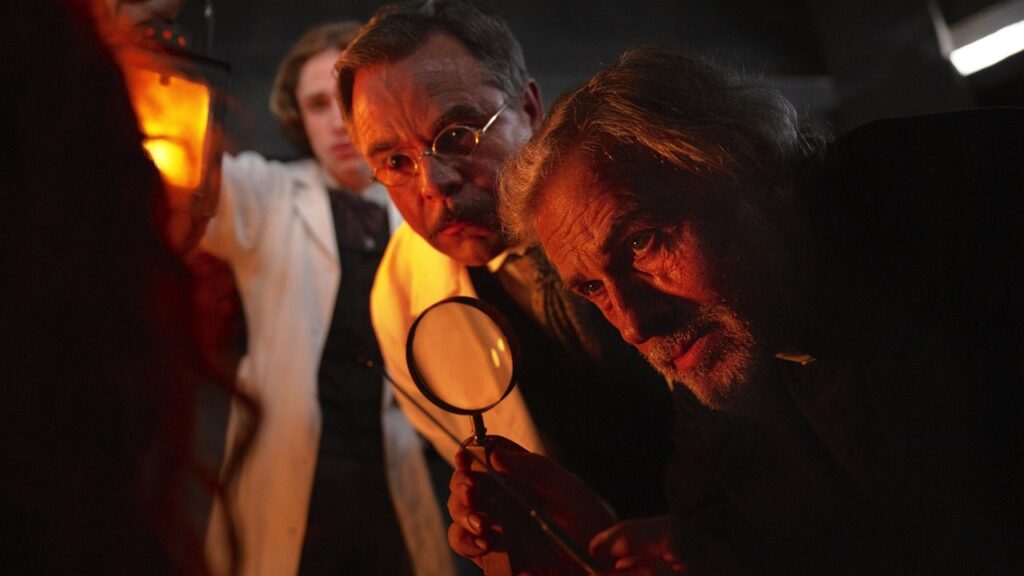
In act one we get Dracula’s origin story – god cursed the man originally known as Vlad (of Impaling fame) for loving his wife too much, in Dracula’s telling of the story at least. As a result of the curse he cannot die. In some of the film’s best bits we watch Dracula repeatedly trying to kill himself and failing, a tragic litany of woe, an uncomedic Groundhog Day.
Act two is Jonathan Harker arriving at Castle Dracul where Harker is introduced to the whole sorry vampire business. Dracula, incidentally, always refers to himself as “Dracul”. CLJ loses that final vowel as if he’s swallowed it – nice touch.
And then, finally, act three takes place in Belle Epoque Paris, where Dracula hopes to be reunited with Elisabeta aka Mina (Zoë Bleu) and Priest hopes to extinguish his flame forever.
It’s 50 per cent Silly Dracula and 50 per cent 1970s Dracula, with a subtext critical of old money, the sort that thinks in centuries not decades. Dracula appears to own property all over the place and is the global citizen of nowhere. The English crown is also mentioned in connection with this bloodsucking Undead. It has “always known how to make a good investment”, apparently. And what is it that’s driven Dracula to the dark side, having started off as a man suffused with love for his wife? Wandering for centuries among Europe’s gilded, debauched nobility in his search for a reincarnated Elisabeta.
Coherence is not its strong suit. Why, for instance, is CLJ eventually playing Dracul as a misunderstood rock god? Why is the editing so disjointed? Why are those CGI demons so woeful? Why so much flashback? On the upside, Waltz is very good as the jesuitical Priest, entirely watchable, as if he’s taken on himself the sacred duty to save the film’s soul. And the ending is entirely satisfying. Turns out this Dracula is a lover not a biter.
Dracula – Watch it/buy it at Amazon
I am an Amazon affiliate
© Steve Morrissey 2026

