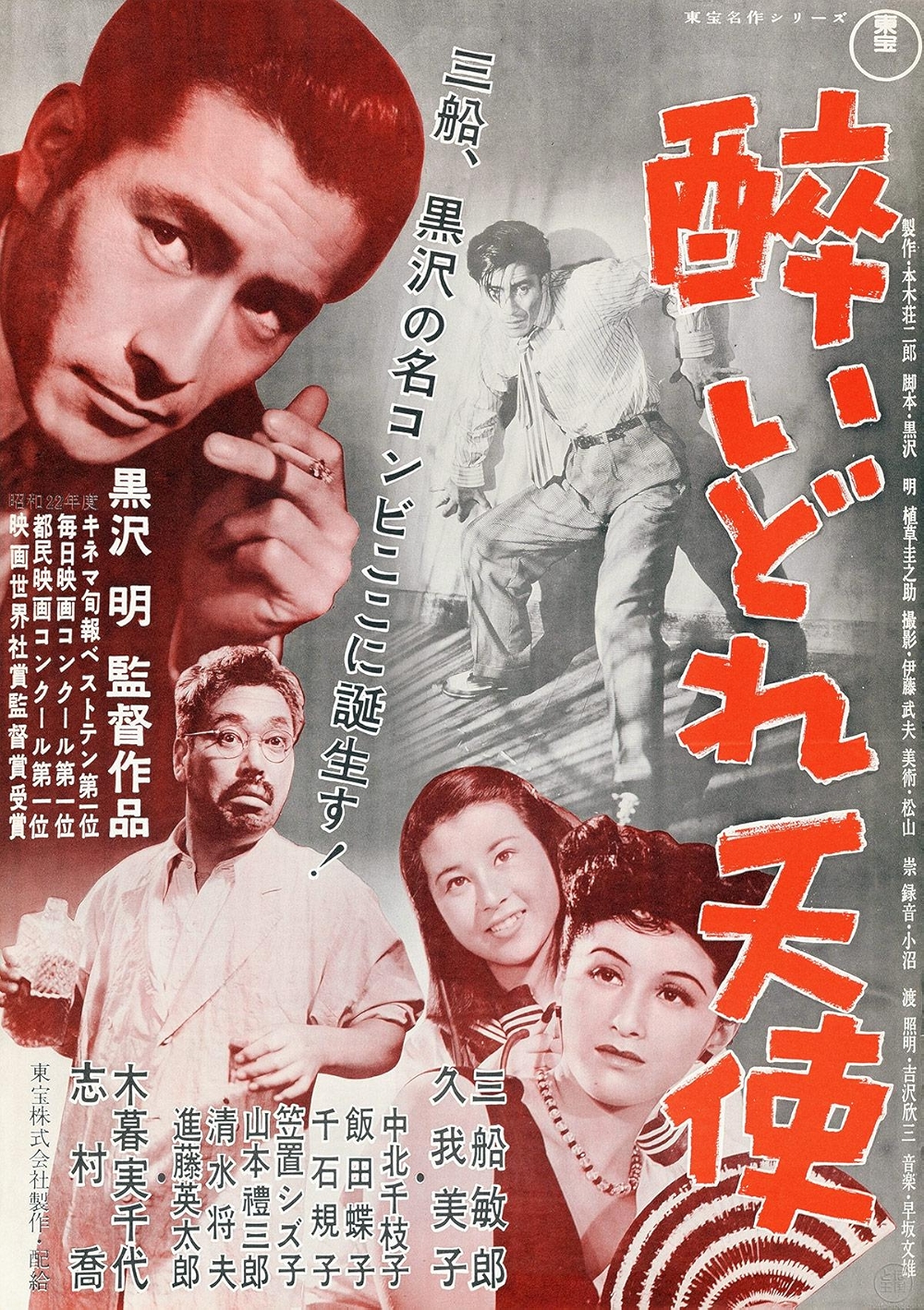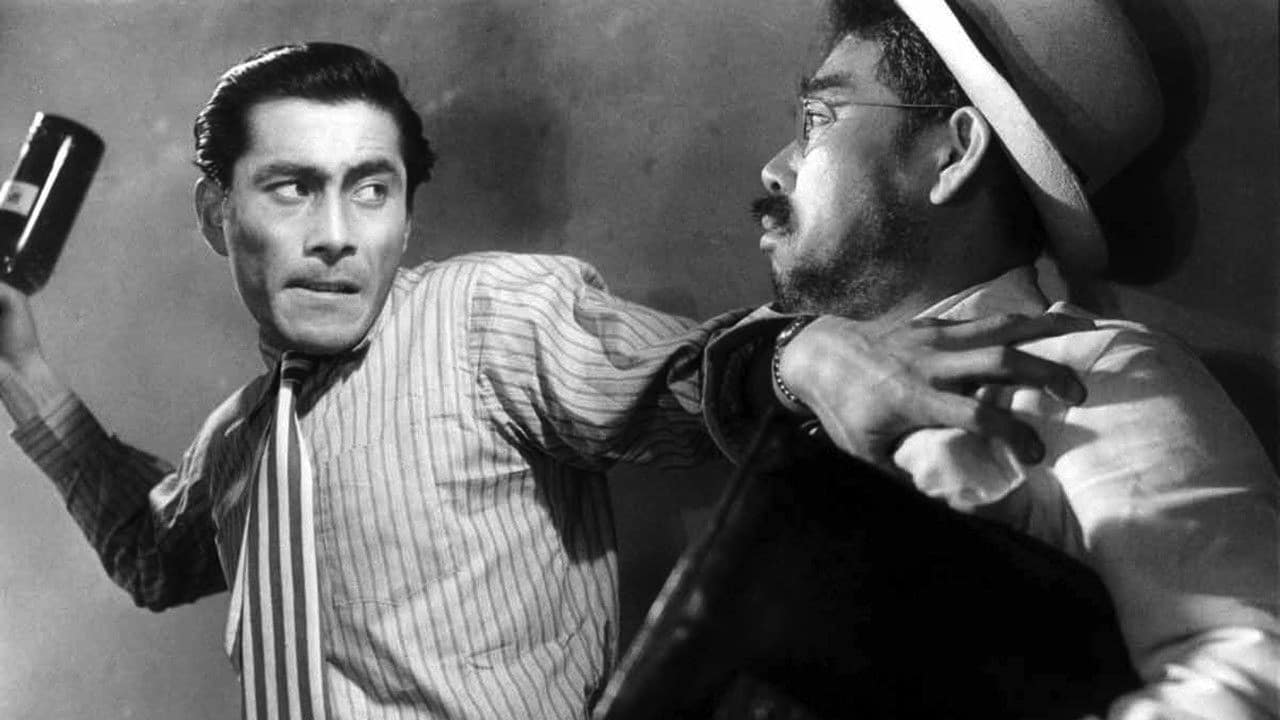
Apparently Martin Scorsese and Leonardo DiCaprio were discussing a remake of Akira Kurosawa’s Drunken Angel. It never happened, but we do at least have the 1948 original, a study of two flawed men in the Japanese equivalent of a film noir setting.
On the one side a gangster played by Toshirô Mifune. On the other an alcoholic doctor played by Takashi Shimura. Kurosawa wastes no time throwing them together. In the film’s opening scene Mifune’s Matsunaga is already at the drunken doctor’s surgery with a bullet in his hand. The doctor gives him short shrift while tending to the wound – he doesn’t like gangsters and isn’t shy about saying so. Matsunaga takes it because he needs the bullet removing, but he’s not happy about it.
Almost as an afterthought the doctor warns Matsunaga that guys with lives like his have a tendency to get tuberculosis. And that’s the plot – Matsunaga does indeed have TB, it turns out. And over the next 90 minutes or so, the doctor will struggle to persuade him to change his ways, give up the booze and tobacco and give himself at least a fighting chance of survival.
Why? Why does this sot care about this hotheaded outlaw? It is the dramatic driver of the piece, but Kurosawa makes us work to see how things fit together. A chalk and cheese attraction, maybe. A sneaking admiration for the younger man’s ability to live outside the law in a country where the rules-based system has so recently led to the disaster of defeat in the Second World War? For his part Matsunaga is just not used to being talked to in the way the brusque doctor addresses him – shouting, most often. He’s a man of violence, so maybe it’s the only language he understands. A relationship of sorts develops, and not a corny one.
There is more overlap than at first appears. Matsunaga’s eye is caught by the looks of Doctor Sanada’s pretty nurse, Miyo (Chieko Nakakita), unaware that she used to be the girlfriend of a yakuza dude who’s about to be released from prison. Okada (Reizaburo Yamamoto) will come looking for Miyo, but she doesn’t want to be found.
Also in orbit are two familiar noir dames. Good girl Gin (Noriko Sengoku) works at a local bar and has an unrequited thing for Matsunaga. Bad girl Nanae (Michiyo Kogure) is his current squeeze, a fly-by-night who will abandon him when he needs her most.
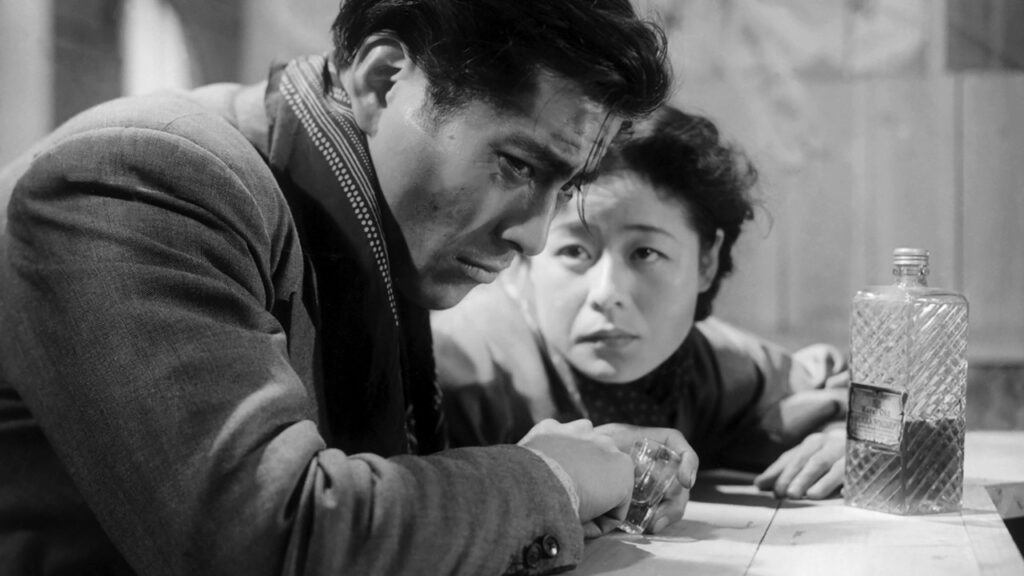
Metaphors for the current state of Japan abound – the broken doctor, the shadow on Matsunaga’s lung, the bubbling cesspool nearby that used to be a clean lake but is now full of crap. The influence of America is everywhere – the music, the sharp suit Matsunaga wears. But it’s the doctor who insists that scientific progress is the way forward, while the yakuza in his western threads is the one in hock to feudal ideas about hierarchy.
It’s complicated.
The acting is interesting. Both leads overact. But whereas Shimura gets away with it – because he’s the more comedic character – Mifune doesn’t. Kurosawa liked his performance, however, and rewrote the film around him, turning what was originally an incidental character into the co-lead. This was the first of many films they’d collaborate on.
In many respects this is a romcom – the odd couple who don’t get on until they do. And there are a few laughs to be had, especially from the Sanada/Matsunaga interaction – one aburpt to the point of catastrophic rudeness, the other losing his temper the whole time. It’s also a tragedy, though it’s not entirely certain early on which of the two men is going to wind up in big trouble.
Scorsese and DiCaprio would doubtless have made a good remake. But which role would DiCaprio have taken?
Drunken Angel – Watch it/buy it at Amazon
I am an Amazon affiliate
© Steve Morrissey 2026