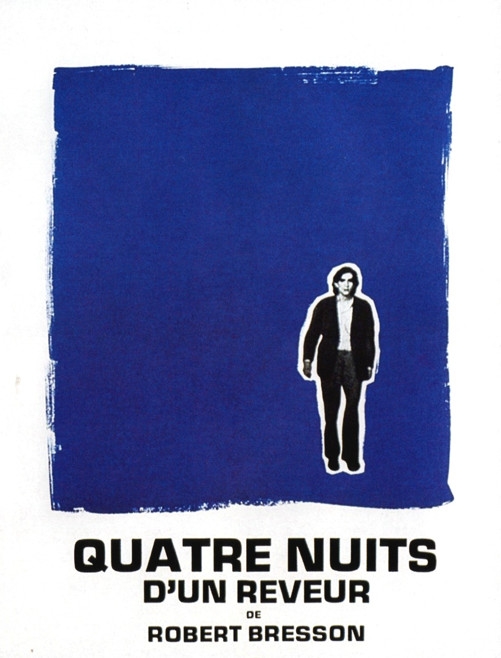
Often pitched as Robert Bresson’s most accessible film, Four Nights of a Dreamer (Quatre nuits d’un rêveur) is, for him, a wild ride. Not exactly pulsing with vivid event, perhaps, but by Bressonian standards highly unusual. The people in it, for example, actually act, rather than read out the words with as little emotion as possible. There is music, it’s in colour. There’s nudity… sex… heartbreak.
Wind the expectations in a touch for the actual film, which follows two young people over four nights. Jacques is a whimsical poetic type who falls in love with women – women on the street – too easily. As we meet him he’s gazing longingly at one attractive women after another in a way that’s borderline stalkerish. One night he spots a young woman about to jump off a bridge. Marthe is unlucky in love and determined to end it all. Having convinced her not to, Jacques also persuades Marthe to meet him over the next four nights to share their histories. He the painter who mopes about observing the world and then records his thoughts on one of those new-fangled cassette machines. She the pretty girl who lives with her mother and has fallen in love with the lodger, who has now gone off to America and may never come back.
Bresson said he wanted to make a film about people falling for strangers while remaining detached from people they actually know – the mystery of human attachment. He’s achieved that with Marthe and Jacques – she and the lodger, who remains a bit of a mystery and is never named. He and the various women in the city, and eventually with Marthe, who dangles the suggestion that she might fall for Jacques too, though they’re both far too intimate by this point to make this possible (if we’re following Bresson’s own rather sketchy logic).
Fans of Bresson won’t get quite what they’re used to. The acting is relatively dynamic, and both Isabelle Weingarten (Marthe) and Guillaume des Forêts (Jacques) do well as the detached duo. They’re naturalistic and loose-limbed. This was des Forêts only really significant role; she was a non-actor who went on to star in Jean Eustache’s epic The Mother and the Whore and had a long career off the back of that and this (not bad names to have on the CV – Bresson and Eustache).

Meanwhile, there is a soundtrack, which is shockingly un-Bressonian, though Bresson pretends there isn’t. He cuts to a radio in one scene to indicate that the music we’re hearing is integral to what we’re watching, not added afterwards. Later, groups of musicians regularly wander into shot, to explain a bossa nova here, or a folk tune there. It’s touchingly cute and entirely transparent. Perhaps it’s a joke.
His lighting too, or that of Pierre Lhomme his DP, is also highly un-Bressonian. Not the stark, flat black and white of A Man Escaped or Au hasard Balthazar but lush colour. At one point Marthe takes her clothes off to gaze upon her own naked body, and Lhomme lays on the sort of gauzy muted lighting you get in soft porn.
It’s all rather dreamlike and whimsical, which absolutely is Bresson, and he does odd things with the sound, which is again one of his hallmarks. Notice how weirdly high in the mix traffic noise is throughout. The background to our lives is… noise? Pain?
Building by slow, oblique strokes, often in dark and underlit spaces, Bresson gives us a psychological sketch of human connectivity. How random we are. Failing to launch and failing to land, we’re driven in hopeless directions, imperfect and not really fit for purpose, but there we are. A strange Gallic shrug of a movie.
Four Nights of a Dreamer – Watch it/buy it at Amazon
I am an Amazon affiliate
© Steve Morrissey 2025