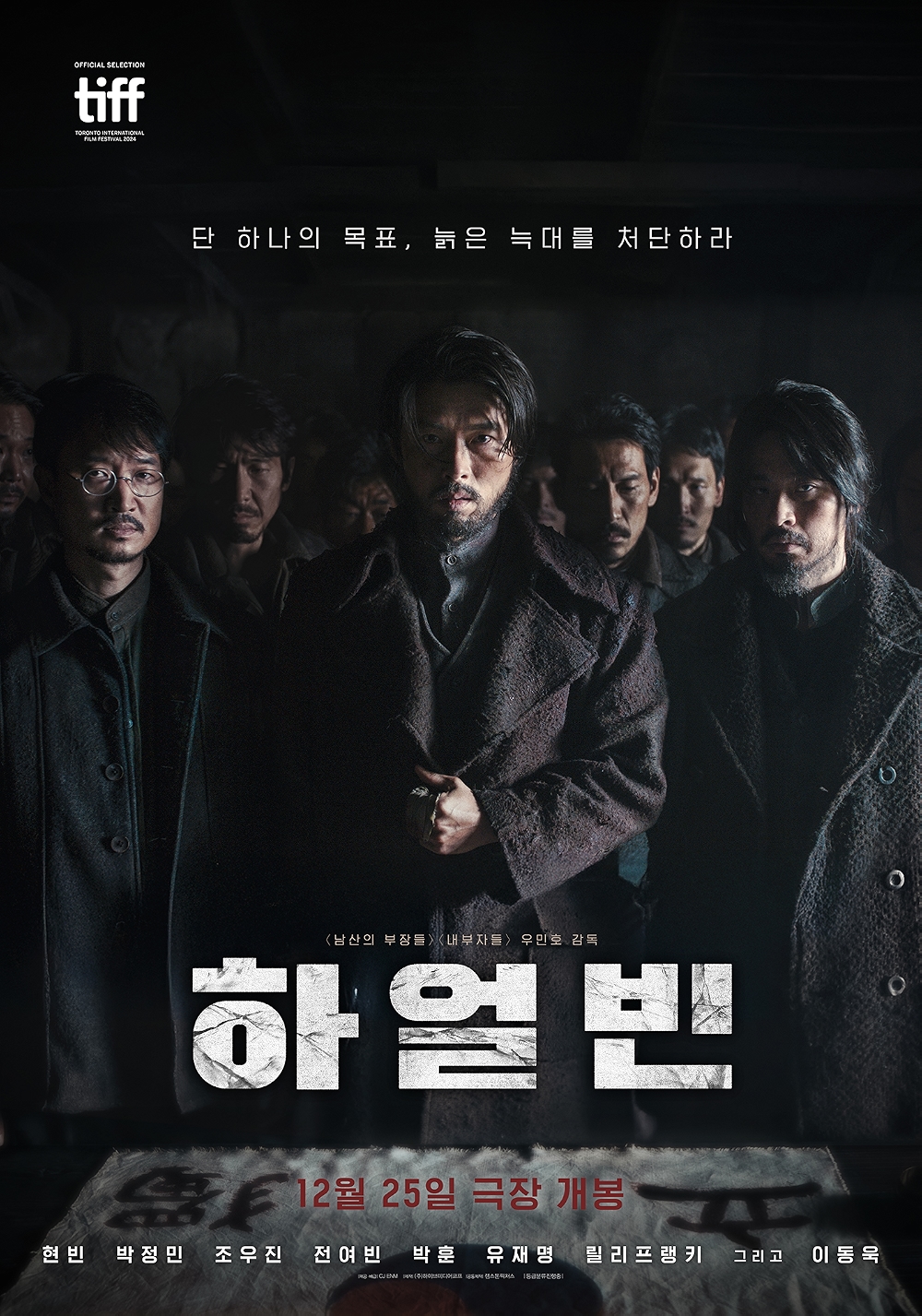
The national myths of one country don’t necessarily click with a foreign audience. Harbin, about Korean freedom fighters battling to throw off the Japanese yoke, makes the point abundantly. If you’re Korean it’ll almost certainly mean more to you than it did to me, a Brit, who without the added zing of patriotic feeling and background knowledge had to rely solely on old-fashioned stuff like drama, characters and world-building to get his scant cinematic jollies.
Director Woo Min-ho puts up a brief written explanation of the situation at the beginning of the film. The 1905 Treaty of Eulsa effectively turned Korea into a colony of Japan, it says, but also had the effect of stirring clusters of brave Korean men and women into action. Men like Ahn Jeung-geun, whose decisive deeds made him into a national hero.
We meet Ahn in the first of many very dark rooms, being hauled over the coals by his fellow freedom fighters after a disastrous conclusion to a campaign, when he magnanimously set some captured Japanese soldiers free and they responded, after regrouping, by massacring his men. Filled with remorse at the deaths of his fellow soldiers but his principles unshaken, Ahn vows to atone for his failure by assassinating the Japanese prime minister. He cuts off the tip of a finger to seal the oath in blood and win back the room with a token of his seriousness.
Over the course of the film the Japanese officer who ordered the slaughter, Tatsuo Mori, recurs like a bad dream, a Korean’s view of Japan personified – vicious, violent, lacking in grace and moral values. And what looked at first like a lavish war epic settles down to become a spy thriller with a cat-and-mouse element, with Mori trying to head off Ahn as he and his fellow plotters travel cross-country on rickety trains, on false documents, towards the town of Harbin, where the PM is due to give a speech. What Ahn doesn’t know is that Mori is in play, and that Prime Minister Ito Hirobumi’s spies are keeping him abreast of what’s being planned. Dot dot dot…

Fabulous locations get the attention of Woo’s camera, and meticulously dressed interiors too, sometimes at the expense of drama. Woo also loves his talky scenes on underlit sets. The result is a film that’s fascinating rather than gripping, though Woo is good at action set pieces, and eventually some tension does start to mount once it’s suspected that there must be a mole in Ahn’s unit – the other side seem always to be one step ahead of them.
In many respects this is a hagiography of a national hero. Ahn is the saint who can do no wrong. He’s barely a character at all, in fact, but Hyun Bin manages to inject him with forcefulness and resolve, and works hard in an attempt to shake some humanity into him. For the other team Park Hoon gets stuck in to the far more interesting character of Tatsuo Mori. Even when they are one-ply, bad guys are always more interesting than good guys.
Lily Franky (you may know him from Shoplifters) comes off best, portraying the Japanese prime minister as a man of courage, humour and low cunning – we could do with more of him, though understandably that can’t happen. This isn’t his movie.
Interestingly, the characters get more interesting the further away from Ahn they are. Mrs Gong (Jeon Yeo-been), a war widow and tougher than her sylph-like figure would suggest. Jeom-chul (Jung Woo-sun), a drunken bandit with a fondness for Russian roulette.
In the end, though, this is one for the Koreans, and of limited use and interest to outsiders, good looking and undeniably well played though this window on a pivotal moment in Korean history is. Non-Koreans should approach with caution, or with a history book.
Harbin – Watch it/buy it at Amazon
I am an Amazon affiliate
© Steve Morrissey 2025