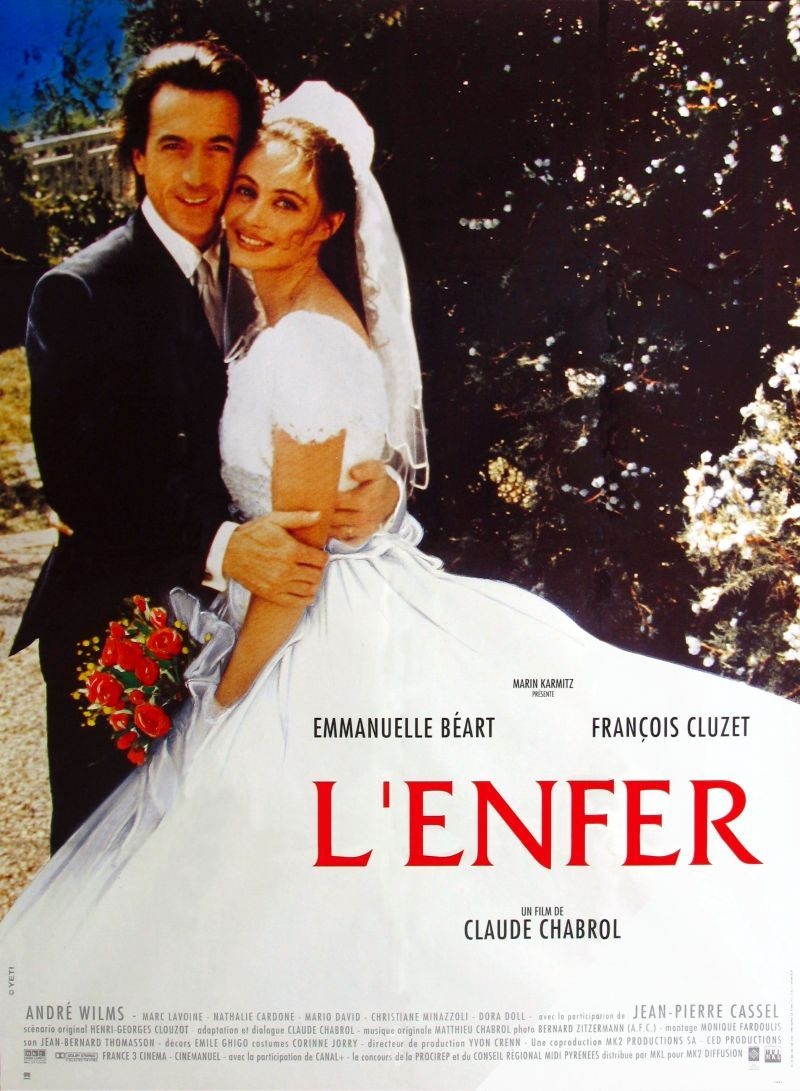
Strangely enough there are two films called Hell starring Emmanuelle Béart. This one is from 1994 and is directed by Claude Chabrol. The other (which also goes by L’enfer in the original French) is directed by Danis Tanovic. None too shabby, either of them.
More strangely, both films are other directors’ movies. Tanovic took on the second of Krzysztof Kieslowski’s Heaven, Hell and Purgatory trilogy after the director died. As for Chabrol, he was completing the film that Henri-Georges Clouzot started in 1964 with Serge Reggiani and Romy Schneider in the leads, which Clouzot abandoned when he got ill (he got better but never went back to it. You can see his footage in the 2009 making-of movie Henri-Georges Clouzot’s Inferno).
Both are fascinating in their own right but Clouzot’s is probably the more interesting. One of the great never-was movies, it was intended to show the young bucks of the New Wave that the older man still had it by doing nothing less than revolutionising (his word) cinema. Clouzot gave himself a heart attack in the process.
Now recast with François Cluzet and Béart in the leads, Chabrol’s take on Clouzot’s material seems at first his usual restrained rather than revolutionary offering. Cool, matter-of-fact and clear-eyed, with suggestions of psychological stirrings in the depths, it’s the story of a man whose relationship with his entirely blameless wife is ruined by his jealousy.
Shading from noticing that other men follow her with their eyes, to little suspicions and doubts, eventually winding up at full-bore psychosis, Paul is the lucky man with the lovely wife, Nelly, who is destroyed by something he cannot control. Nelly, capricious and lovely, girlish and flirtatious, is the adoring wife being driven away by her husband’s increasingly erratic behaviour. The fact that they run a little hotel together – lots of people coming and going – only makes things worse.
It’s all very Chabrol-esque. Béart in her strappy tops the sexy young woman. Rooms decorated in tasteful boho chic – cast iron bed frames, mismatched furniture, throws. Restraint. France as we imagine it at its best.

By an hour in Chabrol has run out of road with his initial story and his initial – Chabrolesque – approach. Paul has become boring with his petty jealousy, the green eyed monster that cannot be placated.
But then Chabrol sets off on road number two, an altogether more subjective examination of Paul’s increasing madness, tilting the camera, shifting the lighting into the gothic. Béart becomes steadily more alluring as Paul spins ever more elaborate fantasies in his head about what his wife is getting up to with one man or another.
Cluzet ups the ante too, going from being a constipated, whiny weak male to something much more dangerous. If part one is about the power women have over men, a power to disturb, part two is about the power men have over women, something much more destructive.
We can get a taste of what Clouzot would have done with the material by watching the 2009 making-of movie. Chabrol appears to have retained the spirit of what Clouzot was up to, especially with the wild switch of mood and approach from the objective and into the subjective/psychological.
It all gets a bit froth-mouthed and straitjacket-adjacent as Paul yields to the goading of his inner voice – a literal muffled voice – but Cluzet pulls it off and Béart really helps by playing her character to the hilt. Who wouldn’t want a wife who looked like her, and who cares if insanity is the price?
Chabrol pulls if off too, in a movie that looks at the halfway mark like it’s going to veer off into the long grass.
Hell (L’enfer) – Watch it/buy it at Amazon
I am an Amazon affiliate
© Steve Morrissey 2025