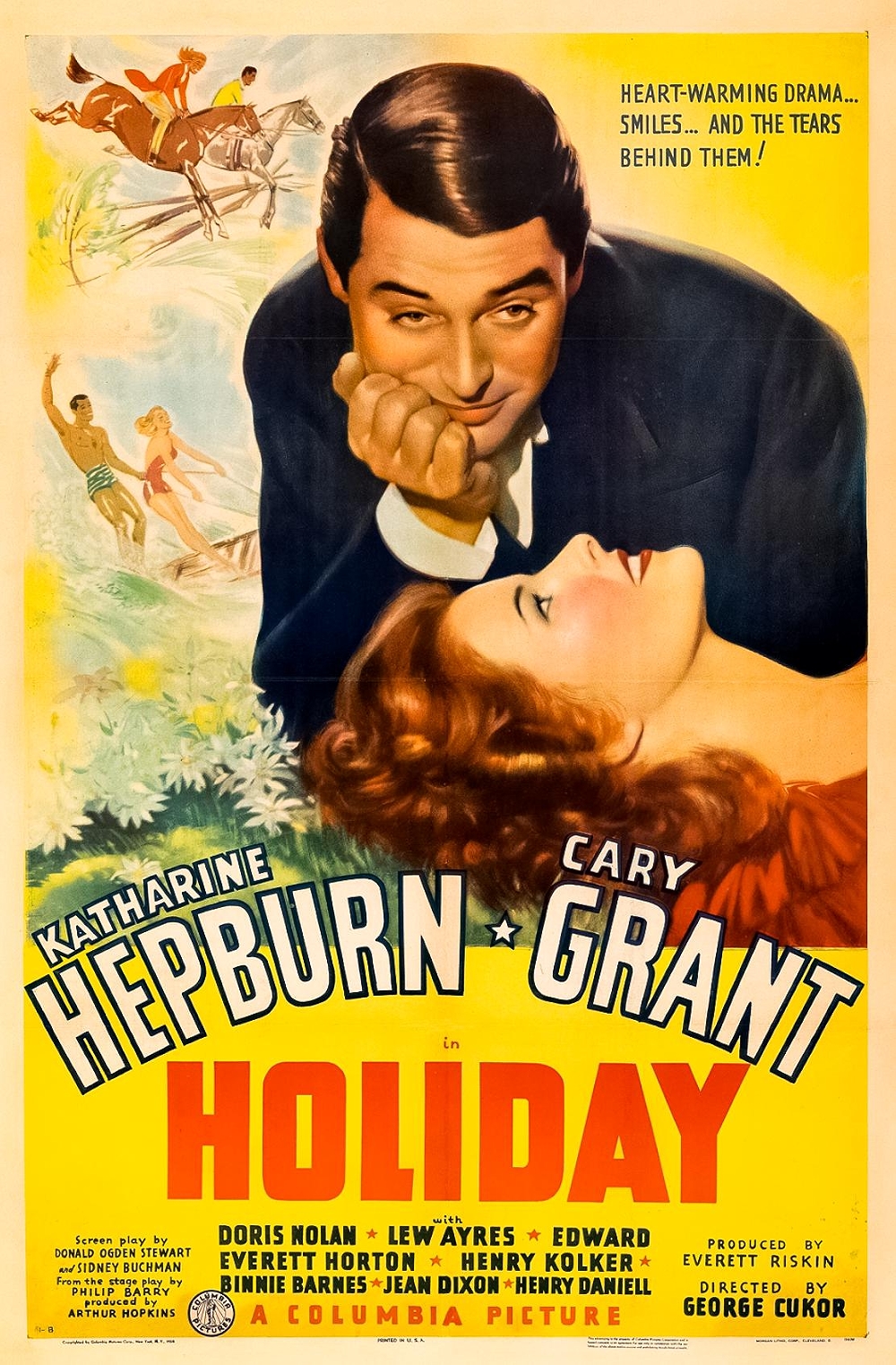
Screwball but not particularly comedy, in spite of Cary Grant and Katharine Hepburn’s presence, Holiday is too serious a business to be unserious about, and there aren’t really any jokes in it. But Grant bashes through it as if it were in the key of fun, and he drags everyone and everything along in his wake. He even throws in a backflip or two here in there, to remind us he got his start in showbiz as a tumbler.
Grant plays Johnny Case, a normal, everyday guy who’s worked his way up to a decent job in finance. Johnny has met and fallen for Julia Seton (Doris Nolan), unaware that she’s from a fabulously well-to-do family. As things kick off, two things are about to happen to Johnny simultaneously – he’ll find out Julia is minted at almost exactly the same time as meeting her sister Linda (Hepburn) for the first time. He’ll falls for Linda immediately, and Linda for him, though it will take the entirety of the rest of the film for the two of them to get round to declaring it.
In the interim Johnny charms the pants off Old Man Seton, who’s worried that this interloper is only after Julia’s money (he isn’t), charms the pants off sister Linda, who can match Johnny eccentricity for eccentricity and rather admires his plans for his future, when he’s come into the money that marrying Julia will bestow on him. Which are: do nothing at all, kick back, look around and take stock. No plans. This gets Julia twitching – she wants her husband to get a job at daddy’s bank so she can live the life of the rich married young woman without a rich married young man lounging about the place disrupting things.
This is the nub the film turns on, Johnny’s attitude, personified in the figure of Linda, who is the epitome of kicking back and seeing what comes, not out of laziness but out of a willingness to experience new things.

The film was made in 1938, and what with the USA still suffering from the effects of the Depression, the luxury of Johnny’s position – work or don’t work? – seemed unlikely to endear itself to audiences. Sure enough, the picture didn’t do well at the box office. Now, it looks like a time-capsule item designed to showcase the talents of Grant and Hepburn – a giddy charm from both – though there are other things to enjoy. Lew Ayres as Julia and Linda’s invariably drunk but decent-enough brother Ned, the film’s conscience, Edward Everett Horton (who was in the original 1930 film adaptation, and playing the same role) and Jean Dixon, as old friends of Johnny’s, who act as commentators and provide the shadow couple that screwball scenarios seem to require.
It’s a play done on film, and obviously so. Director George Cukor makes it elegant and seamless and keeps switching the action from downstairs to upstairs in the Seton mansion, partly to get some movement into the thing but also to emphasise that Johnny is a downstairs kind of guy – a grocer’s son, we’re told – whose forays into the upstairs realm are fraught with suggested danger.
Poor Doris Nolan, who plays the third leg/fifth wheel. Julia is a carefully drawn character and Nolan plays her well, but even at the outset there’s something about Julia that isn’t entirely likeable. By the time the film is finished, she’s shaded almost imperceptibly into being the villain of the piece. The second banana in her own story, it can’t have been easy for Nolan.
But then this was always going to be a Grant and Hepburn showcase. Holiday was the third of four films they did together, this flop following on from Sylvia Scarlett (also a flop) and Bringing Up Baby (another flop) before coming good with The Philadelphia Story two years later. Now, Grant and Hepburn look like a match made in casting heaven. Back then, somebody in the back office obviously thought so too, in spite of what the public kept telling them.
Holiday – Watch it/buy it at Amazon
I am an Amazon affiliate
© Steve Morrissey 2026