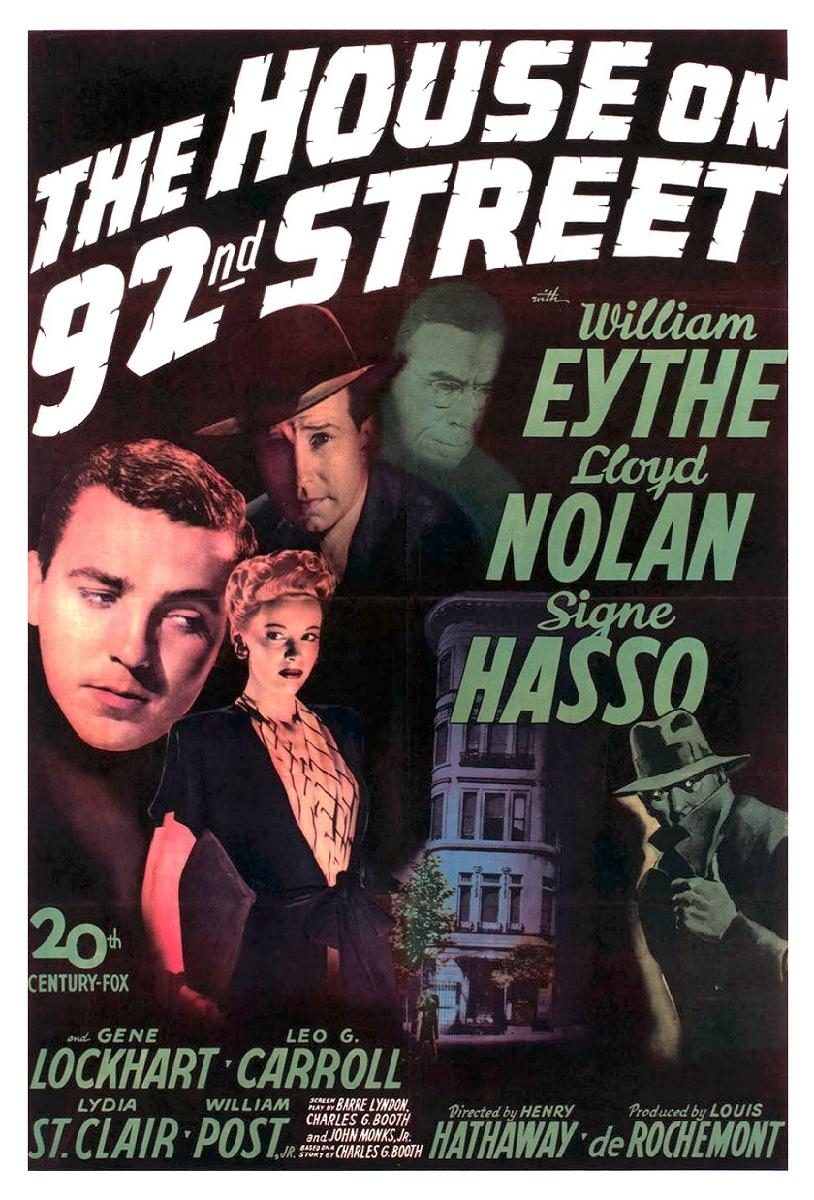
The House on 92nd Street is the sort of earnest propaganda movie Hollywood liked to pump out once in a while in the 1940s. It was made during wartime, so the justification is there, and it deals with a real case – the fifth column of Nazi-sympathising Americans working to overthrow their own government and install Hitler. And it’s based on a real case, the Duquesne spy ring.
Director Henry Hathaway and his writers give us about ten minutes of sonorous scene-setting in a “ripped from the headlines” newsreel-voiceover style before introducing the hero – William Eythe’s Bill Dietrich, a second-generation German American who is recruited as a double agent by the FBI to penetrate the spy ring spiriting military secrets out of the country.
The secrets, the voiceover tells us, concern the atomic bomb. This was still a real-life secret when the film was made – the voiceover explaining that the “Process 97” referred to throughout was in fact the nuclear programme were added at the last minute and must have given the film even more up-to-the-minute urgency.
It’s a Bond-before-007 story in many respects, Dietrich the resourceful and fearless agent walking into the viper’s nest and pretending to be someone he’s not. From here, working against the moment when he will be exposed, Dietrich has to insinuate himself into the ring. This will be doubly difficult because he’s claiming to have an access-all-areas authority that’s unheard of among the old spy hands – there are fears to allay.
Meanwhile, on the other side of town, the FBI beetles away diligently, using the latest tech – fingerprint analysis, spectrographs – to undermine the spies using science. Lloyd Nolan is the human face of the organisation, as Inspector Briggs, a role he’d play again in 1948’s The House with No Name, a film also in love with tech and the FBI.
The House on 92nd Street is a portentous film, no denying, but also rather splendid in many ways. There are some lovely shots of New York in its 1940s glory, and cinematographer Norbert Brodine lays on some swish deep-focus photography here and there, as well as noirish atmospherics, especially in scenes towards the end.

The down-table casting down is very good – Signe Hasso as a slinky dame whose dress shop on East 92nd Street is the front for the spies’ activity. Hasso’s Elsa Gebhardt is Dietrich’s first point of contact and a foil for some superspy-level flirting. This leads him to Lydia St Clair’s hard-faced Johanna Schmidt, the suspicious grump at the centre of the spy ring. Leo G Carroll, as ever playing Leo G Carroll, as Colonel Hammersohn, surely a bad apple. And even further down table, a host of pug-ugly mugs in various spy/G Man minor roles.
They help give the film its air of dirty reality, as does the use of real agents and FBI offices, and a sequence featuring real FBI surveillance footage of the comings and goings at the German embassy in New York. At one point Hathaway inserts a montage of the FBI rounding up suspects in the aftermath of Pearl Harbor. In what’s obviously actual newsreel footage we see sturdy officials and cowed suspects. It looks like something out of the Nazi propaganda playbook. To what extent was Hathaway making a comment?
The voiceover returns here and there, keeping us up to speed and, to an extent, hiding the fact that Hathaway and co are having trouble holding the film’s various elements together by less intrusive means.
This was one of the first of the documentary-style crime thrillers of the post-War years. It preceded Jules Dassin’s The Naked City, for instance, which is often claimed as the first. Maybe for that reason it’s often bracketed as film noir, which is a bit of a stretch, though stylistic elements of noir are undoubtedly here.
Today it remains a stylish and enjoyable movie, though one ridiculously in hock to the FBI’s own image of itself as the fount of security and stern guarantor of liberty. That brief glimpse of Bureau boss J Edgar Hoover in the introductory montage as good as tells us what’s coming our way.
The House on 92nd Street – Watch it/buy it at Amazon
I am an Amazon affiliate
© Steve Morrissey 2026