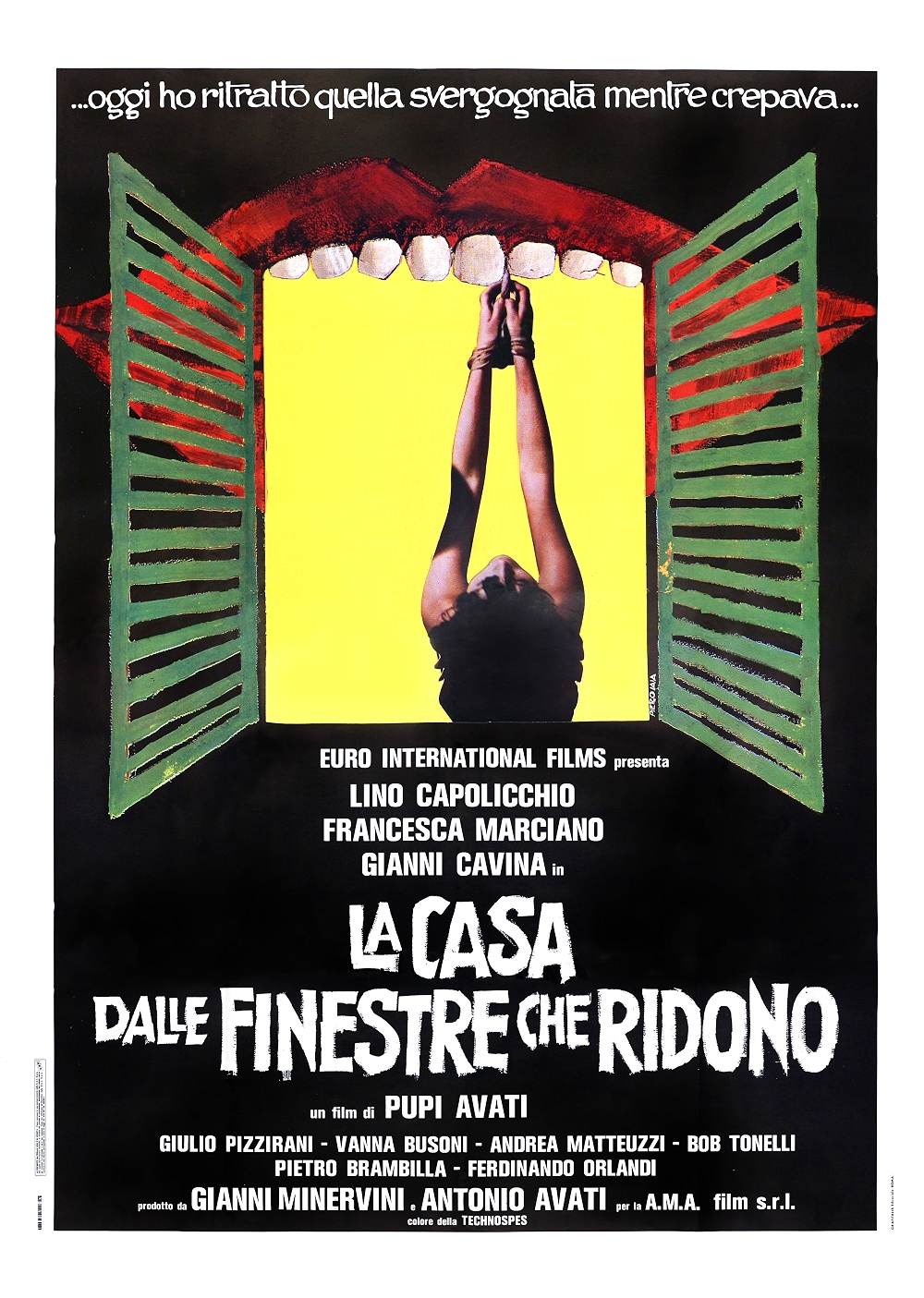
Pupi Avati isn’t one of the big names of giallo and yet The House of Laughing Windows (La casa dalle finestre che ridono) easily stands alongside or even ahead of the best of Argento, Bava and Fulci.
It’s a triumph not of concept or style, though it has both of those, but of a thousand careful craft decisions. It is simply a beautifully made film with a fabulous gothic eloquence, luxuriating in old places and odd faces as it tells a story about a picture restorer in 1950s Italy being menaced by characters from the church fresco he is working on.
There’s a hint of Don’t Look Now in the idea, but really Stefano (Lino Capolicchio), our clever, cultured but naive hero, is more akin to Edward Woodward’s foolish policeman in The Wicker Man, an outsider being conspired against by the locals in an out-of-the-way village.
Avati wasn’t a giallo guy. He turned to the genre after the failure of his previous film, House of Pleasure for Women (aka Bordella), a musical satire about sex and politics (it says here). But he sets out his stall decisively and disturbingly with a pre-credits sequence involving a dimly observed male figure, strung up somehow, being repeatedly slashed while a demented voiceover babbles on about colours coursing through veins. The victim’s? It’s not clear.
And then into the story proper and Stefano arriving in this charming village where an old fresco of the martyrdom of St Sebastian is in serious need of some TLC. “The Painter of Agony”, the locals call Legnani, a famously troubled artist who used to like painting people as they died.
Obviously no good can come from this dabbling in matters Stefano barely understands and before long a friend of his is dead, having mysterious fallen out of a window.

Avati populates his story with gothic characters. The short, impeccably dressed man, the ageing vamp who sets out to seduce Stefano, the giggling idiot who hangs around in the church creepily, the mysterious veiled woman who walks around the town as if in a funeral procession for one, the sick old dear in a darkened room with the shutters firmly closed. And there are the phone calls, from a crack-voiced stranger advising Stefano to get out of town.
In a way it’s not the “what” or the “who” but the “how” of this movie that is so impressive. Avati gets very good performances out of actors who probably wanted to ham it up a bit – giallo being giallo – in much the same way as he squeezes his visuals for their beauty, while suggesting, through askew angles and frames within frames, a sense of dislocation and observation.
The lighting, the camera, the settings are all impeccable and unlike some giallo (Argento in particular) Avati does not crash his edits, gives his characters room to breathe psychologically and isn’t after cheap titillation or sniggers. It’s a much more grown-up giallo than they often are.
Even the post-dubbing is done well, which is something of a miracle in any giallo of this era.
If it sounds a bit staid, yes, maybe it is in its earlier sections. But Avati builds the mood and carefully controls every aspect of the production in an escalation of mystery and weirdness that breaks right when it should.
The film was restored and got a 4K transfer in 2023 and it probably looks as good as when Avati and his DP Pasquale Rachini first shot it. It’s the first film of Avati’s I’ve seen and it’s grat to see that as I write (August 2025), Avati is still cranking out at least one film per year in his mid 80s. Avanti Avati!
The House of Laughing Windows – Watch it/buy it at Amazon
I am an Amazon affiliate
© Steve Morrissey 2025