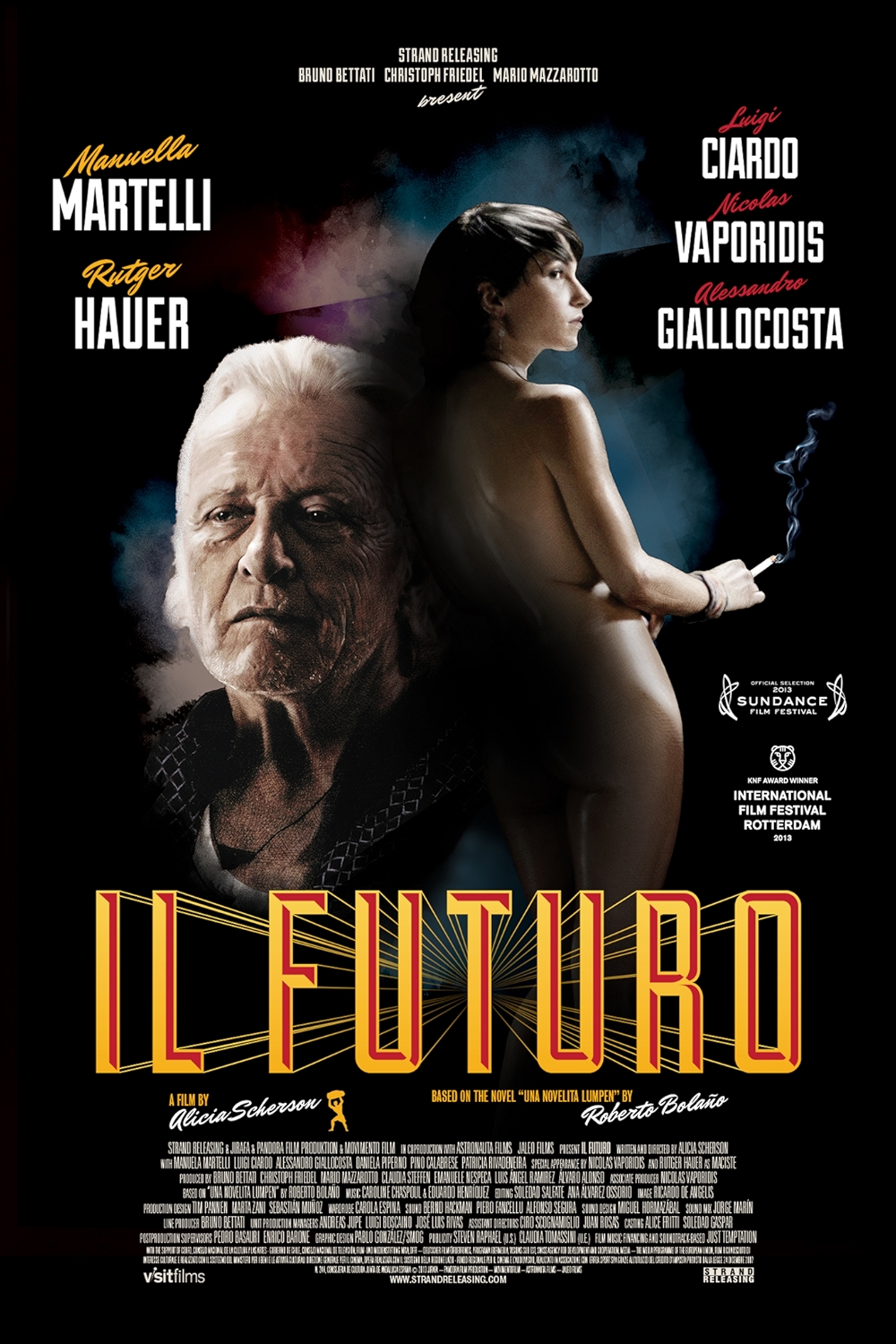
Rutger Hauer was 69 when he turned up in Il Futuro in 2013. He’d die six years later, in 2019, having clocked up another 35 or so screen credits in the interim. Always working, not always in quality product, Hauer was good even in the most disappointing films. But Il Futuro isn’t one of those. It’s a little nugget of quality, a noirish, almost giallo-ish May to December romance co-starring Manuela Martelli, who gives as good as she gets from Hauer.
Chilean director Alicia Scherson starts us off with thriller titles in screaming fonts and a blaring score before dialling things back to the deadbeat. After introducing us to Bianca (Martelli) and Tomas (Luigi Ciardo) – teenagers suddenly orphaned by the death of their parents in a car crash – she lays out a story of rudderless siblings whose lives are going astray.
Bianca, older and so Tomas’s legal guardian, reluctantly takes a going-nowhere job in a hairdresser’s, and puts her life on hold to ensure Tomas doesn’t get taken into care. Tomas, as thanks, starts skipping school and falls in with a couple of personal trainers at the gym where he increasingly is hanging out. Soon, Libio (Nicolas Vaporidis) and Boloñes (Alessandro Giallocosta) are installed on the sofa in Bianca and Tomas’s filthy place.
They are an ingratiating pair, Libio and Boloñes, and save Bianca and Tomas from a relentless diet of pizza and a life of filth by knocking up a few meals and doing the washing up. Both seem sexually interested in Bianca but what this irksome pair are really up to with all the domestic skivvying soon becomes clear. The libidinous losers come up with a plan to install Bianca in the house of a local recluse. Maciste (Hauer) is foreign – Australian? American? – an ex actor and body builder, who’s reputed to have a stack of money somewhere in the big old place he lives in with all the lights switched off – none needed because Maciste is blind.
Because Bianca can speak English, all she has to do is go there, make nice with the strange old blind guy, gain his trust, find out where the safe is and then rob him. Sleep with him if necessary, Libio and Boloñes suggest. What they mean is sleep with him first.

Things don’t quite pay off the way anyone expects. As already spoilerishly disclosed, a romance of sorts develops, between two people who in one respect are similar. They have no future (which explains the ironic title) – Maciste because he lives in the realm of past glories, which he can’t even see. Bianca because her life is on the road to nowhere.
It’s a coming of age story really, though a strange one. Bianca learns that she has a power of sorts over the old guy, who likes to oil her naked body before (off camera) doing whatever big old guys do to pretty young women. Martelli plays Bianca as an amalgam of noirish types – the femme fatale, the victim and the detective on the case. It’s a careful and unusual performance. Hauer is charismatic, as ever, but Martelli matches him, and she also has the sort of sulky, angular face cameras like.
Cliché hovers but is never quite fulfilled. As well as the acting there is much to like here. Especially the interiors of Maciste’s big dark old house, shot in the murk by Ricardo DeAngelis, who has shot all three of Scherson’s solo features (Turistas and Play are the other two), while the score (by Pablo Cervantes, Caroline Chaspoul and Eduardo Henríquez Ilic) is about as wistful as jangly, semi-industrial sounds can get.
As I write Scherson hasn’t shot a solo feature since this one, 13 years ago. Her last gig was as a gun for hire on Finnish TV show Invisible Heroes in 2019. On the evidence of Il Futuro, you’ve got to wonder just what’s going on there.
Il Futuro – Watch it/buy it at Amazon
I am an Amazon affiliate
© Steve Morrissey 2025