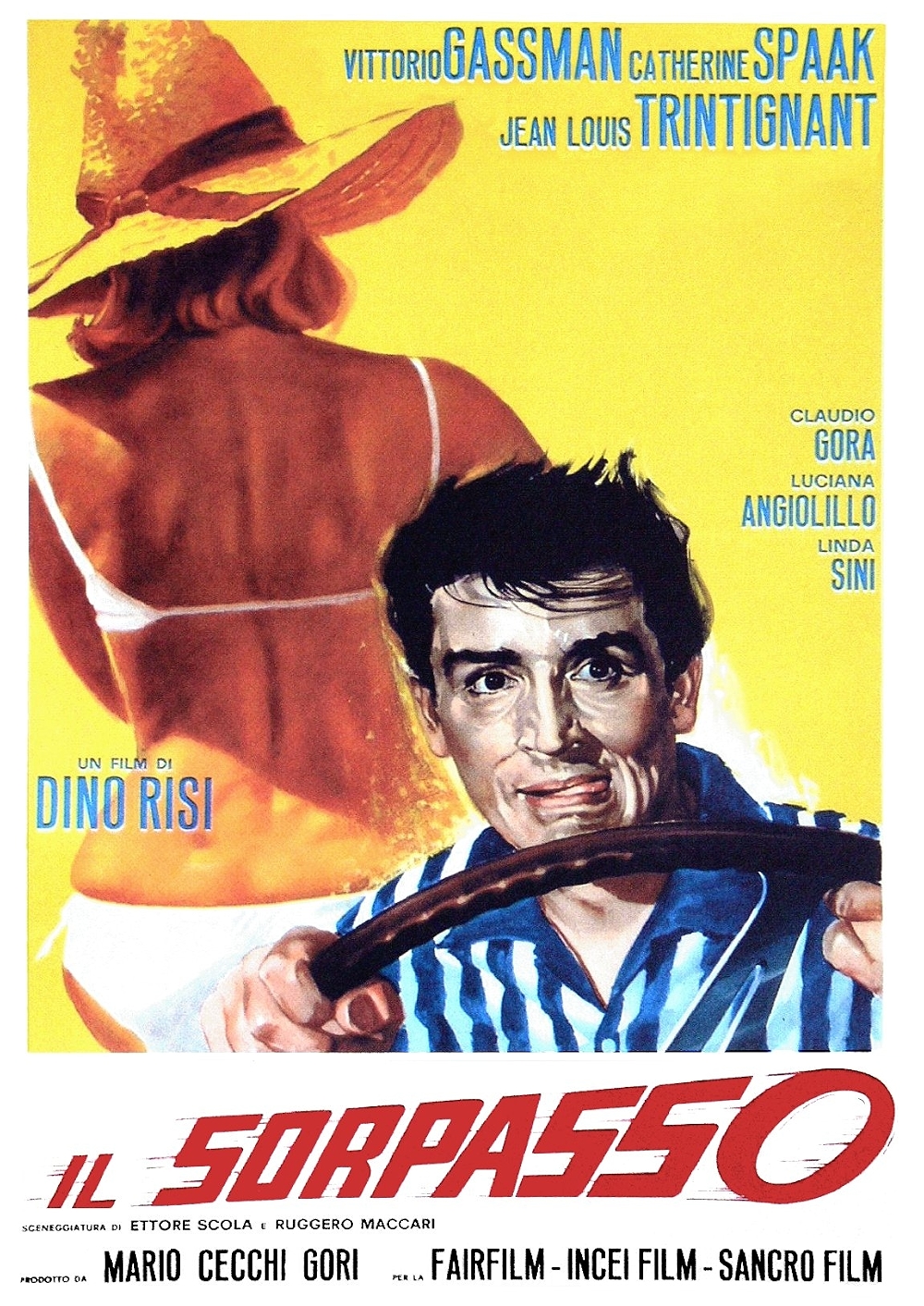
Google Translate suggests The Overtaking as a translation of Il Sorpasso. It’s not perfect – the less elegant “overtaking manoeuvre” is more precise – but it knocks the English-language title of the film, The Easy Life, out of the park.
Maybe, in 1962, when the film came out, international distributors were trying to cash in on the success of Fellini’s La Dolce Vita (which translates as The Sweet Life) from two years earlier. Any port in a storm, I suppose. Foreign-language movies have always been a tough sell in countries where English is the first language.
Though both films are in black and white, the comparisons pretty much stop there. Il Sorpasso is a comedy, a kind of Odd Couple meets Withnail and I, with Vittorio Gassman as the Withnail character and Jean-Louis Trintignant as I.
Both Martin Scorsese and Alexander Payne have borrowed from it – Scorsese for the Paul Newman/Tom Cruise relationship in The Color of Money and Payne for Paul Giamatti and Thomas Haden Church’s one in Sideways. The brash guy and the thoughtful one. The one who gets stuff done and the one who watches life go by. Crass and elegant. Working-class instant gratification versus middle-class deferrment – Bruno (Gassman) drives around in an open top Lancia; Roberto (Trintignant) is studying to be a lawyer.
What marks the film out, and caught the eye in particular of Payne, is the way the film is constructed of almost hermetically sealed stories – one follows the other, all perfectly sculpted. They could almost be juggled around and the film would still work. Some of these little chapters last minutes others only seconds, but all have, as Payne puts it, “beginnings, middles and ends”.
There is no plot as such, in other words. At the outset Bruno and Roberto are thrown together because Bruno needs to call someone and Roberto offers him the use of the phone in his apartment. As thanks, Bruno offers to buy Roberto lunch, and off the two set together, in Bruno’s Lancia, Bruno driving like the maddest stereotype of Italian driving, honking his horn, insulting other road users, catcalling girls, shouting at cyclists, giving people the finger as he overtakes and keeping up a running commentary about whatever is passing through his mind. Pure, unfiltered id to Roberto’s superego, if we’re getting Freudian about it.
Though Roberto is slightly appalled by Bruno, he cannot deny that this guy has something. Bruno is rude, brusque, a queue-jumper, does not play by the rules. But he’s hellishly popular. This is most obvious when they stop off at Roberto’s uncle and aunt’s place, a frosty and slightly patrician couple Bruno has charmed down from the trees within seconds.

One thing it does share with La Dolce Vita is that it’s determinedly modern. Though Fellini was more ambivalent about the go-getting Italy of young people dancing to pop music than director and co-writer Dino Risi is. Here, new is good and the old needs to get out of its way.
There’s a little joke very early – Bruno gestures towards a picture of Brigitte Bardot he has on his dashboard (“Nice looking babe, eh?”), a little reference to the affair Trintignant is supposed to have had a few years earlier with BB. It helps build him up a touch, which is useful, because in every other respect this is Gassman’s film. As the politically incorrect, even for those times, and yet massively charming Bruno, Gassman has this role absolutely down. His performance is full fat, high octane, storm force, all the bells, all the whistles.
It’s usually described as Risi’s masterpiece and even if you don’t go for the relationship – though it would be hard not to – just in terms of technical pizzazz this film does great things. Alfio Contini’s sparkling black and white cinematography makes the most of Risi’s spectacular backdrops (those empty Rome streets, that seaside, the beautiful house where Roberto’s relatives live) and Riz Ortolani’s parping, chintzy score situates it in the early 1960s and keeps the mood light.
There is a dark subtext in there. Bruno’s life lived at full volume in the here and now has its downside. A failed marriage. No money. A daughter (Catherine Spaak as Lili) he barely knows. This bubbles along as a barely there subtext. Until, in the film’s closing moments, the film’s title re-asserts itself in a way that’s shocking yet absolutely the way it has to be.
Il Sorpasso – Watch it/buy it at Amazon
I am an Amazon affiliate
© Steve Morrissey 2025