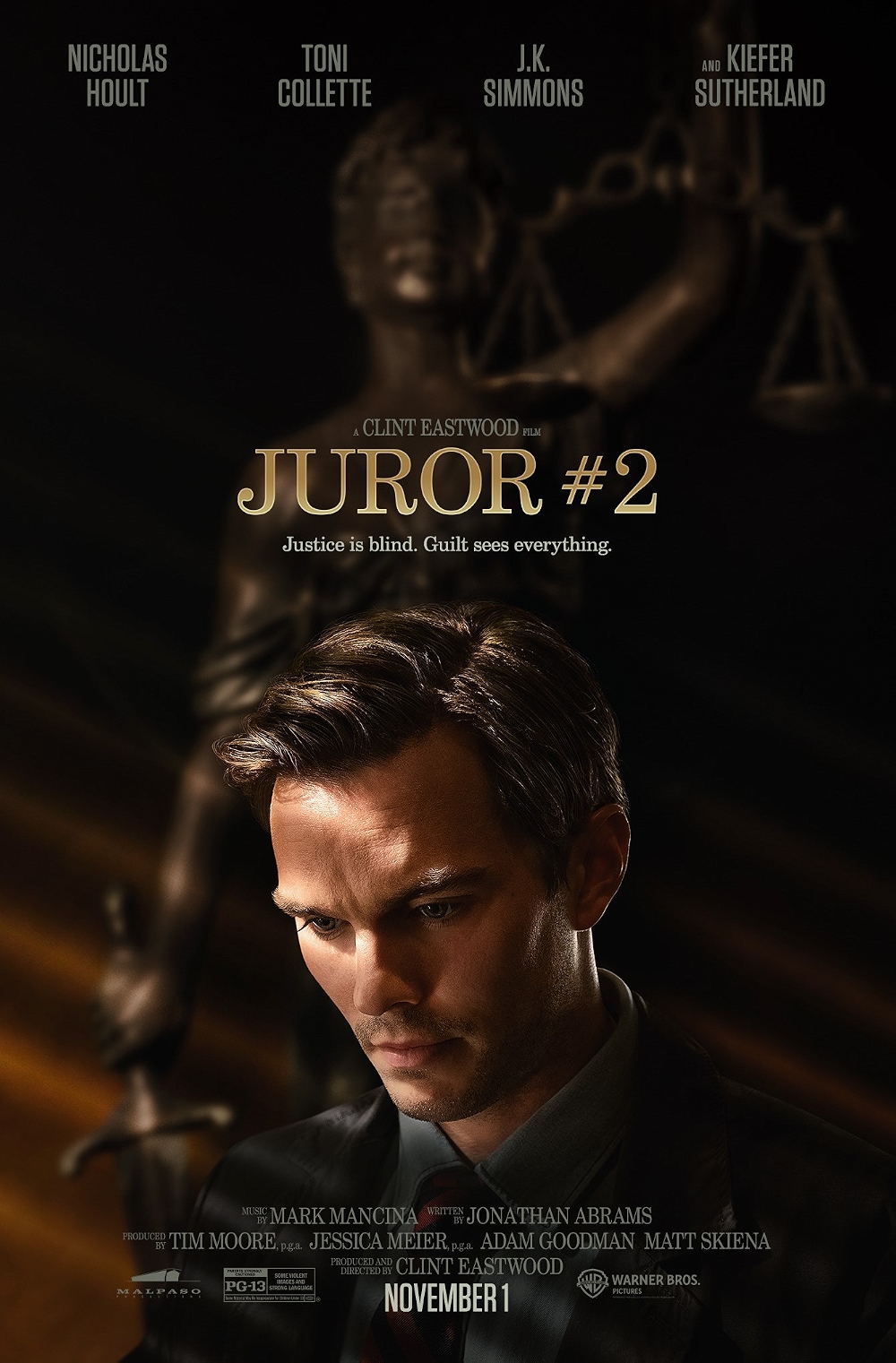
Juror No. 2 is a rare thing these days: a good old-fashioned courtroom thriller. Director Clint Eastwood, 93 when he made it, does it old-style, the way his mentor Don Siegel might have done it, and the result is a streamlined drama revolving around a central dilemma, just the sort of lean and fast second feature Siegel might have cranked out in the 1950s.
It is a very neat plot, which I’m not going to ruin by explaining. What I can say is that Nicholas Hoult is the titular juror, a man who suddenly realises mid-trial that he can free the man accused of murdering his girlfriend at a stroke, but only if he speaks up and incriminates himself.
Because Justin Kemp (Hoult) has a wife at home (Zoey Deutch, very good in an unflattering role) who is very far along with a difficult pregnancy, he’s doubly reluctant to pipe up. Instead he launches a solo endeavour in the jury room to get the accused man, James Sythe (Gabriel Basso), off the hook, re-running the 12 Angry Men strategy to sway his fellow jurors, almost all of whom are convinced that Sythe is their man.
Can Kemp convince them without landing himself in trouble? At some point is his conscience going to override his urge to protect his family? Hoult wears all this on his face without histrionics taking over. Very nicely done – melodramatic minimalism you could call it.
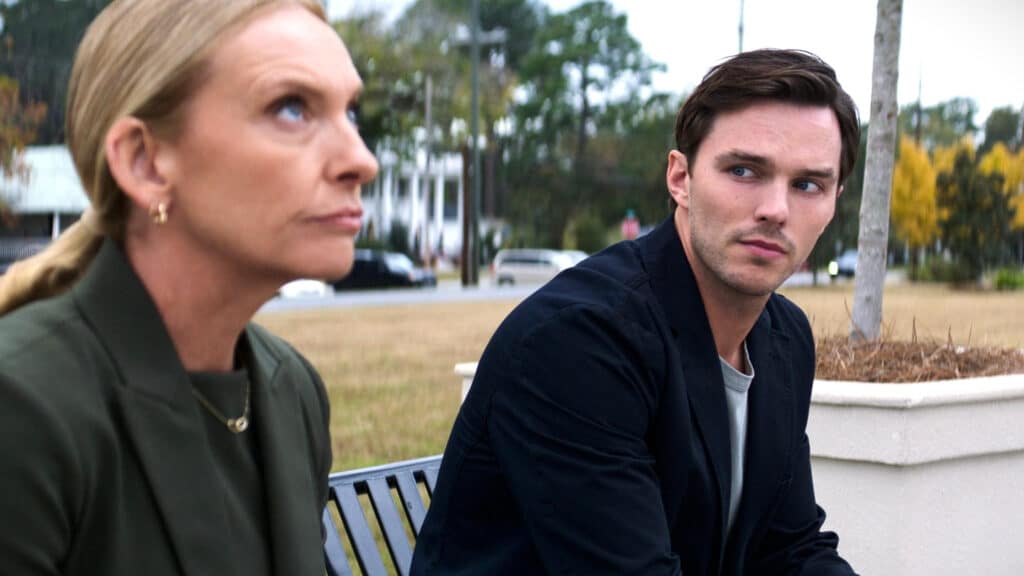
Because it’s Eastwood, there are names in the cast – Toni Collette as the prosecutor who becomes increasingly convinced something isn’t quite right. JK Simmons as a retired cop on the jury also certain the story doesn’t quite add up. Leslie Bibb as the jury foreperson. Kiefer Sutherland as Kemp’s Alcoholics Anonymous sponsor, and, usefully, a lawyer.
Most of them are neither here nor there, apart from Collette, who increasingly becomes a detective of sorts, in the film’s most implausible turn of events. There are a few of these, and it’s best to ignore them if you want to get maximum enjoyment out of Kemp wriggling on a pin. Like the fact that the prosecution’s case relies on courtroom procedure that’s more 1950s Hollywood than current practice, or the accused man’s defence lawyer (played by Chris Messina) not asking questions so obvious that they could be written in black block capitals on the courtroom wall.
Eastwood maximises the potential for culture wars debate by presenting James Sythe as the sort of man’s man – drinks, swears, is aggressive, has a beard and neck tattoo – whose masculinity seems to have him tagged for the crime. But Eastwood ultimately takes a lofty view. This is a drama in which the the system as it’s meant to be is fine, it’s the system as it actually is that’s under suspicion. Justice, ultimately, is what Eastwood is interested in, and one way of watching the movie is to see Collette’s lawyer figure as the latest iteration of the Eastwood of yore strapping on the guns and heading out to mete it out.
The confirmation bias of juries. The unhelpfulness of “going with your gut”. The unwelcome input from sources outside the courtroom – social media, Eastwood probably means you – there is a lot more going on here than you might expect from a film-maker whose next significant birthday is his 100th.
Warner Bros obviously thought the director’s age counted against him and didn’t originally give the film a theatrical release. This in spite of the fact that Eastwood has delivered hits for the studio for over 50 years – most recently with 2018’s The Mule; 2021’s Cry Macho less so – and that he’s one of the names who can still get the oldies out, while the still fairly babyfaced Hoult brings an audience dynamic of his own. In the end Warners relented, gave the film a limited release and the film did OK enough.
Eastwood, 95 at the time of writing this review, has just announced he’s working on a new movie and that he’ll keep on going “until I’m truly senile… Sure there are directors who lose their touch at a certain age, but I’m not one of them”. Fighting talk.
Juror No. 2 – Watch it/buy it at Amazon
I am an Amazon affiliate
© Steve Morrissey 2025