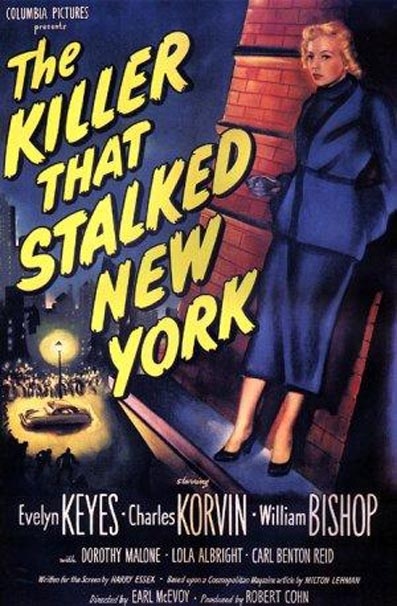
You don’t need to know that the smallpox vaccine was first developed in 1796 but it adds a layer to The Killer That Stalked New York, a pandemic thriller from 1950 inspired by a real-life outbreak of smallpox in New York in 1947. That it did not become more widespread is thanks to thanks to swift action on the part of the authorities, who rolled out a massive vaccination campaign.
Evelyn Keyes plays our Patient Zero, Sheila Bennet, a woman newly in from Cuba, where she picked up smallpox though she doesn’t yet know it. She also picked up something else: a consignment of hot diamonds, intending to smuggle them into the USA in person. But, realising a “T Man” – a treasury official – was on her tail, she mailed them instead, to her husband, who intends to fence them.
In case the crime subplot isn’t enough to capture an audience’s attention, there’s another wrinkle in the relationship between Sheila and handsomely roguish husband Matt (Charles Korvin): he is having an affair with Sheila’s younger sister Francie (Lola Albright), which will in the fullness of time all come out in the open, much as Sheila’s smallpox will.
For the most part, though, this is a story of those in positions of power working for the greater good. Much of the focus is on kindly doctor Ben Wood (William Bishop) and his reliable nurse, Alice Lorie (Dorothy Malone), who find themselves at the centre of a smallpox outbreak after Alice visits the surgery and unawares passes smallpox on to a little girl already sick with whooping cough.
The diamonds can be seen as an ironic metaphor for the more significant payload Sheila has smuggled into the country, and for a while the film gives both strands equal weight, each allowing the other to leapfrog forwards in plot terms. Eventually one has to yield and in the end it’s the diamond story, especially once the compassionate doc and his dutiful nurse have turned detective to try and track down the infectious Sheila, and the authorities have swung into action, in touching displays of civic-mindedness that seem, to today’s eye, implausible.

Personal fecklessness and institutional virtue is the story here, with Sheila, Francie and Matt the most obvious examples of irresponsibility. In meetings between city, state and federal officials, the greater good is the overriding concern. There is more than a faint whiff of the propaganda machine in action.
There are, however, vague attempts at even-handedness – a debate among concerned citizens in a barber shop about the ins and outs of vaccination. An anti-vaxxer shouting “Nobody’s gonna put no germs in me and my family,” to a medical team. A “Vaccine Is Poison,” placard being waved about by a demonstrator.
Clearly conscious that she’s going to be little more than ornamental, Dorothy Malone overacts early on, standing out in a cast who for the most part give themselves to the story. Individuals, apart from sick Sheila, are not what this story is about.
Props to the make-up department, who make the sick woman look truly ghastly as she gets more unwell. Sweaty and swarthy, Sheila looks really ill. In the real outbreak 12 people were infected and two died after city and federal official inoculated nearly 6.5 million people to halt the disease’s spread. It seems like overkill but take a minute to look at pictures of people with smallpox and you might understand what the panic was about.
Talking of which, Panic in the Streets, another pandemic thriller, came out the same year. That was concerned with pneumonic plague, which last broke out at epidemic level in the USA in 1924. That’s right, plague in California in the same century that fellow Americans went to the Moon. How lucky we are.
The Killer That Stalked New York – Watch it/buy it at Amazon
I am an Amazon affiliate
© Steve Morrissey 2026