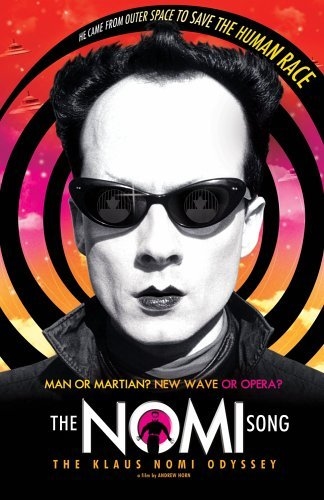
A balding freak in white scare make-up who wore a geometric tuxedo and sang in a six-octave voice that ranged from a yelp to a bellow, Klaus Nomi’s strange, eccentric, short life is celebrated in The Nomi Song, a hymn to the artist rather than the man, though the man does keep peeping out from behind the make-up.
To non-fans, Nomi may only have been seen once, providing backing vocals to David Bowie on Saturday Night Live. Others may have caught the odd moment here and there, a rendering of Purcell, or maybe some throwaway high-camp Eurotrash, or a cheesy 1960s ballad, with Nomi swooping and yowling over whatever he was tackling, shifting octaves with ease, a strange presence and a hard sell.
The hard sell is the story of Nomi’s professional life, which director Andrew Horn pieces together with a lot of archive footage and good talking-head contributions from the people who knew him, plus some off-screen, and rather sweet, reminiscence from his proud Aunt Trude, who knew her nephew was odd but seems to have just rolled with it.
It’s the story of the German boy who wanted to get into opera from an early age but couldn’t find anyone who would tutor his contralto (high) voice. So instead Klaus Sperber, as he then, got a job as an usher at the Berlin Opera, where he sang to fellow ushers and backstage crew.
Eventually, rolling the dice and taking his chances, he relocated to New York where, in the East Village in the 1970s, a broke German immigrant with pastry skills could get by. It was at the New Wave Vaudeville show where Klaus first publicly aired the Klaus Nomi persona. Wearing a see-through cape and heavily made up, he sang an operatic aria in imitation of Maria Callas. Everyone else on the bill that night was larking about, remembers musician Page Wood, but Nomi wasn’t. The crowd was thrilled. A star was born.
From here it’s two steps forwards one step back. Getting a band together and getting some gigs, the New York art crowd wowed by him, the New Jersey roadhouse crowd barracking him relentlessly, Nomi picking up a manager (Ron Johnsen) and an art director (Wood) as he attempted to hew a career from a largely indifferent zeitgeist.
He dropped his original musicians and tacked towards the mainstream – relatively speaking – to try and break through. Nomi was now in a straight “rock band playing songs,” remembers Wood disdainfully. “It was still great.”

He was weird. But that was the persona. In archive of Nomi out of drag and make-up, he comes across as a thoughtful and reserved young man. In his full pomp (triangular tuxedo, hair gelled into spikes, stylised, almost clown, make-up) he came across as something from other space. Sometimes the two personas collide, like in the TV interview where Klaus, in full regalia, explains quietly how to make a lime cheese cake.
He was “one of the loneliest persons on Earth,” remembers Johnsen wistfully, and was immensely frustrated too. Even as everything began to take off – mobbed cars, Japanese Vogue, turning up on the TV news – he still couldn’t get a decent record deal, because record companies didn’t know how to market him.
It’s a lovely and tender portrait of an artist who no sooner eventually started to break through – in Europe at first, then back in New York – than he contracted what was then known only as “gay cancer”. He was dead of Aids, aged 39, in 1983. It was a solitary death, barely visited on his death bed by his friends and bandmates, some of whom had fallen out with him, some of whom were scared they’d get the disease too.
It’s also a lovely and tender portrait of a place and a time full of promise, when economic circumstances allowed freaks and misfits to live in inner-city New York, where in a hothouse of creativity whole loads of weird and wonderful (and phoney and awful) stuff was produced.
The film goes out on a high, with Nomi singing “What power art thou who from below”, retitled as The Cold Song, the standout work from Purcell’s 300-year-old opera King Arthur. Nomi, in front of a full orchestra, in a ruff, breeches and white make-up, sings it like his life depends on it. Once finished, he stands there impassive and robotic as the audience’s applause slowly starts to swell into a roar. Fade to black.
The Nomi Song – Watch it/buy it at Amazon
I am an Amazon affiliate
© Steve Morrissey 2025