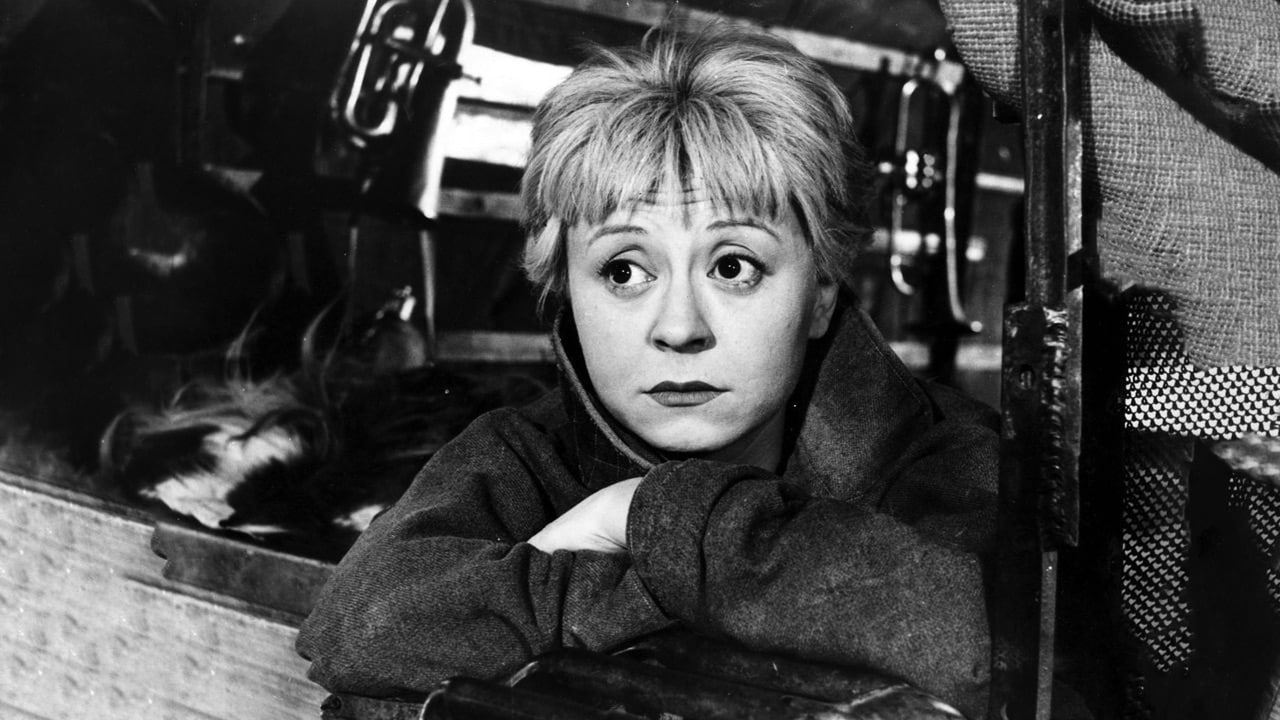
The simple Italian led astray by an egotistical monster. Who could Federico Fellini have had in mind when he was making La Strada in 1954?
This, according to all the books, is where Fellini the neorealist ends and Fellini the fantastical begins, in a movie about a strong man “buying” a halfwit daughter off a poor woman and then touring Italy with her as part of his act.
It was Pope Francis’s favourite movie and directors as diverse as Peckinpah, Kurosawa, Konchalovsky and David Cronenberg have all sung its praises. Fascinatingly, both Bob Dylan and Kris Kristofferson have claimed it as an influence on key songs – on Hey, Mr Tambourine Man and Me and Bobby McGee. For what is in many respects a fairly simple movie, La Strada has managed to be quite a lot of things to quite a lot of people.
“A complete catalogue of my entire mythological world,” Fellini once called it. And it is all here, at its most basic, all the stuff we’d later associate with him, colour to one side. The circus, the phantasmagorical, a love of the iconographic image, Catholicism, the simple peasant life, the wisdom of idiots and children plus characters who arrive on screen as if they had escaped from a tarot deck.
Fellini based the dumb halfwit on his own long-suffering wife, Giulietta Masina, who plays simple Gelsomina as about 75 per cent Harpo Marx. It’s a canny performance. Like Harpo, wide-eyed blonde Gelsomina – treated like dirt by the gruff Zampanò – may not be as dumb as she looks. Her childlike persona may be a way of moving through life unmolested. Anthony Quinn’s Zampanò is similarly ambiguous: the womanising brute might have something resembling a heart beating away inside the big chest he regularly wraps in chains, before breaking free spectacularly in front of a boggle-eyed public.
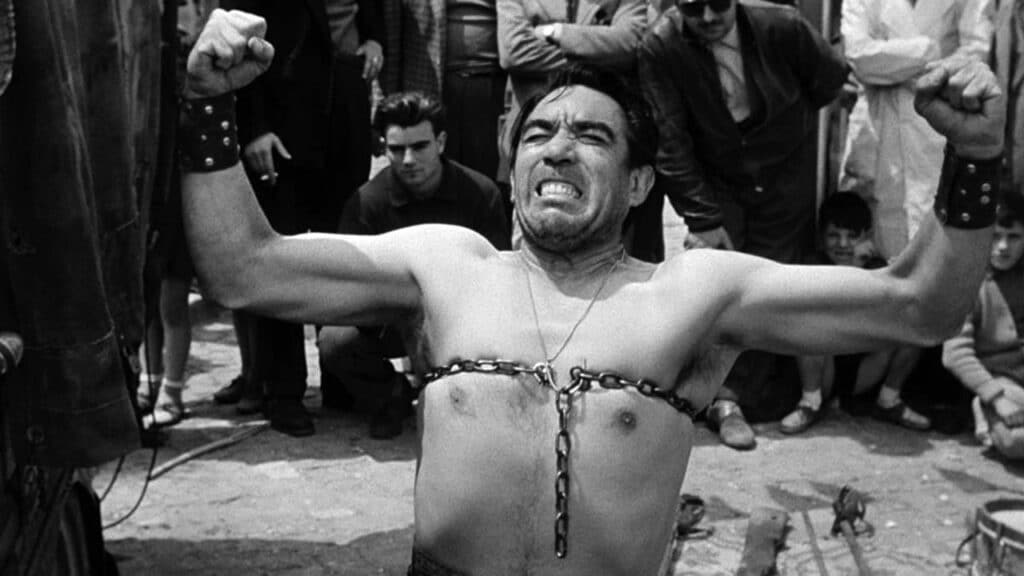
In fact the public isn’t boggle eyed and the escape isn’t that spectacular. Italy needs no strong man (no names mentioned) and the feat of strength is all for show. Zampanò is one of the last of a dying breed of itinerant entertainers in a world that no longer values them – people have the movies and TV. The peasants he entertains also inhabit a fast-disappearing world, where horizons stretch no further than the village boundary, children grow up to do what their parents did, celebration is communal and the influence of the church massive.
If Gelsomina is Italy, then her meeting with the Fool, a trumpet-playing wire-walker who offers her a chance of escape, is the country’s exposure to the blandishments of what Fellini would later examine more closely in La Dolce Vita, which translates as “the sweet life”. If you only know Richard Basehart from his many, many stern-faced roles (in Voyage to the Bottom of the Sea, He Walked by Night or Moby Dick, for example), his performance here is eye-opening. With a fluting voice, physically nimble and playing a bird-brain, Basehart’s Fool is the flipside of Quinn, who is all masculine heave.
The three central figures are archetypes, Air (the wirewalker), Earth (the strong man) and Water (Gelsomina), and though all three are impressive, Quinn’s performance is all the more remarkable when you factor in that he was playing Zampanò at in the early morning then playing Attila the Hun for another director in the afternoon.
This is not Fellini’s best film. Though it has lovely visuals thanks to sharp and clear cinematography by Otello Martelli, and a sympathetic Nino Rota score, it’s not quite as loose as Fellini would later get. He’s still hemmed in a touch by neorealism. The initial reception to it was hostile – Italian critics were particularly ungenerous – but then it went on to win the Oscar for Best Foreign Language Film. As a possible consequence of that it’s often rated very highly (I suspect by people who could use an off-the-peg opinion). But better than 81/2?
La Strada – Watch it/buy it at Amazon
I am an Amazon affiliate
© Steve Morrissey 2025

