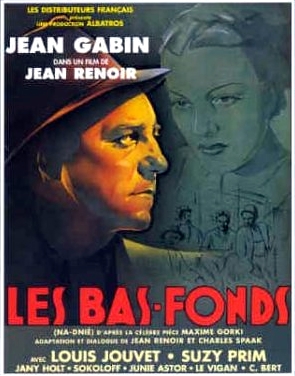
Beautiful but basic, Jean Renoir’s 1936 movie Les bas-fonds (aka The Lower Depths) isn’t the only adaptation of Maxim Gorky’s stage play. Among many, many other people, Kurosawa did a version in 1957, sticking closer to Gorky’s 1902 original, something Renoir himself later acknowledged he himself should have done. Kurosawa’s is the better version, he reckoned.
Renoir’s reason for fiddling with the story was, he said, to get around the casting of the actresss Jany Holt – who he thought was “terrible” but was forced to accept – rewriting around her to diminish her role.
There is room for the experiment. Gorky’s original plot is full of people, very Russian, but it constellates around Pépel, a smalltime thief who gets friendly with a big-stakes gambler who has lost it all. Meanwhile, Pépel is trying to squeeze himself out of a relationship with his landlord’s wife while also attempting to get close to her sister, which is the role Holt plays.
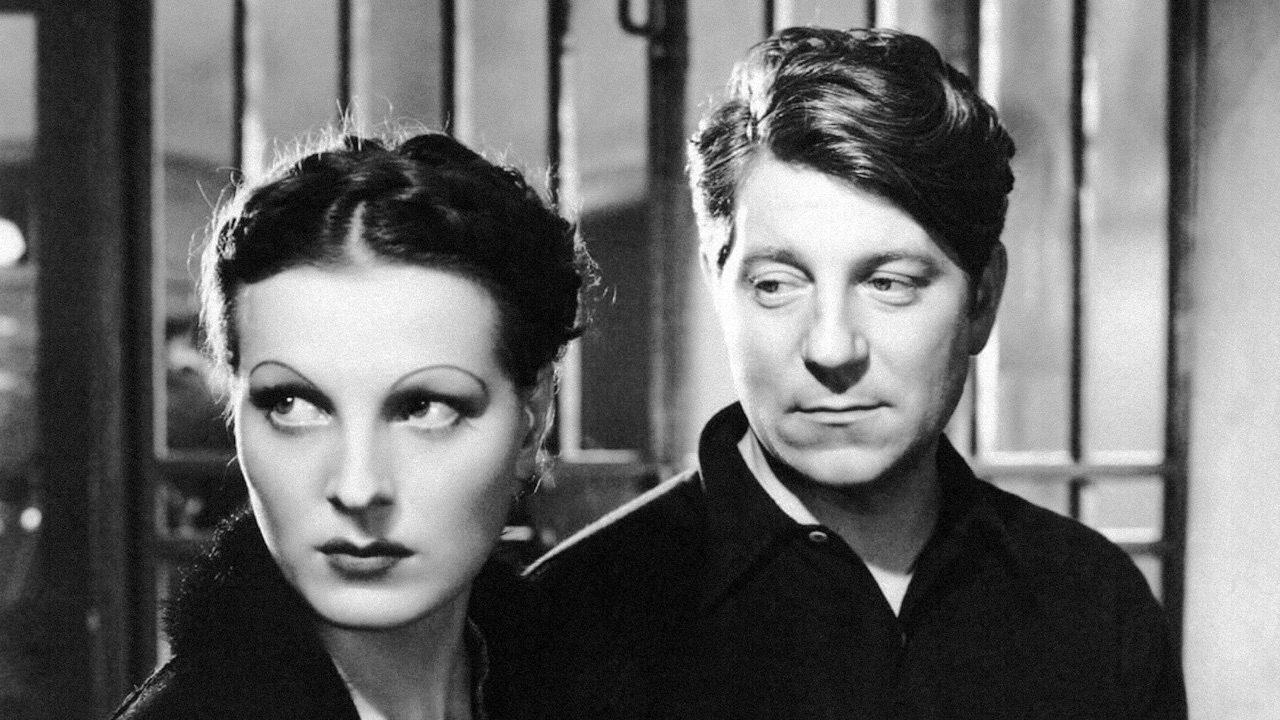
It’s not quite a poetic-realist movie. It’s not quite picturesque enough, though it’s plenty pretty if that’s what you’re looking for, and Renoir’s camera movements are gorgeously fluid, his lighting carefully precise and his film full of long tracking shots and bravura movie-making stuff, if that’s your thing.
But it’s a touch dull, sad to relate. Some of this is the Holt problem but most of it isn’t. There just isn’t much of a story to grab hold of. Jean Gabin burns calories as the charismatic Pépel, crook, womaniser, friend of the common man and the toff alike. Louis Jouvet also sparkles away as the Baron, the inveterate gambler who has lost everything and is about to kill himself when he finds Pépel burgling his home.
The men see something they recognise in each other – their own weaknesses reflected, maybe – and form an instant bond that is the film’s strongest suit. A bromance of sorts develops, and when the Baron eventually moves into the flophouse where Pépel lives with fellow ragamuffins, it is confirmed.

The film is at its most Russian here, in the detailing of the lives of the fellow slum dwellers. The drunken accordionist, the wildly romantic actor, the sentimental actress and her love of trash novels, the sick woman who will die before the end. Plus Kostylev (Vladimir Sokoloff), the skinflint landlord, Vassillissa (Suzy Prim), the wife desperate to remove her husband from the equation and make off with Pépel, not forgetting Natacha (Holt), the sister who Pépel wants more than anything in the world.
The film’s depiction of the grinding awfulness of poverty – it’s not called The Lower Depths for nothing – is undermined by Renoir’s love of a pretty picture. He vacillates. Poor look grim in his depiction of it, but Renoir also can’t resist dotting it with beauty. His lighting in particular is relentlessly spectacular. But the Baron’s arc – he likes it in the flophouse, where life is simpler and people less false – entirely undermines the point of the film. Gorky was trying to say that we defend ourselves against the worst aspects of life with silly self-deception; in Renoir’s version, the self-deception looks like it’s a goal worth pursuing.
Was this movie an influence on David Lean’s 1940s Dickens movies, Oliver Twist and Great Expectations? I can find no suggestion that it was though the chiaroscuro looks and Renoir’s Dickensian characterisations are not a million miles away from Lean’s. Either way it’s minor Renoir but worth seeking out for its technical brilliance if nothing else, which is all the more apparent if you’re watching Gaumont’s 4K restoration, which is a thing of beauty.
Les bas-fonds aka The Lower Depths (Renoir and Kurosawa versions) – Watch/buy at Amazon
I am an Amazon affiliate
© Steve Morrissey 2025