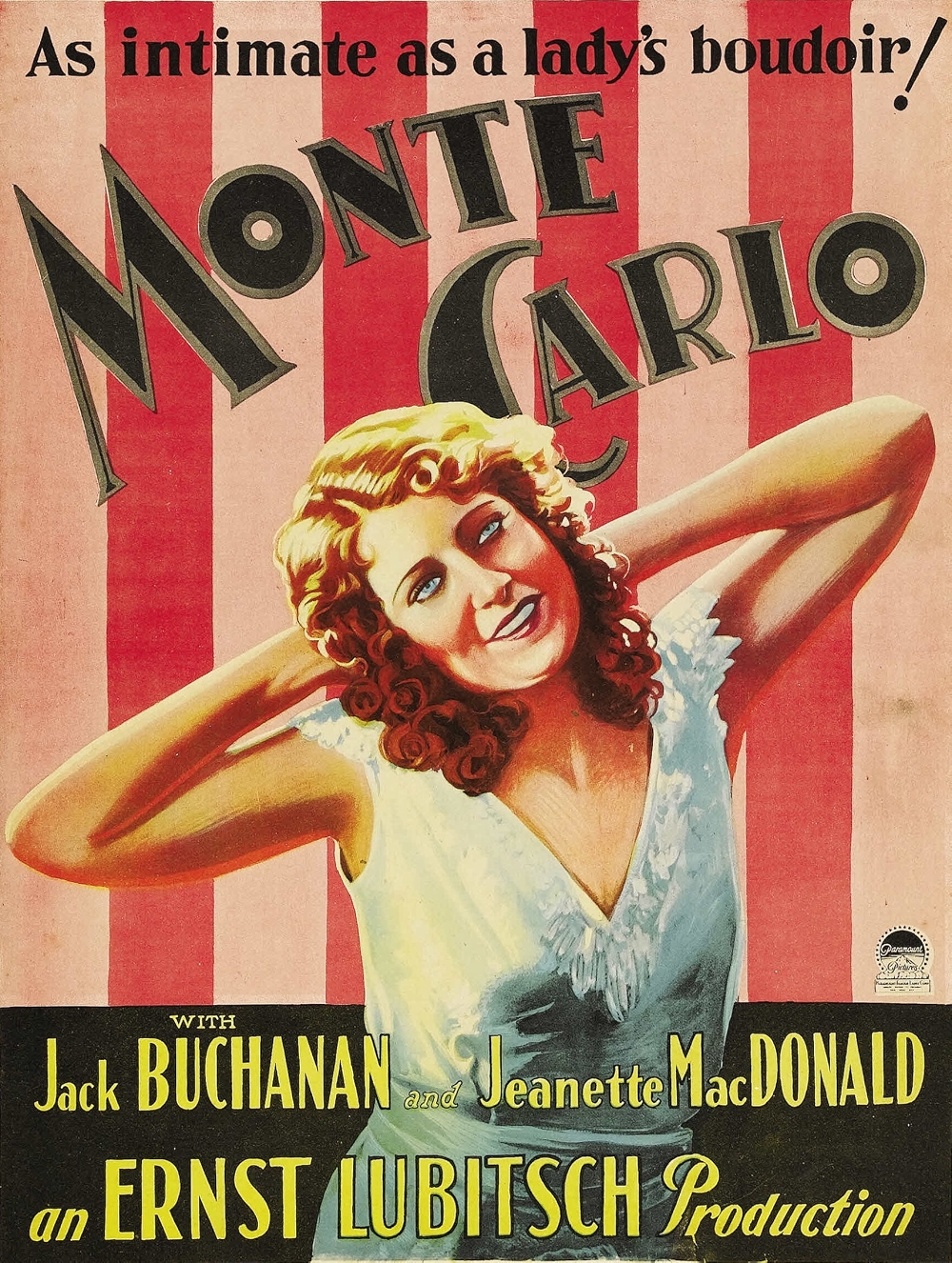
Jolly and bright and unfashionable in so many ways – which just makes it better – Monte Carlo is also an Ernst Lubitsch film and so bubbles along like a thing demented. It has entirely uncool stars like Jack Buchanan and Jeanette MacDonald in the leads and a storyline taking repeated runs at the mistaken identity idea.
MacDonald later became known for the films she made with Nelson Eddy, and is all the better without him here, as a flappy, silly, delightful countess who runs away on her wedding day from the oafish daddy’s-boy duke she’s meant to be marrying. In opening scenes that are textbook “Lubitsch touch” stuff and could come from a silent movie, we learn that this has happened before. Resigned to it, Duke Otto gathers himself together and heads off to Monte Carlo to find his fugitive bride-to-be and bring her back.
But in the interim the broke Countess Helen has taken up with Count Rudolph, a playboy gambler who was watching from a discreet distance as Helen gambled away the last of her money and is now posing as a hairdresser to get closer to the woman who has turned him into a hopeless lovelorn lapdog.
Eventually, of course, Otto will turn up and there’ll be a showdown of sorts, true identities will be revealed, Helen will let on that she is in fact broke and living on her reputation… and so on.
Now and again Lubitsch pauses the action for a song, and MacDonald obliges with that dated semi-operatic voice of hers. If there are still any out there, MacDonald fans will recognise Beyond the Blue Horizon, the song that became her theme tune.
MacDonald’s playing is light and loose as a liberated woman who wants things her own way, even though her star appeal today is hard to fathom – blondes like her were ten a penny in the 1930s. But then you could say the same about Buchanan, who wasn’t much of a singer or dancer but held his own against Astaire and co in The Band Wagon, and does the same here.
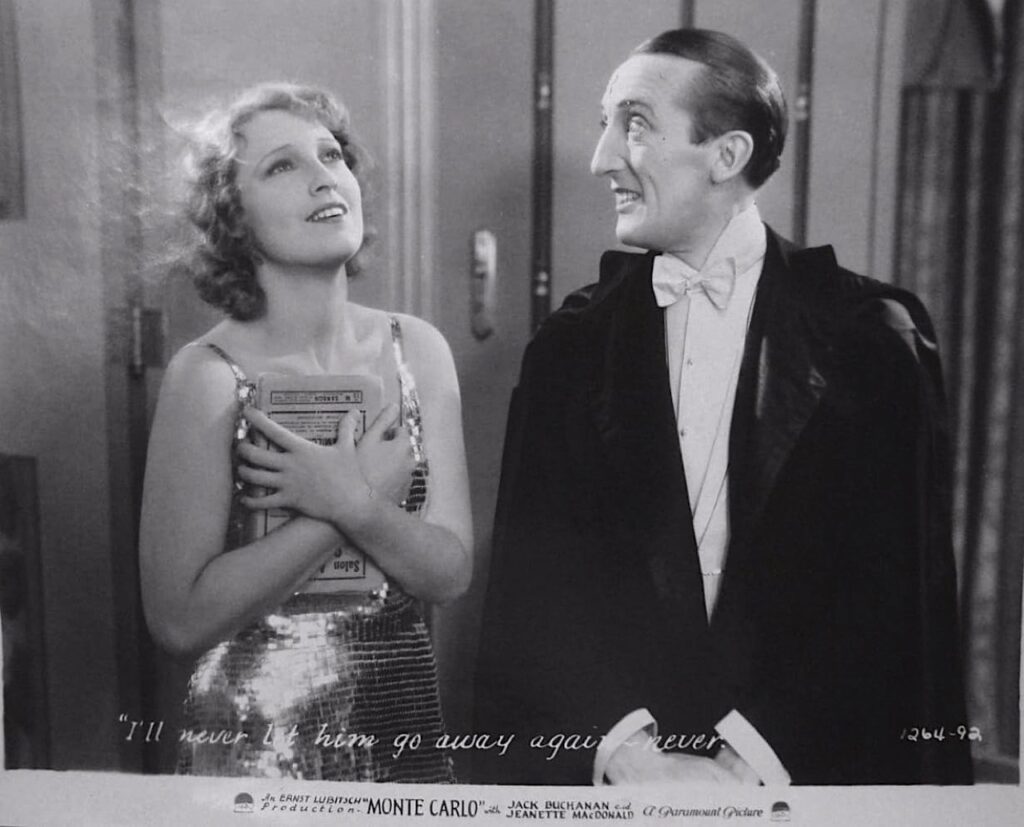
Talking of neat performances, ZaSu Pitts as the Countess’s down-to-earth maid Bertha adds comedy value with reaction shots that are mostly deadpan disbelief at the nonsense these high-born idiots get up to. She’s us, in other words. And stealing the limelight every time he’s on screen (which isn’t very often), Claud Allister as Duke Otto, who plays the jilted man as an absolute buffoon who’s a testament to generations of inbreeding.
As so often with Lubitsch, the action takes place in a Hollywoodised version of Old Europe, where the quaint ways of various old countries are held up for affectionate appraisal. Aren’t they funny, those Europeans, and also rather cute!
Lubitsch’s “touch” is all narrative tricks – shorthand – he learned from the silent era. Made in 1930, Monte Carlo was shot in both silent and talkie forms, because so many film theatres didn’t have talkie equipment yet. Though not remembered for his musicals these days, that’s what four of Lubitsch’s first five sound films were (The Love Parade, Monte Carlo, The Smiling Lieutenant and One Hour with You, if you’re counting).
This is an unexpectedly enjoyable little film, halfway along the road to being a musical but with enough action and humour for those who get twitchy when everything pauses for a song. Lubitsch rounds everything off with scenes set in an opera house, where the singer on stage is playing a common barber posing as an aristocrat. Nudge, wink, I’ve done an update on an old operatic standby, Lubitsch is telling us, letting us in on the joke.
Monte Carlo – Watch it/buy it at Amazon
I am an Amazon affiliate
© Steve Morrissey 2026