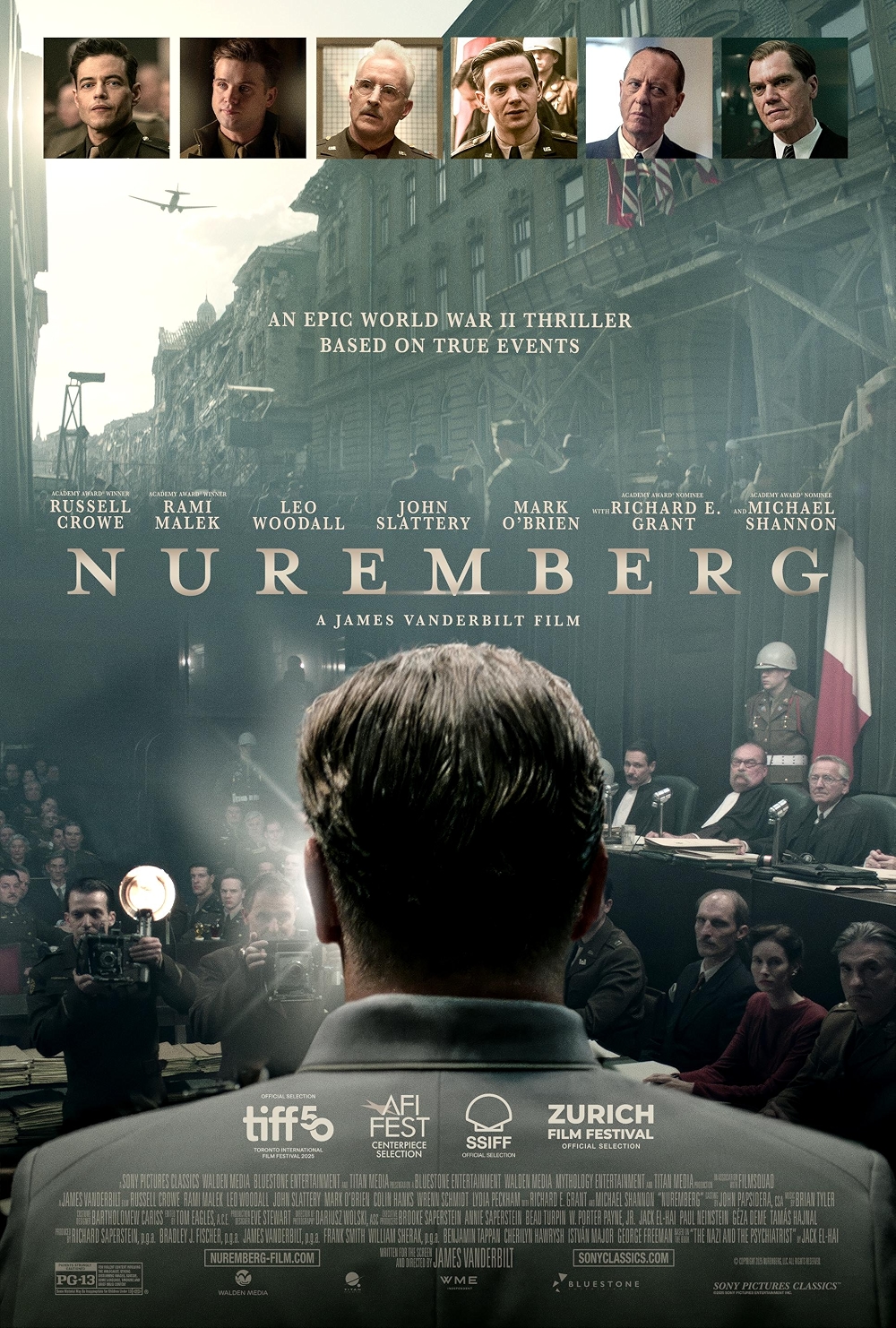
Would you have guessed, when Russell Crowe was appearing in Australian TV soaps like Young Doctors and Neighbours that one day he’d be playing the lead in Nuremberg? And that he’d have gone from being a slim, handsome chap with tousled hair to someone who could effortlessly play Hermann Göring, sour-faced, fat and oozing self-regard.
The self-regard maybe – actors, huh – and transformations are what actors are all about, after all. Wibbling to one side, Crowe’s performance as Göring, Hitler’s Supreme Commander of the Air Force and an unrepentant Nazi right to the last moment, is the making of James Vanderbilt’s film.
Set at the Nuremberg War trials in the aftermath of the capitulation of Germany, the story is told through the eyes of the psychiatrist appointed by the Americans to assess Göring and his fellow Nazis, to find out what made them the men they were and to keep them alive in the face of the constant threat of suicide.
Much of the foundation of the so-called “rules-based order” of the post Second World War was laid at Nuremberg, which wished into existence a set of laws that hadn’t existed until that moment – war crimes, crimes against humanity etc – laws that Göring and his crew (Hess, Streicher, Dönitz, Ley et al) refused to accept as legitimate. As far as they were concerned they were behaving completely lawfully when sending millions to their deaths in the gas chambers, footage of which is presented at the trial in a moment designed to shock the Nazis into contrition (and may shock modern viewers all over again).
Much of the film is Rami Malek’s shrink, Douglas Kelley, and Crowe’s haughty, sly, clever Göring locked together in doctor/patient consultation, until the film eventually shifts into courtroom-drama mode and Michael Shannon’s American chief prosecutor, Robert H Jackson, steps up to cross-examine the truculent Göring, aided by Richard E Grant’s Brit Sir David Maxwell-Fyffe, who is not on screen much but is decisive.
There is a lot of dialogue lifted from transcripts in these courtroom scenes and they give the film its flavour, particularly the Nazi high command’s disdain for the whole process – victors’ justice, they reckon.

Working off the book The Nazi and the Psychiatrist by Jack El-Hai, James Vanderbilt’s film benefits vastly from the verbatim material, lending it an authority and bolstering his rather standard shooting style – sepia, desaturated.
Vanderbilt has been here before. His 2015 film Truth was also highly procedural and covered a high-profile event – newsman Dan Rather’s fall from grace after a news report about President George W Bush’s military service.
Reviews of Jack El-Hai’s book tend to point out that once Göring leaves the story it falls down a touch – the Nazi is just much more interesting than the psychiatrist – and the same is true here. Crowe’s Göring dominates the screen and for all the little added drama of a second shrink being brought in to challenge Kelley’s perceptions and a half-hearted romantic subplot, Malek cannot do very much to drag the spotlight away from Crowe.
It is the victors’ justice angle that makes it continuingly relevant, rather than the trial of wicked men who died long ago, and in a postscript there is another thought: in a radio interview we hear Kelley challenging the notion that there was something unique about Germany at that time. That what happened there could never happen in, say, the United States. Of course it could, he argues.
And in little cutaway scenes sprinkled through the earlier parts of the film we get tender meetings between Doctor Kelley and Göring’s homely wife and piano-playing daughter. He may be a monster to the rest of the world but to them he’s a husband and father and they miss him. It’s unexpected and lays the ground for that radio-station postscript – normal, everyday people can get up to the most wicked things if allowed to. Fascinating.
Nuremberg – Watch it/buy it at Amazon
I am an Amazon affiliate
© Steve Morrissey 2026