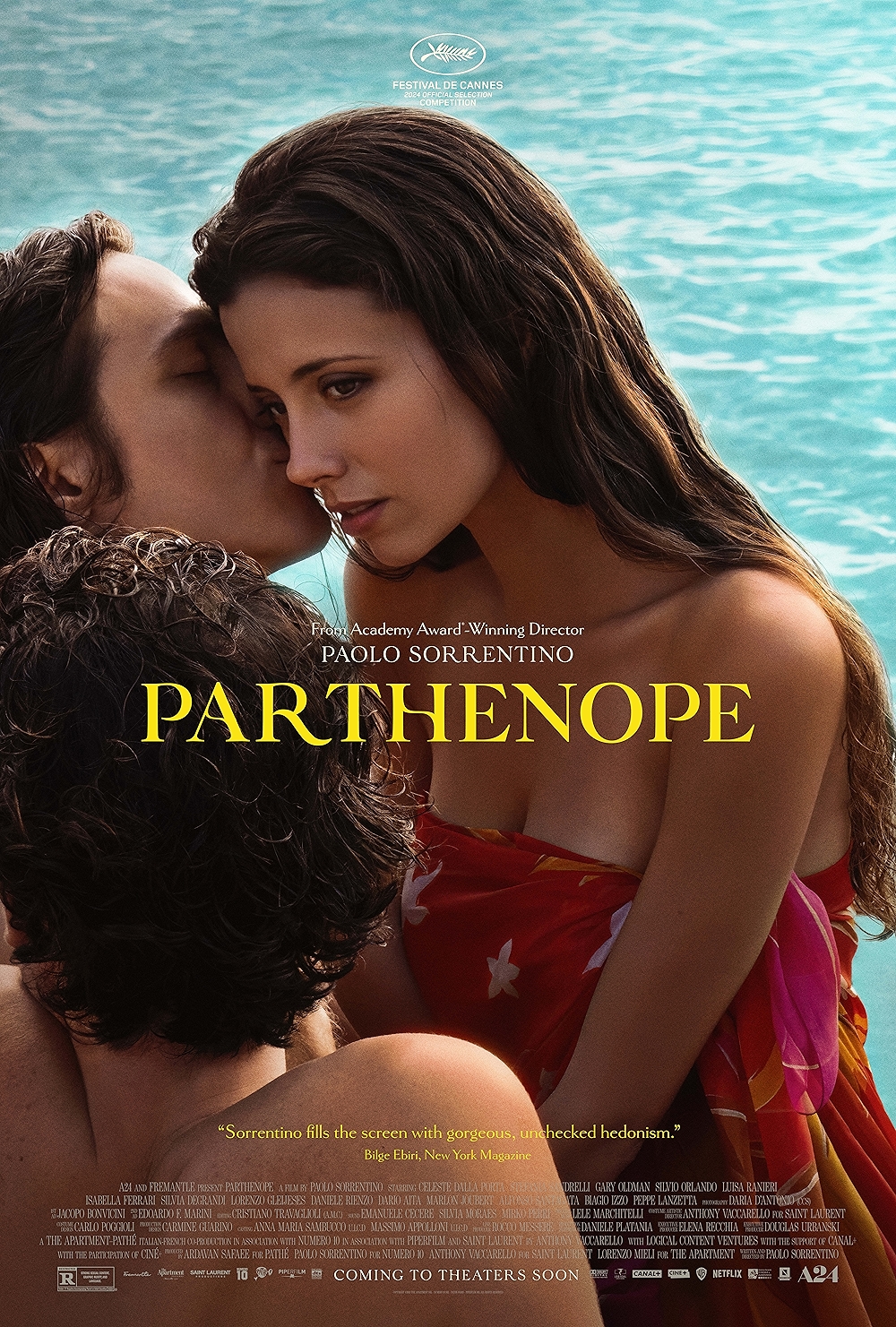
Parthenope is Paolo Sorrentino vamping, riffing on Paolo Sorrentino. A fabulously good looking film full of defeated old guys and spectacularly hot women, it nods as ever to La Dolce Vita, has a nice cameo for a famous actor, and the grotesques keep coming as if it had somehow accessed Fellini’s dreams.
What is it about though? Sorrentino has said it’s not about the Greek version of the Parthenope myth – the siren who lured men onto the rocks. Or the Roman version – the beauty loved by the centaur Vesuvius, who was turned into a volcano by jealous Jupiter while Parthenope herself became a city, the future Naples. And yet it is about both of those in its own way. Parthenope, first glimpsed in 1950 being born into the briny waters off the coast of Naples, but mostly seen after she has grown up to become a woman so beautiful her looks could start a war. At home the housekeeper’s son falls for her. Her own brother too is horribly smitten.
There is tragedy, the odd bit of comedy but mostly there is the sort of languid glamour we’ve come to expect from the director of The Great Beauty (Sorrentino at full strength), or Youth, which teamed Michael Caine and Harvey Keitel up in a very Thomas Mann-style sanatarium in the mountains for more exquisiteness.
There is a hint of Mann here too, in the suggestion that there might be a cholera outbreak at one point, which turns out to be a blind alley in terms of plot. But then that is this film, a formless picaresque that drifts along, following this beauty on her gilded journey through life, being offered things mere mortals cannot have. Parthenope’s beauty makes her godlike. Poor people venerate her like she is a saint. Priests lose their minds. Even gay men are tempted. “Beauty is like war: it opens doors,” says epigram-spouting old soak John Cheever (Gary Oldman), one of the few men who can resist her, because he’s gay, and even he’s wavering.
Parthenope’s magnificence, in effect, grants her access to a Fellini film.

En route, meetings with women who were once as hot as she is – Greta Cool (Luisa Manieri, a Sorrentino favourite) and Flora Malva (Isabella Ferrari, another), aged actresses grown monstrous on self-regard. And the occasional man who values Parthenope for her mind. Another of the gossamer plot strands Sorrentino sets up is Parthenope’s desire to be an anthropologist and it’s in the figure of bluff Professor Marotta (Silvio Orlando) that we get closest to an emotional connection and a story.
There are standout sequences, like her sexual adventure with an aged cardinal – even his underwear is scarlet – and another one, in which two very pretty individuals make love while their families look on as if they were at the theatre, a mini-satire on decisions about breeding as everyday eugenics.
But on the whole it is like wading through luxury chocolate, or eating a meal consisting entirely of truffles. When not making films, Sorrentino turns out high-end advertising for the likes of Bulgari and Hennessy and here the sense of listless privilege is almost overwhelming. No one is in a rush. When Sorrentino throws in an actual slo-mo shot, time almost grinds to a halt.
Watch it for its imagery. It is glorious. Symmetrical compositions, impeccably tasteful lighting, people dressed like they are ready for the catwalk. And watch it for Celeste Dalla Porta, who plays Parthenope as if she too is astonished by the way her beauty disrupts everything. Her performance makes sense, when much of the rest of the film threatens to fall apart at any moment.
While deep in the soil Sorrentino appears to be asking a question about the quantifiable value of beauty, on the surface he gives us Sorrentino’s Greatest Hits, or maybe Sorrentino goes jazz, extemporising on themes done more coherently, less impressionistically in his other films. Is he being bold, though, or lazy?
Parthenope – Watch it/buy it at Amazon
I am an Amazon affiliate
© Steve Morrissey 2025