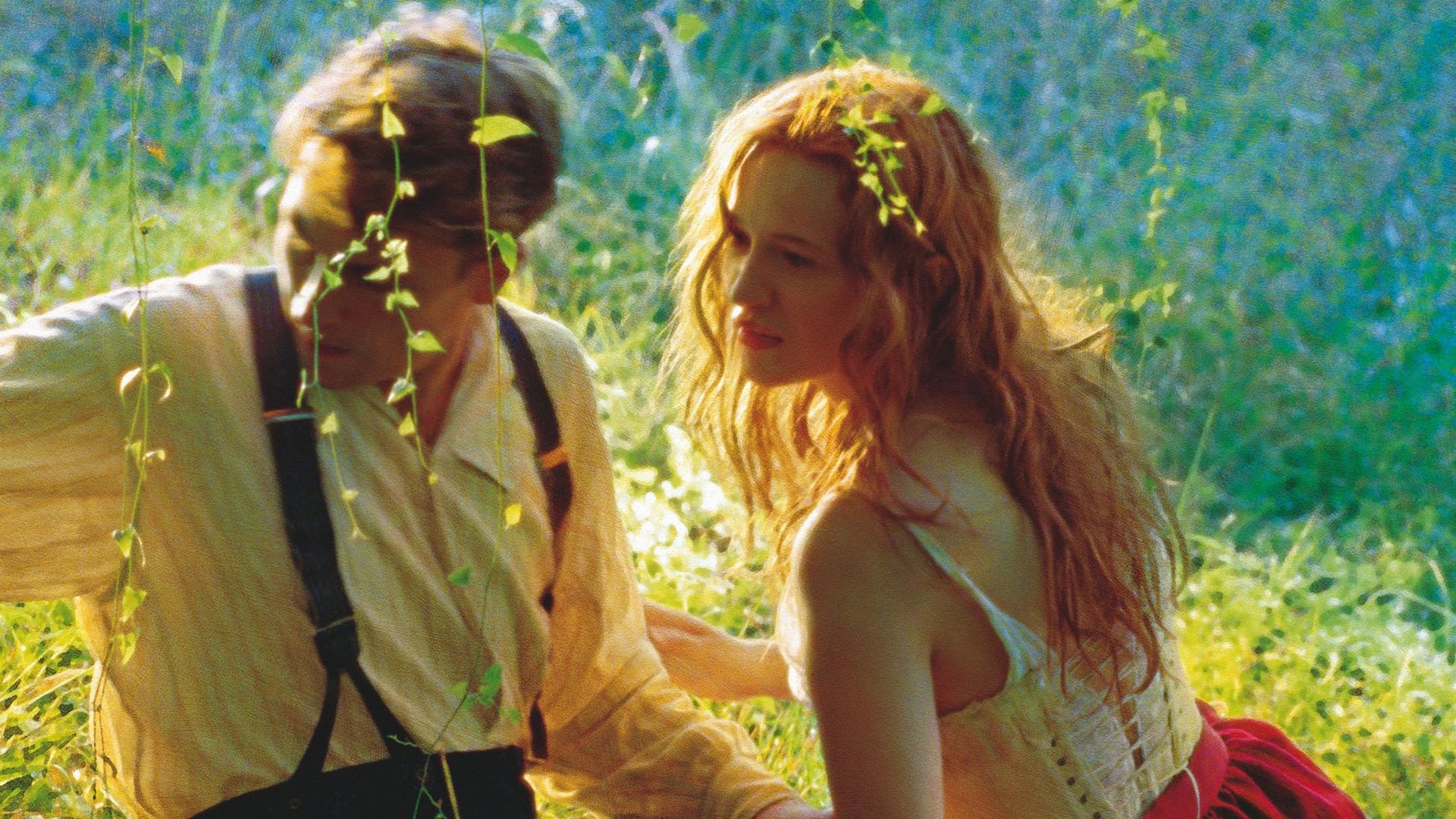
There’s a fascinating factoid at the centre of Renoir, Gilles Bourdos’s film about the old painter Pierre-Auguste and his son, the future-filmmaker Jean. Both men shared the same muse.
Andrée Heuschling was the last in a long line of life models for the aged Impressionist, a celebrity painter who by the end of the First World War was wracked with rheumantoid arthritis and coming towards the end of his life. She was also the woman who encouraged his son, Jean, wounded and back from the battlefront, to give up ideas about being a ceramicist and to go into film-making. In Bourdos’s telling of the story, Heuschling essentially offers Renoir a deal – you can’t have me unless you make something of yourself, and ceramics isn’t going to cut it.
In linear fashion Bourdos lays it out. Heuschling arrives at the old painter’s villa, having been sent there by Matisse. Renoir Sr instantly gets her out of her clothes and onto a canvas (in paint). Enter a limping Jean, who falls for the young woman, and the two of them fall in love.
What the old painter thought of all this is left shadowy. He generally bedded his models, is the suggestion, but by this point in his life no longer had the chops. Resigned acceptance? Benign tolerance? Some father-son envy? Possibly a bit of all three.
There is an overlap in the visual style of the father and son – the woozy impressionism of the father later becomes the lyrical poetic realism of the son – so Heuschling as a bridge between the generations, artistically and physically, works at a functional level, at the very least.
Whatever you think of the film – dramatically inert is the general opinion (and having watched it I can only agree) – it’s fascinating as a potted history of two famous artists as one is about to hand the baton to the next. The film does not tell us this but Jean financed his early films by selling dad’s paintings. Because those Renoir paintings have a crowd-pleasing, jolly, upbeat and picturesque quality, there was no shortage of takers.

Bourdos also gives us insight into painterly technique, roping in master forger Guy Ribes to recreate various Renoirs. Ribes had done jail time for passing off Picassos, Chagalls and, yes, Renoirs, as the real thing when in fact he’d painted them himself. That’s Ribes’s hand showing us how Renoir makes the highlights pop, how he musses up the image impressionistically with a dry brush, and so on.
Again, as in so many French films, the film gives us France as the most splending place on the planet to live. There, on the Cote d’Azur, where P-A Renoir went to live when the arthritis got too bad, the honeyed light pours into the gorgeous old villa busy with women tending to every whim of the man they call “maestro”.
As Renoir Senior, the 86-year-old Michel Bouquet twinkles away like a man trying to dispel any notion that there was anything of the dirty old man in Renoir’s fascination with young flesh – “What is like the skin of a young girl?” he asks at one point, as if it were a philosophical conundrum.
Talking of which, there’s plenty of Christa Théret’s unclothed body. She looks radiant, hair tumbling down her back, straw hat on her head, but there’s also a wilfulness to Andrée which Théret catches well. This is a poor girl whose looks have created an opportunity and she is determined to seize it.
As young Renoir, Vincent Rottiers does what he can when he can with a character who sits uneasily in the film. Is this film about Andrée, or Jean, or the pair of them, or is it the old guy who’s central, and if so is it the man or the painter? In the end it feels as if in not quite deciding which way to go, the film has ended up going no way at all.
Still, look at it. Composed like a series of beautiful paintings. There’s a scene set in a kitchen at one point, where Bourdos and his DP Mark Lee Ping-bing (who took over on In the Mood for Love when Christopher Doyle left) go to town on some detailed mini-portraits – vegetable prep, a rabbit on a hook, fish being descaled.
The whole film is a bit like that – a touch lifeless but undoubtedly gorgeous, a story told through tableaux semi-vivants.
Renoir – Watch it/buy it at Amazon
I am an Amazon affiliate
© Steve Morrissey 2025

