
Not so much neo-noir as neon-noir, I Saw the TV Glow is Jane Schoenbrun’s follow-up to We’re All Going to the World’s Fair, and continues in much the same vein, interrogating identity and authenticity in psychic landscapes constructed from online memes.
Pink and orange are the key colours, though it’s shot dark like a noir, often at night, and has problematical sexuality lurking beneath the surface, as noir so often does. Its story is about a smaltown girl too mixed up for these tame streets and the white-knight male who rides to her rescue and is entirely out of his depth – see almost every noir female/male coupling for more details.
It’s the 1990s and we’re at a high school, where seventh-grader Owen forms an across-the-divide relationship with ninth-grader Maddy, the pair of them united by a love for and obsession with a TV show called The Pink Opaque, a fantasy/supernatural affair tapping the zeitgeist with its fight of good against evil, Buffy the Vampire Slayer in all but name.
“Sometimes The Pink Opaque feels more real than real life,” says Maddy at one point, one of those sentence you’re obviously meant to copy down and regurgitate at exam time. Schoenbrun also drops in occasional snippets from the fictional show – very pretty teenage girls in earnest convo or being menaced by fantasy villains – which points up not only that she’s brilliant at pastiche but that The Pink Opaque is nothing like real life and Maddy couldn’t be more wrong.
But then that’s the point. Later, Maddy, hoping that Owen hasn’t struck up this friendship because he has the hots for her, asks Owen if he likes boys or girls. “I… er… like TV shows,” says Owen, who really does like TV shows and doesn’t really have any friends apart from Maddy.
Zipping between the 1990s (fictional and “real” versions) and ten years later, when Maddy returns to her town claiming to have spent the intervening decade inside The Pink Opaque itself, the whole thing is a mad stew of high gothic reminiscent at times of Richard Kelly’s Southland Tales, his baroque follow-up to Donnie Darko.
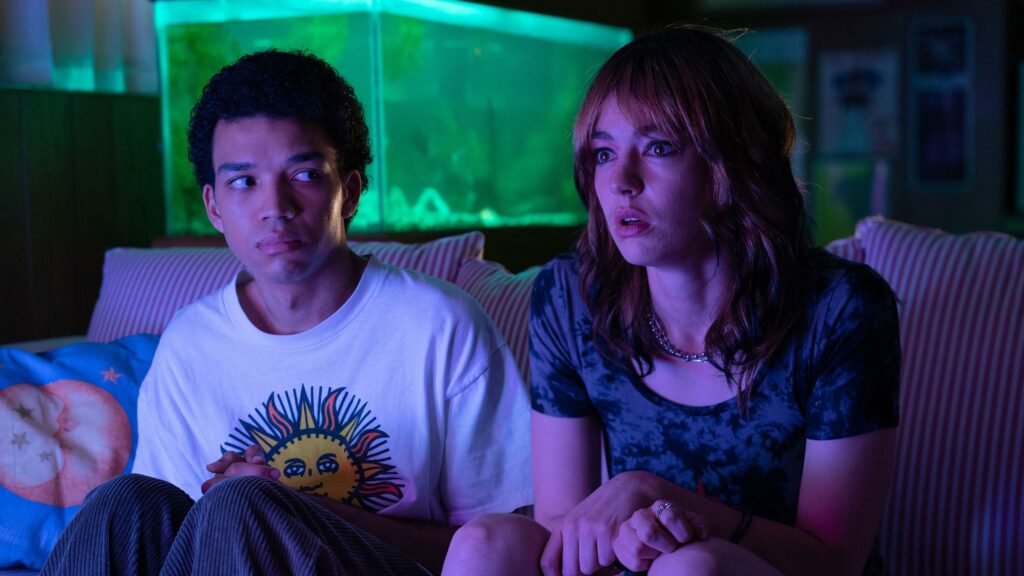
Justice Smith and Brigette Lundy-Paine play Owen and Maddy. Both are around 30 in real life, and the moodily dark lighting is probably the only thing maintaining the shaky fiction that they’re meant to be teenagers. Both are very good. It’s another chameleon role for Smith as the smalltown sap, but it’s Lundy-Paine who stands out, particularly in a late monologue to camera that demonstrates an ability to hold an audience by charismatic power alone. You might remember Lundy-Paine as Keanu Reeves’s daughter in Bill & Ted Face the Music, a standout performance in a competent time-waster.
Schoenbrun is a trans woman, Lundy-Paine is non-binary. Both go by they/them, and to an extent the arrival of the buffet-style approach to gender and sexuality opened up by the advent of the internet is what Schoenbrun is taking on, as she did in We’re All Going to the World’s Fair.
Marshall McLuhan coined the phrase “the medium is the message” in 1964 and to an extent Schoenbrun is operating inside the same paradigm 60 years later – we consume the media and it then consumes us. Watch enough Buffy and you become Buffified.
That said, there is no need to delve below the surface. There is also no need to see the film as an allegory for the transgender experience, which Schoenbrun has said it is. The film works on its own terms, as a story in the Buffy style, complete with fizzy on-screen graphics, pop-culture referencing and serious teenage issues (parents! sexuality! monsters!) dealt with in a teen-serious way. Look out for faces from the era, like Limp Bizkit’s Fred Durst or Amber Benson, who played Tara in Buffy the Vampire Slayer. The fact that in The Pink Opaque there’s also a character called Tara is, of course, deliberate, another easter egg for people who like TV shows maybe a bit too much.
I Saw the TV Glow – Watch it/buy it at Amazon
I am an Amazon affiliate
© Steve Morrissey 2024

