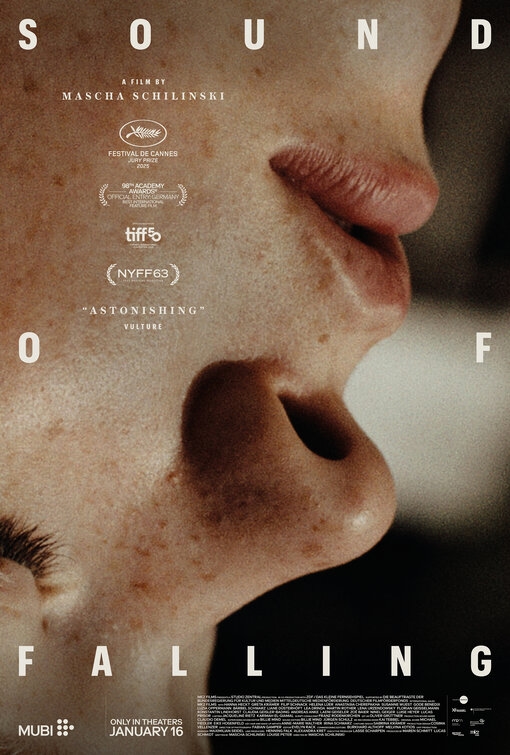
A remarkable “if these walls could talk” movie set in the same big farmhouse over the generations, Sound of Falling (In die Sonne schauen, in the original German), is a bold and hypnotic drama starting with the eye-catching image of a pretty young woman with one leg hobbling along on crutches. It turns out that the young woman doesn’t have a leg missing at all. She’s just tied it up, possibly in sympathy with the young man who is lying feverishly in bed in an adjoining room. He really does have a leg missing, though what Erika most notices about him when she looks in on him is the way his sweat is pooling in his belly button. She dips a finger in and has a taste.
Suddenly the action has shifted. We’re no longer in the 1940s with Erika (Lea Drinda) but in the 1910s with Alma (Hanna Heckt), soon afterwards in the 1980s with Angelika (Lena Urzendowsky), before winding up close to the present day, where Lenka (Laeni Geiseler)and her parents Christa (Luise Heyer) and Hannes (Lucas Prisor) are in the middle of renovating the old place – and letting the stories trapped in its walls free???
It’s beautifully done, with cool restraint, and shot as if it were on 16mm film – grainy, Academy ratio, a waft of light added, as if to make the “film” give of its best. Director/co-writer Mascha Schilinski keeps us at a slight distance, as if we were eavesdropping on events. The odd cool, dreamy song by Anna von Hausswolff adds to the impression – that we’re seeing everything slightly through a veil. Is that young man without a leg the same much older man without a leg in the 1980s? Are most of these people related to each other? Schilinski makes us work it out, shifting from one era to another with no indication that she’s made the leap. Sometimes there’s a thematic connector – the missing leg, or one family’s idyllic summer afternoon by the river to another family by the river on a similarly idyllic summer’s day in a different era. Sometimes the link is verbal – “Warm,” says Erika to her sleeping sister as she climbs into bed in the 1940s. “Warm,” says Christa to Hannes as she pulls his penis out and rubs it on her forehead in the 2020s.
Mascha Schilinski’s last film, Dark Blue Girl (aka Die Tochter) was about a couple’s relationship being sabotaged by their own young daughter. She clearly likes to come at relationships from an awkward angle. Sex keeps rearing its head here, and it’s often of the inappropriate sort family’s don’t talk about but everyone knows is going on. Wonky desire – tasting that sweat – sex, death, the circle of life.

One close analogue is The Tree of Wooden Clogs, Ermanno Olmi’s 1978 documentary-inflected drama following an Italian family over a year. Neither film exactly trades in happiness – contentment is about as far as it goes here and in Olmi’s film. Both are concerned with the rhythms of existence, but here Schilinski adds a concern with events in one generation echoing down the decades, usually daisy-chaining from one human to the next. But maybe other mechanisms are at work which no one really understands – in 1972 The Stone Tape, written by Nigel Kneale, made bold sci-fi out of what’s only hinted at here.
By the end all the families in all the generations have tasted death. Death stalks life, of course, otherwise life would never go anywhere. Schilinski expresses it with great grace and delicacy, but there’s a real darkness as well, a nightmare snuggling up next to the dream.
Sound of Falling – Watch it/buy it at Amazon
I am an Amazon affiliate
© Steve Morrissey 2026