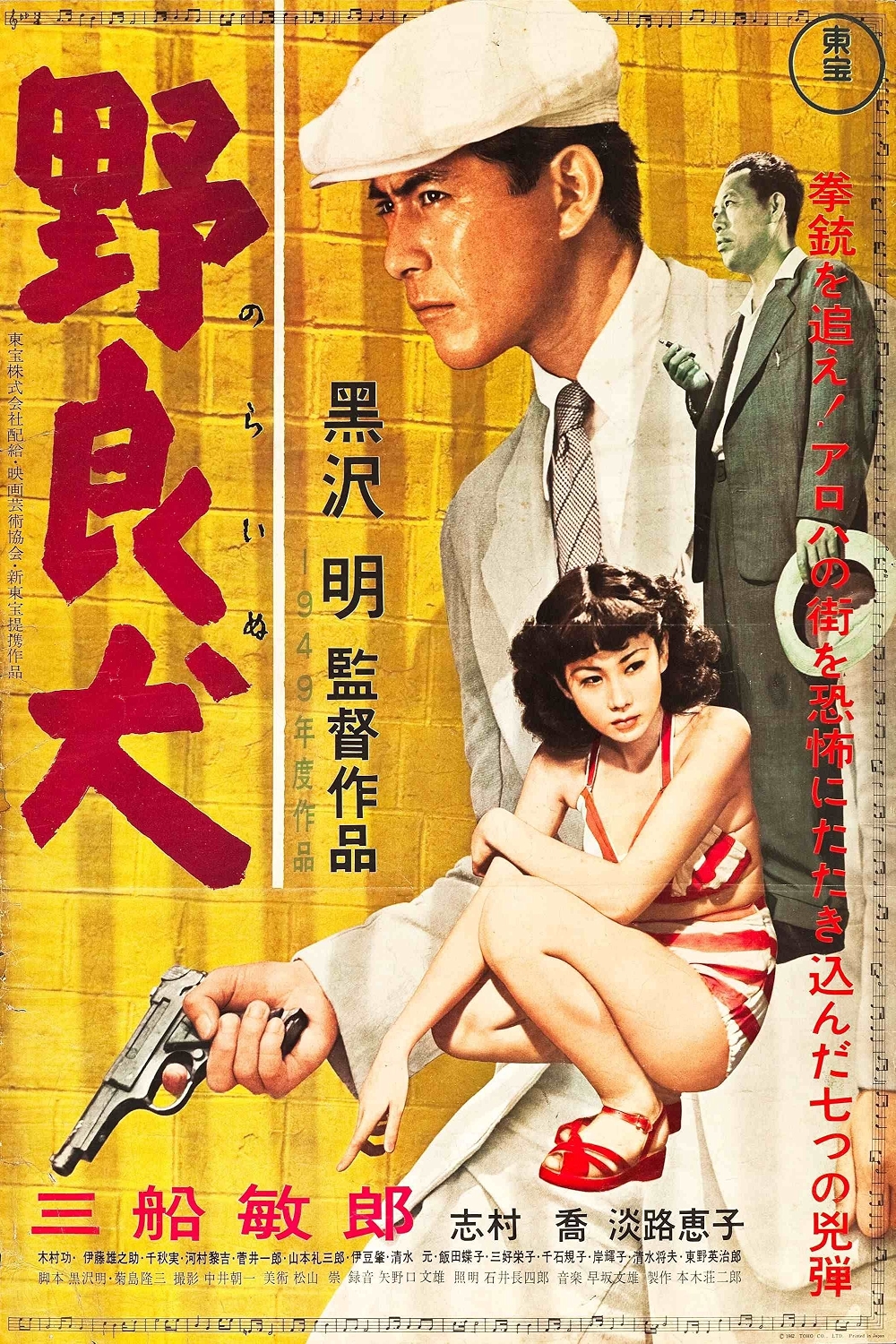
Subtle, understated Japanese film noir, 1949’s Stray Dog appears to be Akira Kurosawa’s embrace of the post-War reconstruction of Japan in the image of the American conqueror. It may be something else as well.
But before all that, is the “stray dog” we see panting in the opening titles meant to be Japan itself? That dog does not otherwise feature in the film. No dog does.
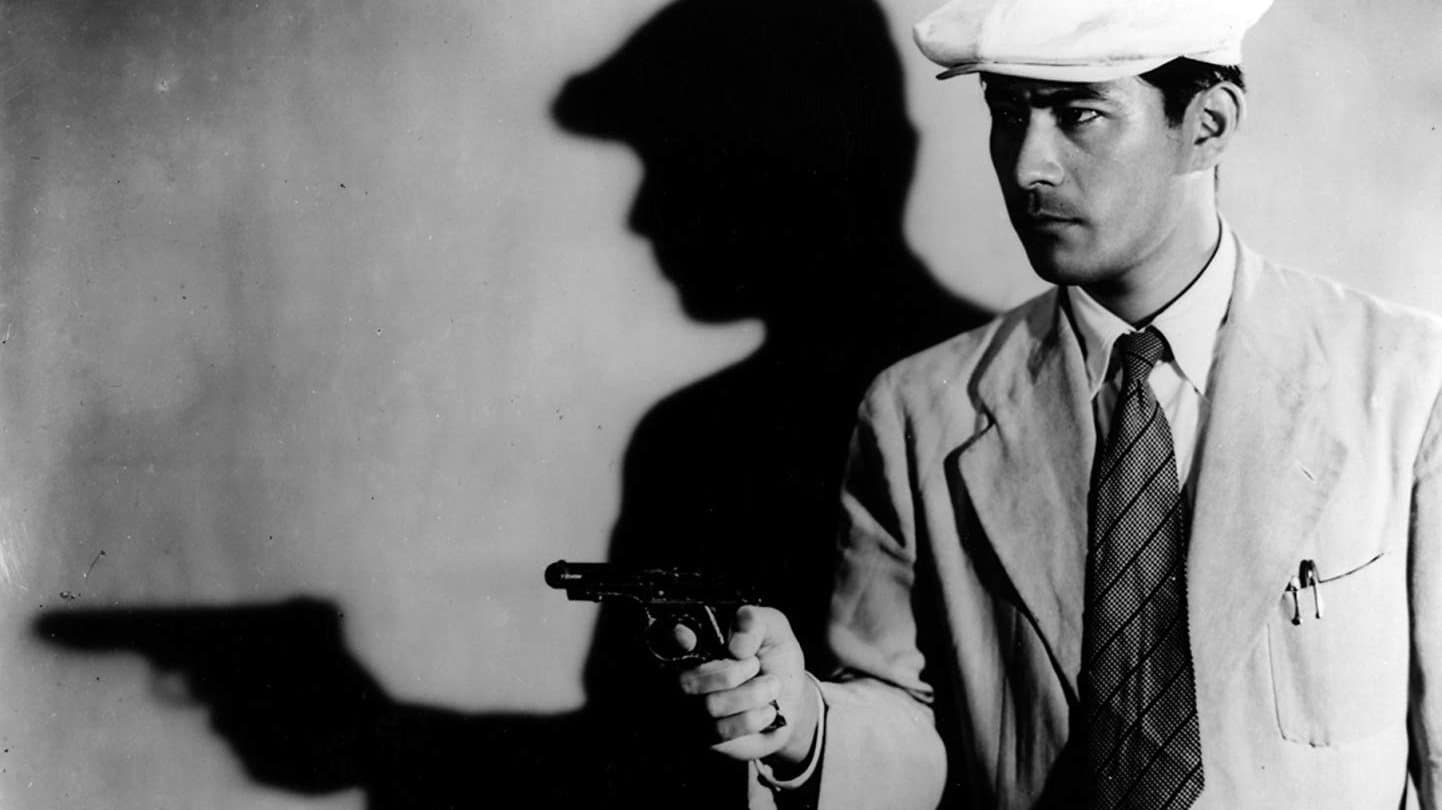
Instead of canines, Kurosawa beetles away at a Maguffin leading us from one end of his movie to the other. The story of a diligent young cop, Detective Murakami (Toshirō Mifune), who one sweltering day on a crowded bus has his police revolver lifted from his jacket pocket.
Murakami will spend the rest of the film trying to get his gun back, discovering en route that it’s been used in a series of crimes. As Kurosawa details those crimes, he reveals his main interest – a portrait of Tokyo as it rebuilds in the aftermath of the Second World War.
The second unit is strong in this one. Inspired by Jules Dassin’s The Naked City from the previous year, Kurosawa sent Ishirō Honda (of Godzilla fame) out onto the Tokyo streets to catch daily life in all its documentary glory. Honda’s footage makes a massive contribution to the film’s overall tone, but props to Kurosawa, who incorporates the footage well – noodles are shovelled into gaping maws, crowds bustle, baseball games heave, markets bustle, hotels teem, nightclubs vibrate, trains seethe, and so on.
Overall, American noir is the idea. The guys dress in clothes in the American style. Murakami is the familiar down-at-heel cop. There’s a voiceover. An urgent score. The English subtitles (if you’re using them) are wiseguy-slangy (on the Criterion version I watched, anyway).
Kurosawa also later said that he wasn’t so sure about all the technical virtuosity on display. Maybe he was showing off a bit, he suggested. It is impressive though. Cameras swing about and slither through crowds, there are layers of depth, extreme close-ups, whipcrack movement, montages, wipes, snappy edits. There is no lack of visual variety.
Perhaps he was trying to add weight to a story superficially without much substance. There really isn’t much to it, just a cop looking for a gun and coming across different suspects. A cop who is eager, earnest, naive, sensitive, impetuous and falling over himself to atone for his failure to stop his gun from having been taken in the first place.
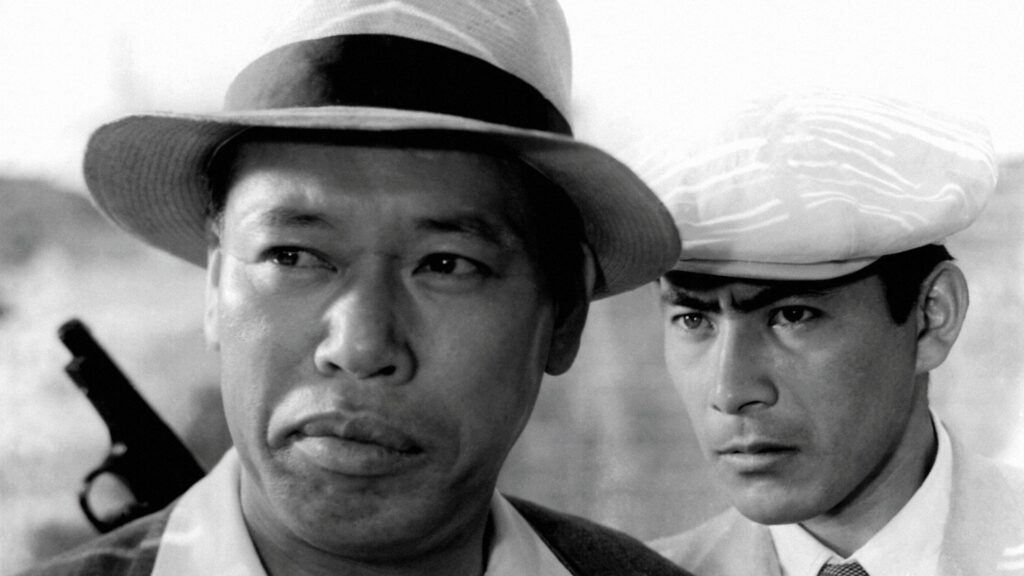
Atonement is an obvious theme and Murakami its ambiguous representative. The other key character in this movie is an older cop, Chief Detective Satô (Takashi Shimura), a guy from the bad old days who has seen it all before. In telling scenes set in Satô’s home we get one of the film’s few human moments, when the cops stop being cops for a moment and are just guys hanging out off duty. It turns out that Satô, tainted by recent events though he is, may have something to offer. Perhaps, it’s suggested, Murakami’s embraces of all things American is a bit too much. At one point Satô describes his younger colleague as “après-guerre,” lapsing momentarily into French to suggest Murakami is possibly a bit too “post War”.
Remember that American censors were marking Kurosawa’s homework. Their key objection to the movie turned out not to be the suggestion of nationalism renascent but the dog panting over the opening titles. Was it in distress, they wanted to know? Whoosh!
But then this is an incredibly low key movie, a stiletto rather than a blunderbuss. The acting is uniformly brilliant. Not to take anything away from Mifune, who is in many respects a cipher, Mr Maguffin, but the relaxed and low-key Shimura is particularly excellent as the cop who gentles his way towards a result. Keiko Awaji also stands out as the hard-faced dancer who is the key to everything, a femme fatale of sorts driven mad by unattainable baubles.
There you have it – a soft-shoe noir, a flickerbook of finely wrought character sketches and a whispered examination of the post-War Japanese mindset. And some close-ups of a doggie panting as the opening titles roll. Kurosawa the sly dog!
Stray Dog – Watch it/buy it at Amazon
I am an Amazon affiliate
© Steve Morrissey 2025