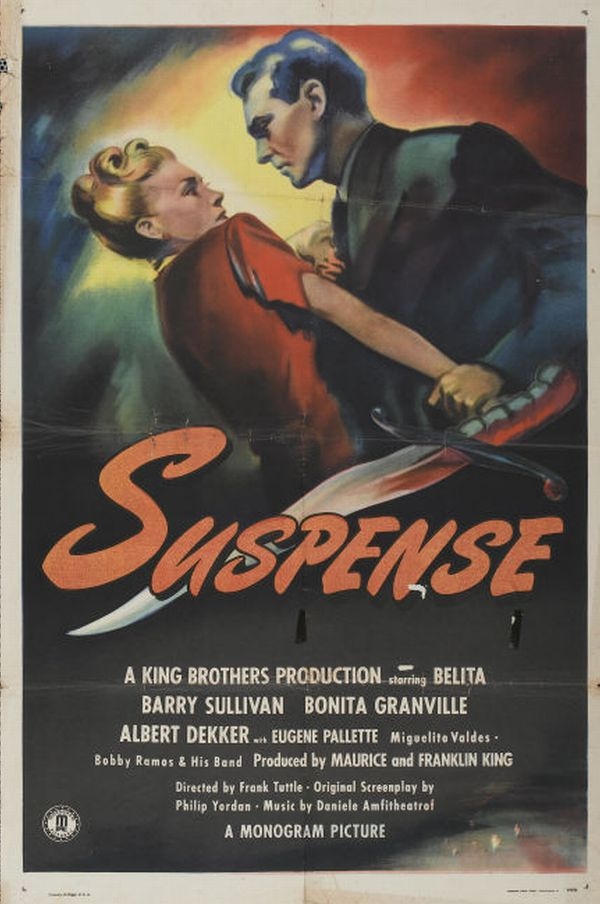
Film noir on ice! Suspense is a bit of a mess and the critics didn’t like it much when it came out in 1946. But the years have added a touch of fairy dust and there’s enough in here to entertain and delight, plus some decent performances, fine noirish lighting and a sense of paranoia towards the end so intense it’s almost as if Franz Kafka had a hand in things.
In short it’s the story of a drifter who gets a job on an ice show and then falls for the boss’s wife, who is the show’s star attraction. At a certain point the boss disappears under an avalanche, leaving the way clear for the two of them to stop hiding their affair. But is the boss dead or is he up to something? For that matter, why does the jumped-up drifter appear to change character about halfway through and start plotting the murder of the woman who caused all the hoo-haa in the first place? It’s all very strange.
But let’s meet the players. Barry Sullivan, as everyman Joe Morgan. Belita as Roberta Elva, ice star and femme fatale of sorts. Albert Dekker as the cuckolded Frank, who gives Joe a job and lives to regret it. Eugene Pallette, in his last film, growing away majestically as Frank’s right-hand man, Harry, the only straight arrow in the whole thing. And Bonita Granville as complicating femme number two, Ronnie, the sour to Roberta’s sweet, all cinched waist, overpainted lips and elaborate hair.
They’re a mixed bag. Sullivan is excellent as always, in that scrappy, plucky way of his. Belita fits her role perfectly. She could be terrible – and was only a year later in this film’s follow-up, The Gangster (also with Sullivan) – but she is entirely in the role this time out and plays a blinder. Dekker is affectless as the potentially highly interesting Frank, while Pallette oozes good fellowship and gives a touchingly old fashioned performance, almost winking at the camera at times. Granville does what’s required – bad girl as is written.

The film periodically stops for ice-dance numbers, which is Belita’s chance to show what she can do (she skated for Great Britain at the Hitler Olympics in 1936). This is probably her finest hour and she’s great both on and off the ice. In between musical numbers the film considers the roles of men and women quite extensively. Roberta’s determination to always be the driver in any car she’s in, for instance. Plus that telling interlude in the mountains, before Frank accidentally starts the avalanche that will engulf him, where she’s the one out getting wood for the fire while he’s in the kitchen with a pinafore beating together ingredients for some culinary confection. Does it mean anything that when Frank is first introduced he’s stroking a cat? It probably does.
Is Joe the guy Frank could never be, the man who will take his rightful place in the driver’s seat, putting Roberta back riding shotgun? Watch and wonder.
By the end you may have other questions. Where does Ronnie, with her man’s name, fit into all this? What was the point of introducing Joe’s back story in New York?
It is a mess of loose ends but it is at least a beautifully made mess. Directed by Frank Tuttle, who knows how to knock out product, it’s lit by Karl Struss, the cinematographer who worked with Lang and Chaplin. He lays on the subtle drama with lighting that’s shadowy but not overly so.
In the end it appears to be a plea for a return to the status quo ante before the war ruined things – women as passengers not drivers and drifters drifting rather than getting ideas above their station. 1946 – a pivotal year for noir, on ice or any other way.
Suspense – Watch it/buy it at Amazon
I am an Amazon affiliate
© Steve Morrissey 2026