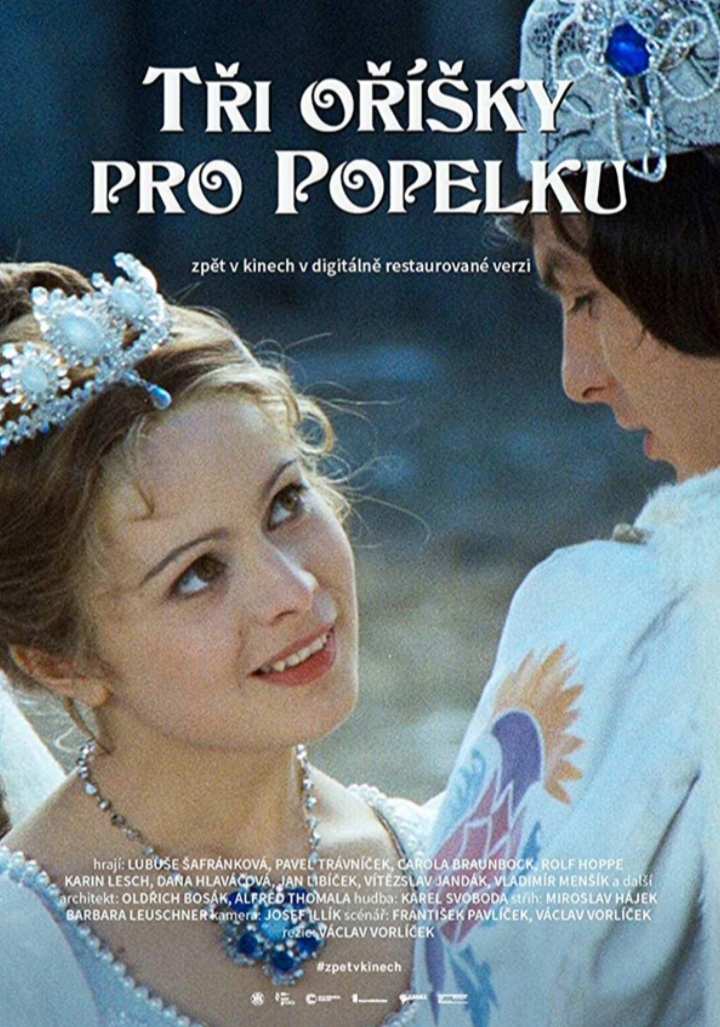
If you already know Václav Vorlíček’s Three Wishes for Cinderella it’ll most likey be because you grew up on it. It’s a tradition in some European countries to watch it at Christmas. A Czech/East German co-production made in the days of the Iron Curtain, its appeal is obvious as soon as it gets going. It gives it to us straight – a good, old-fashioned fairy tale so traditional it could be half-timbered, with virtuous maidens and hissable villains, noble rulers and stout yeoman. All is in its place and all is right in the world.
That said, there is no fairy godmother, no pumpkin coach and no glass slipper. Instead the nearest we get to a magical creature is an owl, though the magic all seems to originate in three hazelnuts given to Cinderella by her stepmother’s servant. Its original two titles – one in Czech, the other German (the cast are mixed too, speak in their own language and are dubbed) reflect this. Tři oříšky pro Popelku or Drei Haselnüsse für Aschenbrödel translate literally into English as Three Hazelnuts for Cinderella.
But in all other respects a very familiar story. Cinderella, benighted stepchild of a rancorous stepmother, thanks to the enchanted hazelnuts, winds up going to the ball after all, in spite of her stepmother and stepsister’s attempts to stop her, catches the eye of the handsome prince, who then moves heaven and earth to find the mysterious young lady – whomsoever this slipper (not glass) shall fit etc
Libuše Šafránková was not the first choice to play Cinderella, but she is a charmer in the role, almost convincing in boy’s clothes for the bit of the story where Cinderella in disguise meets the prince in the forest and impresses him with her crossbow skills. She’s also convincing at the ball in full regalia, including a veil, winning the heart of the slightly self-absorbed, fairly entitled prince by playing hardball.
Pavel Trávnícek is a handsome prince, Carola Braunbock a grim stepmother, and Dana Hlavácová an impressively horrible Dora, Cinderella’s stepsister. Rolf Hoppe and Karin Lesch are particularly good in nothing roles as the king and queen, concerned parents first and regal luminaries second.

If you know the East German TV show The Singing Ringing Tree, there is something of its slightly surreal and mysterious atmosphere here (helped along by being in a foreign language, of course). And the locations – a wintry Czechoslovakia of mitteleuropean castles and forests – add to the feeling of just-rightness, which the score of swooshing harps, trilling flutes and tinkling pianos does nothing to disturb.
There is a scene in which the prince goes hunting and looses off a crossbow bolt at a fox, which we see struggling as it dies. It’s a shock if Disney is your reference point but for the most part there is nothing here to frighten the horses, and aspects of the production sometimes tend towards the pantomime. At one point the king, queen and prince prance about in clothes so ridiculously arch that you have to smile.
There are little stabs of comedy. The wicked stepmother getting most of it. Less successful are supposedly amusing scenes featuring attempts by the prince’s tutor (always a fail) to connect with his pupil, who always gets the better of him.
You can get a subversive reading out of it if you want – the prince is the prize rather than Cinderella – and in the scenes where she’s disguised as a young man this seems most obvious. But on the whole the message is “know your place” – Cinderella may get a promotion but no one else gets any social advancement.
The film was restored in 2015 and it’s been done carefully. It looks like something from over 50 years ago, but also very spruce, as if it were a classic car that’s lovingly been brought back into tip-top good-as-new condition. All is as it should be.
Three Wishes for Cinderella – Watch it/buy it at Amazon
I am an Amazon affiliate
© Steve Morrissey 2025