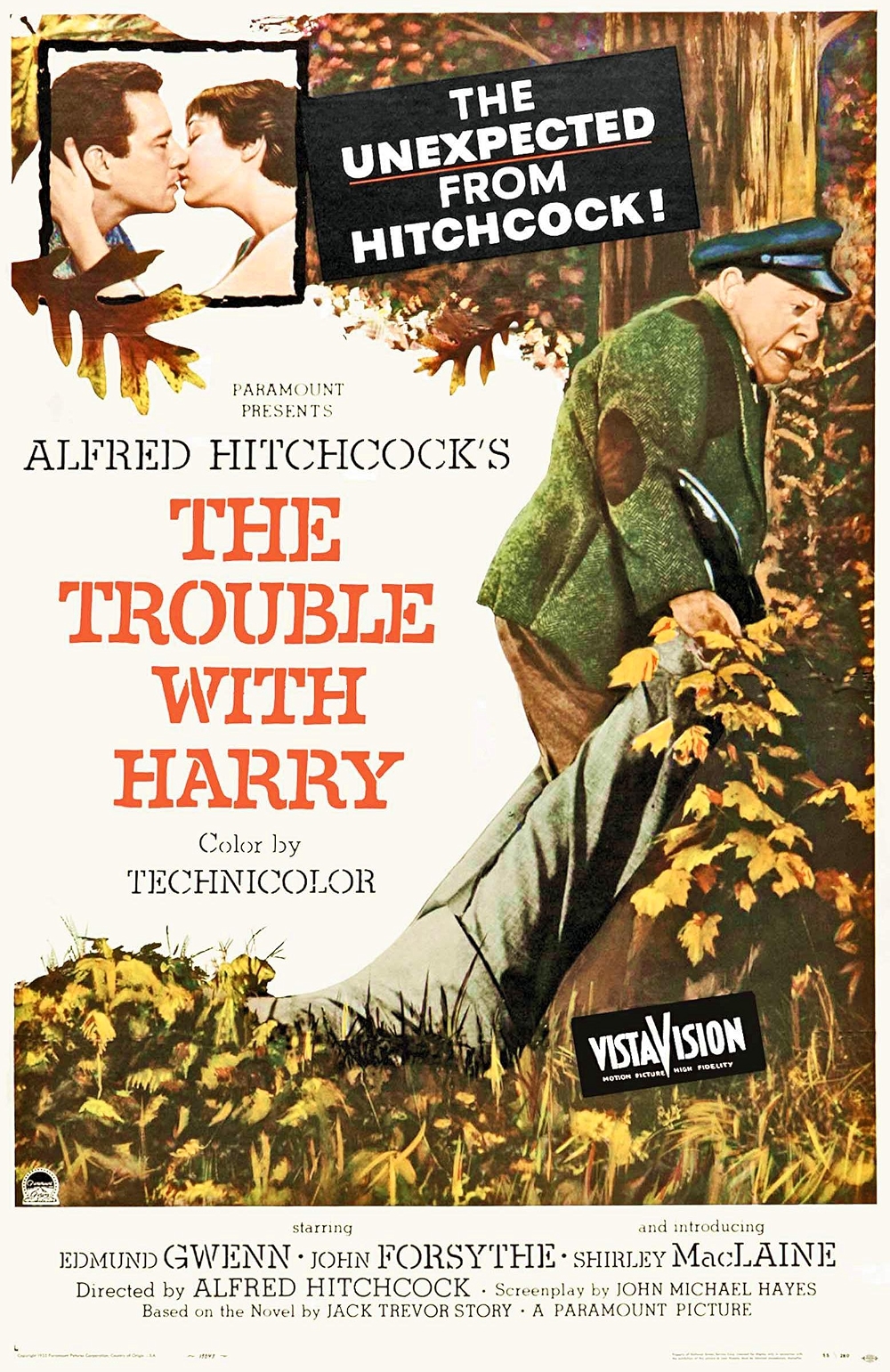
A wag rather than a humourist, Alfred Hitchcock generally ran into trouble when he tried to make a funny film. Case in point: The Trouble with Harry, an arch confection notable for two things: it was the first time Hitchcock worked with composer Bernard Herrmann; and was also Shirley MacLaine’s screen debut.
There are two conceits at work in this movie. Number one is the body that won’t stay buried. Number two is the nonchalance of the citizens of a white-picket American town who stumble across it, one way or another.
That starts with Arnie, a boy roaming the countryside near his home who hears a commotion and a shot and then discovers Harry Worp dead on the ground. While Arnie hurries off to fetch his mother (MacLaine), a retired sea captain out hunting, Captain Wiles (Edmund Gwenn), finds the body. Convinced a stray shot from his gun has felled poor Harry, he decides to dispose of the body. It’s while Captain Wiles is dragging Harry off, a leg in each hand, that spinster Miss Gravely turns up. With a cheery, “What seems to be the trouble, Captain,” she sets to work flirting with the old salt and has soon invited him to afternoon coffee and muffins at her place, the dead man no impediment to amorous endeavour.
Re-enter Arnie and Mrs Rogers, a bookish doctor (Dwight Marfield) who wanders by oblivious, a tramp (Barry Macollum) who kicks the body and steals the dead man’s shoes, then Sam Marlowe (John Forsythe), an artist incapable of selling any paintings, and eventually Calvin Wiggs (Royal Dano), a deputy sheriff who drives a 1913 Buick, even though it’s 1955. Cue comedic backfiring.
Before the day is done, Harry will have been buried and dug up, buried and dug up again, then buried and dug up one more time, with Deputy Wiggs always threatening to make the death official by, just once, being in the right place at the right time. In the interim, almost everyone we have been introduced to will step forward and declare themselves responsible for the dead man’s untimely demise.

Hitchcock paints a cute, even twee portrait of Vermont. Life centres on the general store in this conventional community, which nestles in a landscape of vivid autumnal colour (apparently the leaves were stuck on the trees by hand and it must have been a hell of a job). The Technicolor cinematography is spankingly good. Robert Burks is DP, as he was for all the big films in Hitchcock’s late 1950s heyday – To Catch a Thief, Rear Window, Vertigo, North by Northwest.
There are no real stars to speak of, and that’s partly what Hitchcock is trying out – can I make a film if Cary Grant, Jimmy Stewart or Grace Kelly aren’t in it?
Forsythe, the film’s central character, appears to have decided to take his acting cues from Cary Grant. His easy charm and loose limbs may not be a real substitute for the real thing but he does OK. If you only know Forsythe from Dynasty, you might be surprised at how unconstipated he is.
Shirley MacLaine is sensational, in an instant star-is-born way. But the best performance in the film is Mildred Natwick’s. As Miss Gravely, an older woman who has fallen in love and is caught out by it, she is remarkable.
Is Hitchcock vaguely having a go at remaking Thornton Wilder’s Our Town? He could be. The two men had collaborated on 1943’s Shadow of a Doubt. Remove the body and the dark humour and what’s left is obviously Wilder-esque. Until things get a touch Agatha Christie in the whodunit finale, when Hitchcock re-runs the murder mystery as farce.
The dark humour is why it didn’t fly in America, reckoned Hitchcock, but really the bury/rebury conceit is implausible and runs out of puff long before Harry has been dug up for the final time. Hitchcock’s static direction is puzzling too, as if he were directing a play rather than a film – so many speeches given by forward-facing characters, almost as if they were addressing the audience.
In 1941’s Mr and Mrs Smith, Hitchcock showed what happens when he gets the proportions wrong. His films are best when they use comedy as seasoning not the meal itself. The Trouble with Harry is another case in point. Not bad, just a bit laboured. The fat man laughing at his own jokes.
The Trouble with Harry – Watch it/buy it at Amazon
I am an Amazon affiliate
© Steve Morrissey 2026