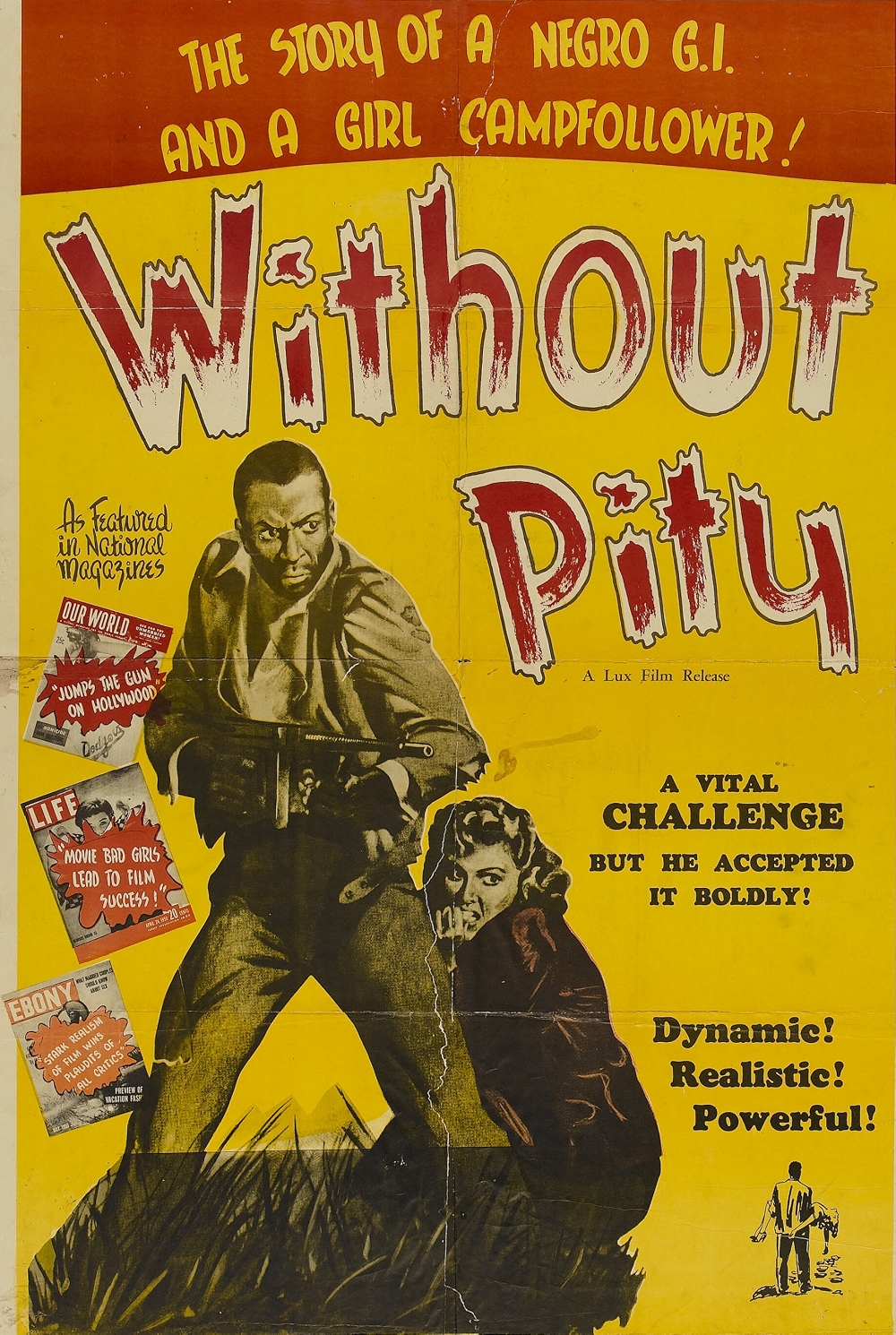
Matter-of-fact neorealism meets its opposite, torrid melodrama, in Senza Pietà, aka Without Pity. Remarkably, it’s a successful meeting of equals, probably thanks to director Alberto Lattuada’s decision to go at his material at breakneck pace. Whatever else you can accuse this film of, it isn’t slow or lacking in incident.
It throws its two main characters together early on. In the immediate aftermath of the Second World War, displaced Italian Angela (Carla Del Poggio) is hitching a ride when she first bumps into Jerry Jackson (John Kitzmiller), a black US sergeant who jumps onto the goods train Angela is on and winds up taking a bullet for his efforts. Because she’s a good girl Angela helps Jerry get medical attention but that gets her arrested. They go separate ways – him to hospital and her to a detention centre. And that would appear to mark the end of the Angela/Jerry story. In fact they will meet again later in the movie, by which time she has all but abandoned her search for her missing brother and is on the run with Marcella (Giulietta Masina), a young woman she met in jail, and Jerry is dealing with the fallout from a smuggling operation gone wrong.
A portrait of a country putting itself back together after the war is the result. Without Pity is an Italian The Third Man, in some respects. It’s full of shadowy characters trying to edge themselves into the picture while edging competitors out. People like shyster Baron Hoffman (Carlo Bianco), and gangster Pier Luigi (Pierre Claudé), who both cross the path of Jerry and Angela at different points. Whether they are major players or walk-ons, escape from the current situation is everyone’s goal. In Angela’s case there is a moral dimension to this – will she be forced to turn to prostitution? In Jerry’s case it’s more social – his black skin marks him out as different.
Because Marcella has a black boyfriend when Angela first meets her, the suggestion is there from early on that Angela and Jerry will become romantically entangled, even though Angela doesn’t at first know what to make of this exotic “negro” serviceman. Maybe Jerry’s nationality trumps his skin colour – America looms large in this movie as a beacon of freedom and plenty.

Ironically, the film never got seen in the USA, where the transracial relationship proved too hot an issue, nor was it shown in the American or British zones of occupied Germany. But it was a big hit in Italy, where it bolstered the career of Del Poggio and gave star-to-be Masina her first screen credit.
Del Poggio, a favourite of Vittoria De Sica, was married to director Lattuada, and Masina was married to Federico Fellini, who co-wrote the film and apparently directed the odd bit of it (I’d guess it’s the stuff set at the funfair).
Amazingly, and presciently, Lattuada, Fellini and the other co-writers, Ettore Margadonna and Tullio Pinelli, find a place in their action-packed story to sneak in a critique of what would later be called la dolce vita – consumer society seeming an odd target when the issue at hand appears to be keeping body and soul together. But then this is a film of contrasts, if not contradictions – Aldo Tonti’s gorgeously sinuous lighting isn’t necessarily what you need when portraying deprivation and hardship. But he is particularly good at moments of melodramatic climax – suddenly there’s smoke and dramatic lighting everywhere, which Nino Rota’s often poignant score underlines.
Two noble souls trying to do their best in a broken world, moving at speed through constantly changing situations and being buffeted this way and that by social expectation and prejudice. In an American film it might end on a more hopeful note than it does here. But an intertitle card right up front warns us that the film is set in a world that has caused people to “forget their pity”. And that’s the way it pans out. It’s not known as a key work of Italian neorealism for nothing.
Without Pity – Watch it/buy it at Amazon
I am an Amazon affiliate
© Steve Morrissey 2026