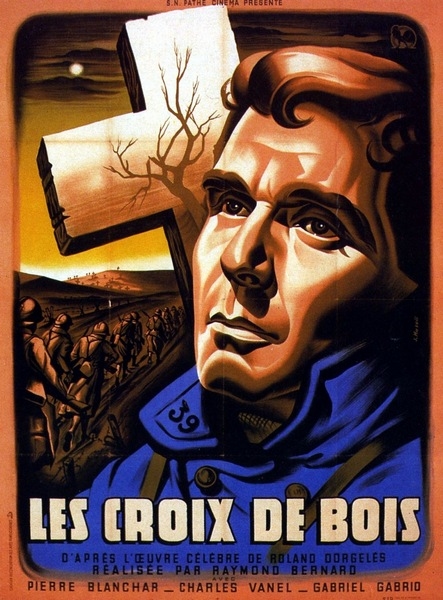
1932’s Wooden Crosses (Les croix de bois) is more death, less glory than your average drama about the First World War. That might explain why it doesn’t always make it onto the “best of” lists, where The Big Parade, 1917, All Quiet on the Western Front, Paths of Glory and Westfront usually jostle for a place on the podium.
It’s more about the collective experience of warfare than individual heroics, which might also explain that absence, though there is a lead character, in the shape of Gilbert Demachy (Pierre Blanchar).
Constructed in classic style, it starts with war being declared to scenes of national jubilation in France. Men eagerly signing up. Trains loaded with troops pull out of stations while women throw flowers and sing La Marseillaise. We meet Demachy, a student volunteer arriving at an infantry headquarters only to be told by the old hands that he’s missed all the action. Banter. Camaraderie.
Other key characters are introduced, notably Sulphart (Gabriel Gabrio), this unit’s leader not in terms of rank but of natural authority. Strong, fair, commanding, generous of spirit, Sulphart is a figure familiar from later war films and will take Demachy under his wing. They will bond and become brothers in arms.
These are the men we follow as director Raymond Bernard lays out his spread – epic depictions of trench warfare, shot on the Marne, where the battles had actually taken place only a handful of years before, with a cast of men who had all fought themselves, including Blanchar (who is 40 and so too old to be playing a student, though he gets away with it).
Getting the “sonic ambience of the battles” was a key concern of producer Bernard Natan and he used all the newly available resources of Pathé’s sound department to achieve it. This, decades before the term was coined, is a film with “sound design” and the whump, whine, crack and boom of ordnance, the rattle of bullets and the whoosh of magnesium flares gives us a sense that death in a battle zone can come in all calibres, from any direction at any time.
Bernard mixes it up – in the trenches where the men wait and listen nervously to the sound of a muffled pickaxe as the Germans burrow beneath them, away from the front where they drink and carouse and bitch about the officer class, back in the trenches for a full-on pitch battle, going over the top, men flopping down dead the instant they are out in the open. There are poignant flashbacks, done silently (sound is the realm of war), to the men’s lives before war broke out.
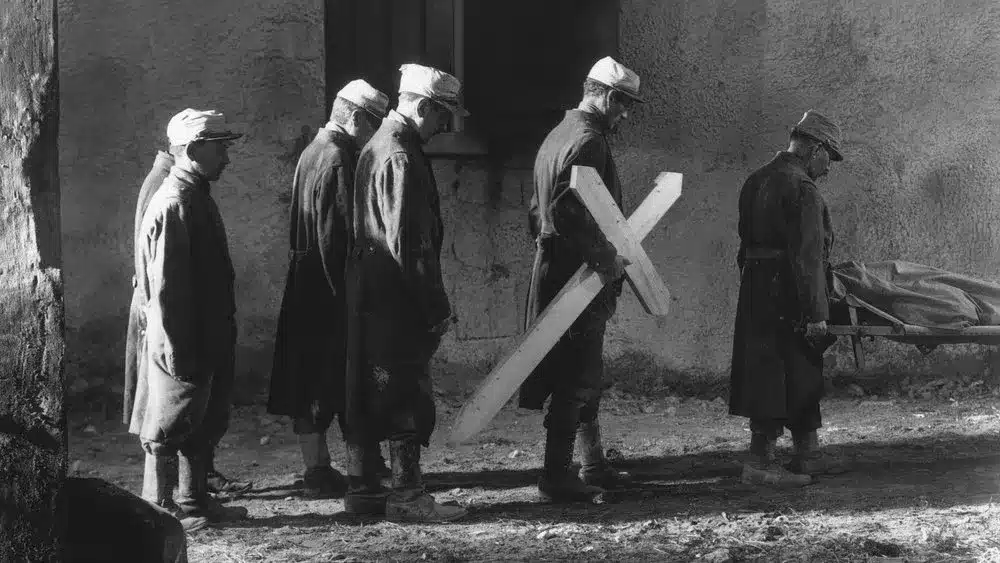
And, eventually, there is the climax, a massive battle sequence that obviously influenced Kubrick’s Paths of Glory. “Ten Days this went on,” says an intertitle card after an age. More depictions of fighting. “Ten Days”, it says again. Then twice more – “Ten Days”.
Technically the battle sequences are remarkable, the camera charging down the trenches in a way Kubrick obviously noticed. Bernard and editor Lucienne Grumberg use cross-cutting to convey chaos and fast-changing situations, the ebb and flow of battle, the fog of war. It’s noisy, dirty, the men are exhausted and no one knows what they are doing.
Bernard has an eye for an image – the battle sequence set in a cemetery is grimly ironic too – but resists the temptation to make it too pretty. Dirty realism is his aim, downbeat dramatics. Injured men whimper out in the mud, where they will die before the stretcher bearers can reach them at night-time.
Blanchar and Gabrio are both excellent, though this isn’t a film about individual action so much as about collective experience. There is a pitilessness to it that’s remarkable – the sacrifice on a huge scale is what Bernard and co want to get across, and they do.
The 2014 restoration is remarkable too. The image is sharp and spankingly clear, and though dialogue has a slightly tinny quality familiar from films of the era, it’s perfectly fine. Not the sound effects, I hasten to add, they are astonishingly good. I watched the Pathé version, which is superb, though there is a Criterion double with Bernard’s Les Misérables (another epic) and a region-locked Eureka Masters of Cinema version that’s meant to have the edge on the others (or so say DVDBeaver, who know what they’re talking about).
Wooden Crosses – Watch it/buy it at Amazon
I am an Amazon affiliate
© Steve Morrissey 2025