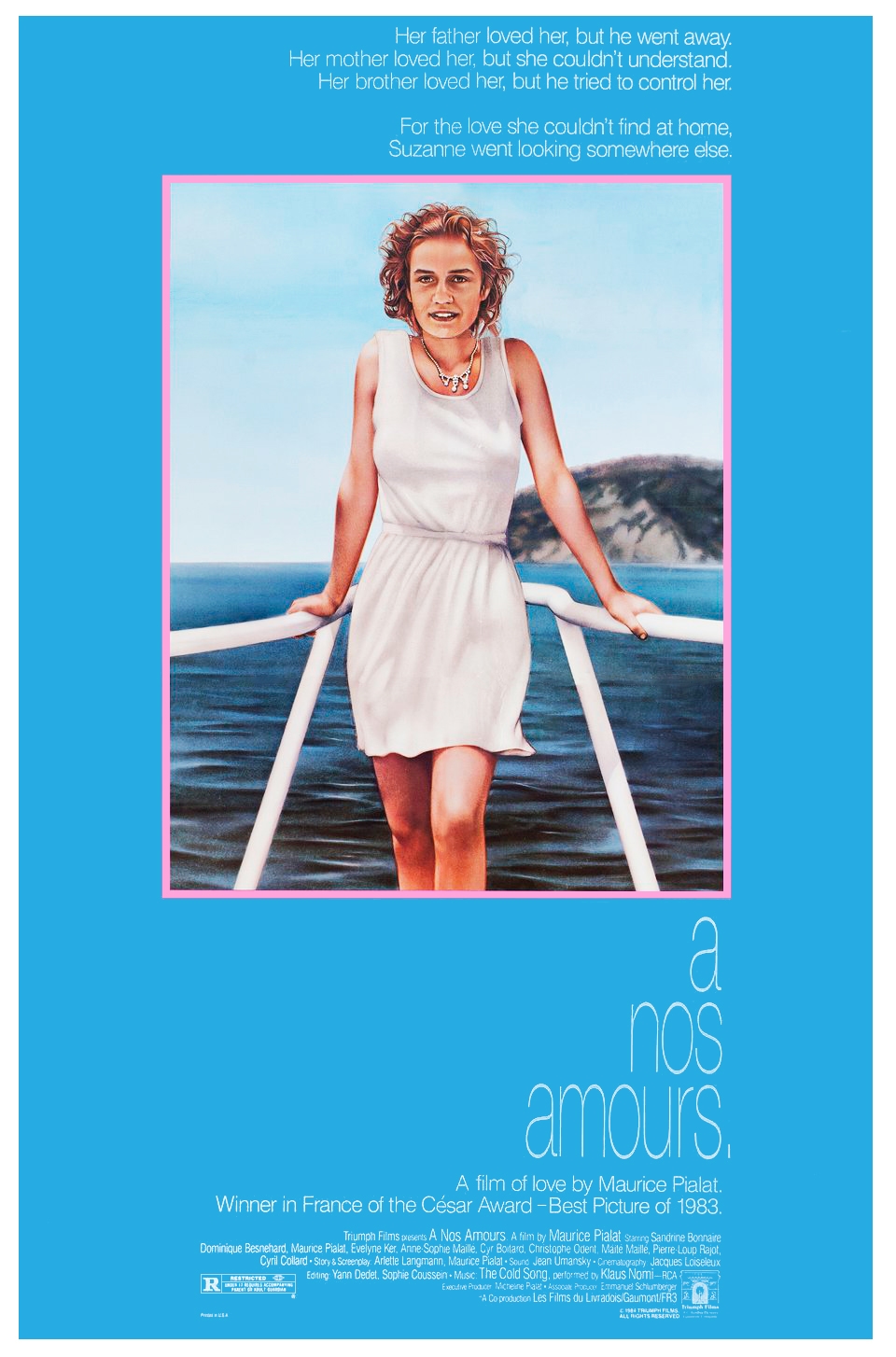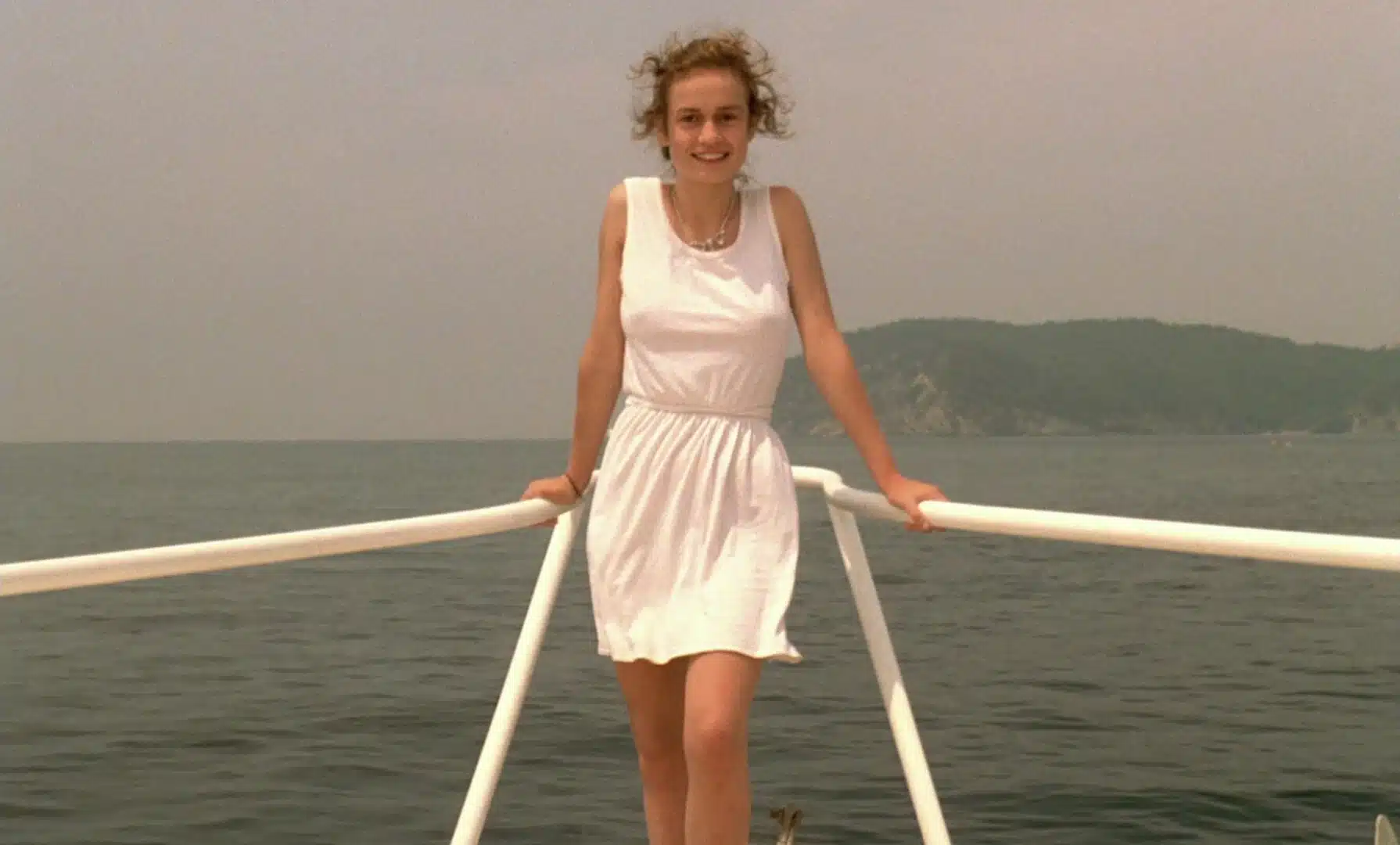
A crazy mixed up film about a crazy mixed up girl, if it’s nothing else 1983’s Á Nos Amours (To Our Loves, sometimes To Our Romance) is a brilliant showcase for the astonishing Sandrine Bonnaire, sexy as young French stars tend to be, in her debut on screen, possessing it entirely and aged only 15 or so.
She plays the effortlessly hot Suzanne, a precocious tease wielding the weapon of her good looks and fully functioning libido in a series of encounters with older men. These dark-haired, worldly and hairy guys are the opposite of Luc (Cyr Boitard), the fair-haired, sulky, smooth-skinned boyfriend of her own age she will dump repeatedly as Suzanne’s story plays out. Which only makes Luc want her more.
A girl’s sentimental education is the idea. The film is by Maurice Pialat, and he sets up a Freudian family background for Suzanne, the slightly absent father she loves too much (played by Pialat himself), the mother (Evelyne Ker) distraught at Suzanne’s increasingly “hookerish” attire and the brother (Dominique Bresnehard), too fond of the mother and fairly obviously gay – it’s confirmed towards the end.
Pialat intertwines the hothouse family life – dad leaves to live with another woman, then returns at a crucial, Freudian moment to exert his authority; brother Robert, protecting his mother, beating up his sister Suzanne – with Suzanne’s life outside, where she takes refuge in men’s bodies but cannot commit emotionally. “It’s as if my heart has run dry,” she says at one point.
Pialat also piles on the atmosphere. In early scenes set in the summer France vibrates with heat and lusty anticipation and Pialat introduces Suzanne with a slo-mo turn to the camera that’s a provocative, Lolita tease.

This does not feel like a film that’s over 40 years old. Apart from the regular glimpses of Bonnaire’s naked teenage body – too much for modern tastes, I suspect – Pialat’s film feels bang up to date, a vivid mix of the real and the melodramatic, with performances that are right on the money. Evelyne Ker gets a particularly great scene where she completely loses it over her daughter’s behaviour, the sort of thing that people become actors to play, while Pialat as the wayward and domineering dad is a more subtle but threatening presence. Bresnehard is fine as the brother constantly clutching his pearls, but the film belongs to Bonnaire, its focal point. Her performance as the increasingly worldly Suzanne never lets go of the notion that she’s just a little girl underneath and the men are just a staging post on her quest for happiness.
I liked the countertenor Klaus Nomi popping up on the soundtrack, twice, to sing Henry Purcell’s The Cold Song (What Power Art Thou? when Dryden wrote the lyrics originally). It lends the whole thing an otherworldliness and hints at the spirituality Pialat wants to suggest is lurking in Suzanne.
Though, it must be said, personally I didn’t buy this side of the film much. The film is also simply too long. It’s said what it has to say fairly early on and once Suzanne’s course is set, we are simply waiting for her to get through another few of the dark-haired daddy figures she seems to like before, surely, some epiphany ambushes her.
There is the sense of wheels spinning and that Pialat has thought his way into his scenario but cannot quite think his way out of it again. These sentimental education/bildungsroman movies tend to be like this though, with one-damn-thing-after-another plotting that doesn’t quite know how to resolve. Alors, as they say, it did set Bonnaire off on a glittering career that includes roles in films by the likes of Agnès Varda, Claude Chabrol, Patrice Leconte, Brian De Palma and Audrey Diwan. Here, you can see why they were all lining up.
Á Nos Amours – Watch it/buy it at Amazon
I am an Amazon affiliate
© Steve Morrissey 2025