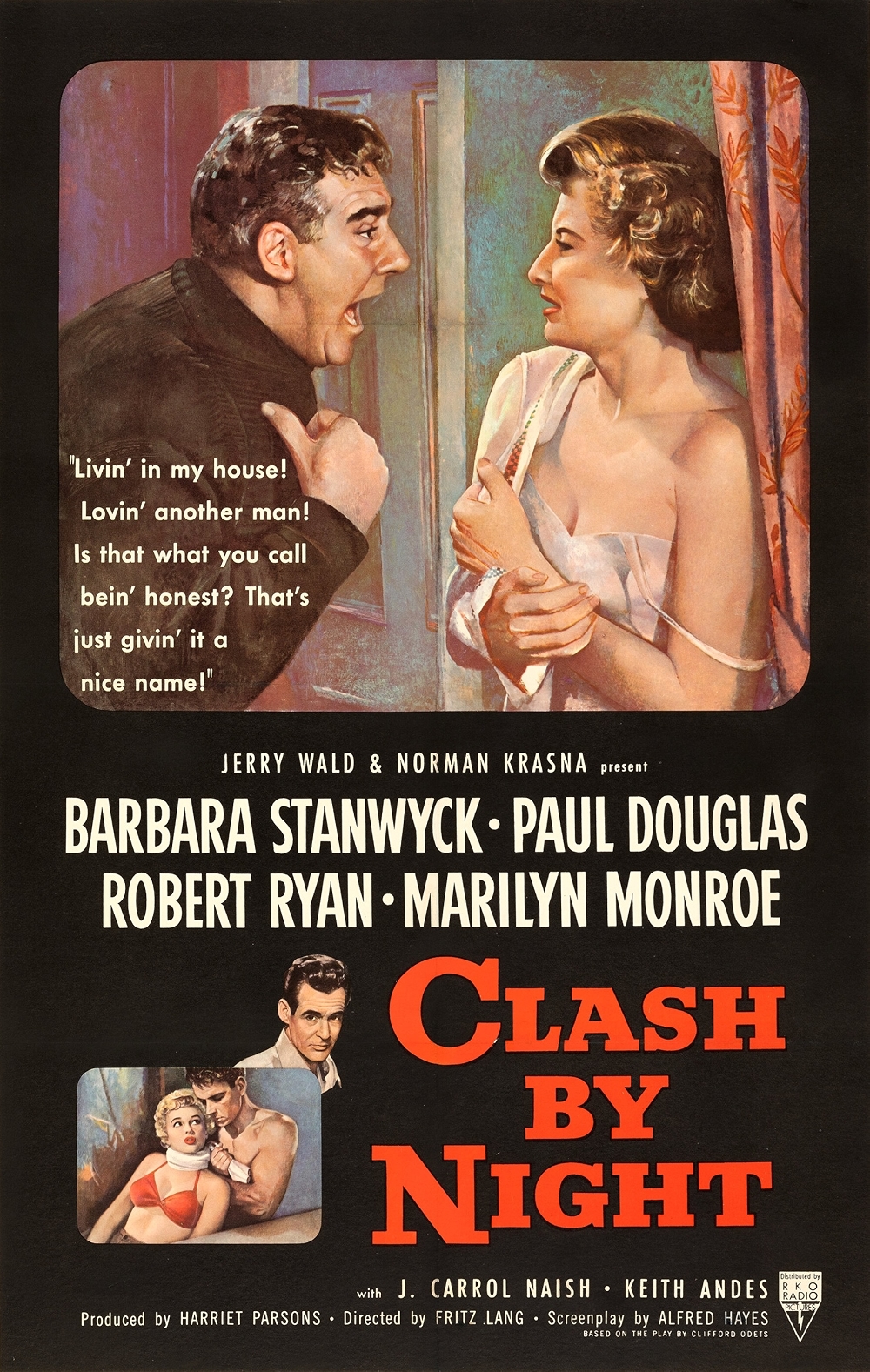
Marilyn Monroe as a fishwife?! 1952’s Clash by Night has some fun incidentals like Monroe, making much of a small role. But the real action is with Barbara Stanwyck, as a goodtime girl who’s worn out her welcome after ten years in the big city and is now back in the coastal town where she grew up to wreak havoc among the menfolk.
It’s another tough-nut role for Stanwyck, who plays a woman who decisively knows what she doesn’t want but isn’t quite sure what she does want. Should Mae, for instance, go with her head and marry dull and dependable Jerry (Paul Douglas)? Or have a fling with bad boy Earl (Robert Ryan)? Jerry is a decent guy and owns a boat, after all. Earl on the other hand, is a married movie projectionist with a treat-’em-mean demeanour. The sort of man Mae can’t resist.
Too domestic and daytime to fully fit the bill as a film noir, Clash by Night is often described that way because two noir eminences are involved – director Fritz Lang (who has Scarlet Street and The Big Heat on his CV), and Nicholas Musuraca, the ace cinematographer who virtually invented the genre with Stranger on the Third Floor and went on to light Cat People, Out of the Past and The Blue Gardenia. Prime noirs all.
While Mae strings Jerry along and plays serial footsie with Earl, Monroe’s character Peggy – who works at the fish canning plant – is in a shadow relationship with Mae’s younger brother Joe (Keith Andes), who wants to tame the flighty and girlish Peggy by marrying her. Her “problem” is feistiness, same as Mae but without the added third-party complication.

Oppositional elements abound. The city and the small town, men and women, progress and tradition, young and old, day and night. And because most of the people in town are Italian migrants there’s an old country versus new tension too. Jerry’s Uncle Vince (J Carrol Naish) reckons women these days have too much education and free speech, that they’ve been “spoiled”. On the other hand Jerry’s dad (Silvio Minciotti) spends his days either looking for booze or sleeping it off. So who’s spoiled?
The film is based on a Clifford Odets play and the sound of creaky boards is deafening, most obviously in the the speechifying slowing down the action at every significant turning point. Lang tries to get round this by inserting outdoor, semi-documentary moments set on Jerry’s boat, but in fact it’s the actors who drag his film most decisively into the movie realm, with performances full of energy.
Earl is a bad man and dramatically has to be – we’re rooting for domesticity, aren’t we? – but he is painted as so irredeemably unpleasant that it’s really hard to understand what Mae sees in him. Meanwhile, in the other corner, there’s Jerry, a sap. Not exactly attractive either. Mae’s choice is what it’s all about – though only having two unsatisfactory options isn’t that much of a choice.
For all Mae’s apparent powerplay, women in this movie don’t really know what they want until a man tells them. Call it a belated entry in the post-War effort to get women back in their box now that the men are back from fighting the war. Mae’s reluctant to go there and eventually gets called “rotten” by Jerry, who hasn’t a bad word to say about anyone. “I know,” she replies. This might not be a film noir strictly speaking, but Mae is the film noir femme fatale par excellence, an irresisitible force in the 1940s now hitting the immovable object of the 1950s.
Clash by Night – Watch it/buy it at Amazon
I am an Amazon affiliate
© Steve Morrissey 2025